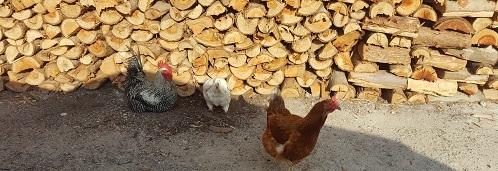
Handsome b/w rooster with lovely red hen and nondescript white hen facing away from the camera 🙂
This morning Mike and I had an outing which took up half the morning. First, we drove to the home of Maureen, book club member who currently has custody of the book club’s books. I turned in my old ones, found a few to take out and spent 10 minutes chatting with her on her sunny front doorstep. We then moved on to a woodyard that delivers wonderful firewood and ordered a load to come tomorrow. Whenver I go along with Mike, there are always lots of cars there, but today, for the first time ever there were no other customers around, though I’m sure they’re doing good phone ordering service, what with winter just around the corner.
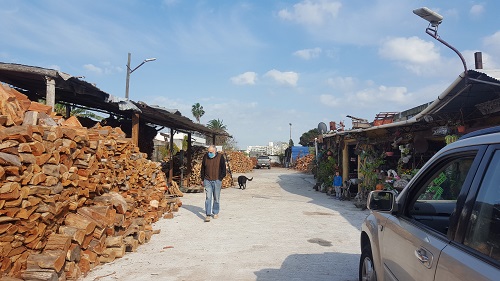
Los Lenos woodyard – in good order as usual, beautifully stacked, with enough free space today to admire it. They also sell several varieties of plant seedlings, herbs and pinecones… animals are friendly, and the little kid cute, but of course we had to keep our distance 🙂
We took a round about way home, and though shopping malls and theatres are still closed, many other businesses are open with mask and distancing protocols. Public transport is functioning well, food distribution is efficient, there are no noticeable shortages. People are working and out and about, often wearing masks but often not, too.
We stopped at a favourite fruit and veggie place for several things including a baguette for lunch. And, as it’s a warm day, we made the most of it and ate lunch out on the terrace. (bad weather’s coming with a storm due tonight) We ate salad and cheese with our fresh baguette, and talked with one of the offsprings on the phone.
Easy skillet / one-dish meals cooked at home from scratch, without too much fuss, using basic ingredients + fresh food are very important to Quarantine Caterers.
Actually, ‘without too much fuss’ is how I usually cook, anyway. I love delicately flavour nuanced gourmet meals as you might find in a classy restaurant, or at a dinner party where someone else has slaved over a complex recipe served up on a nicely set table. Once we feel confident as the quarantine eases, as it will eventually, one joy we’re anticipating is of going out to eat at a good restaurant. Many people say this but I think it will take a while for us all to feel ok with this.
For good nutrition and ease of cooking, anything involving rice has always been good value. Yesterday my good friend Heather sent a link to a FB post about a packaged food,essentially all the dry ingredients for a risotto, new packaged food that appeared on Australian grocery shelves in the early 60’s. Rice-a-Riso (still available) rapidly became popular. In the packet were rice grains with tiny little rice shaped noodles, plus a sachet of various fried flavourings and dehydrated little pieces of chicken, beef or dried tomatoes. You browned the noodles+rice then added the seasonings and some boiling water, stirring until the water was absorbed and the rice cooked. As a quick and easy side to the meat or fish, as the meal itself, and something you could easily make much larger to feed last minute mealtime visitors by the addition of other finely chopped foods.
Rice is the most widely grown and eaten grain in the world, and Australians have always eaten plenty of it. In our house Mum cooked curry which of course we had with steamed rice. In the late 50s there was a blight problem in the Tasmanian potato crop, so about two years there was a potato shortage, and prices went through the roof. During that time Mum mostly served rice instead of potatoes in our meals, and we only had potatoes when there were visitors around the table. For some reason we weren’t allowed to comment on that matter.
When I was young, a popular dessert in Australian homes (and at our grandmother’s) was rice custard. What the family eats is generally determined by whether the family cook likes it, or not. We often had boiled and baked custards, but ours rarely contained rice, so clearly Mum herself preferred custard without it. I never cared for it particularly, either, but being well brought up, never complained if rice custard was served when I was ‘out’, because as we all know, when you’re the visitor you eat whatever you’re given 🙂
Orange chicken risotto.
Last year in Brasil I enjoyed a lovely rice dish for lunch in a cafe in Gramado where I was teaching at 2019 festival of patchwork and quilting, an event sadly cancelled this year for obvious reasons. I don’t remember what the recipe was actually called, but I’d call it an orange chicken risotto, for which there are several recipes on line. It was wonderful. and I recreated it at home, successfully, along these lines:
Dice enough boned chicken breast for each person.
Brown these pieces in olive oil on high heat, remove and set aside.
Finely dice a medium white onion, lightly brown, remove and add to the cooked chicken pieces.
Use the pan drippings, with a little more oil if needed, to brown about 1/2cup dry rice per person.
To the rice add a cup of boiling water, the juice of a large orange, about 1/2 cup of white wine (optional), and 1tsp of fine orange zest: add to the rice and bring to low simmer stirring frequently. If it looks dry before the rice is properly cooked, add more juice, wine or water.
Finally add the chicken pieces, onion and about a handful of chopped cilantro.
You could add a green veggie or a salad; the restaurant didn’t.
Heat, serve and enjoy 🙂
It’s a perfect dish for lunch on a day at home, and as I haven’t made it since last year, I’ll make sure fresh cilantro and chicken are on the next shopping list. I keep a running list of things we need on the kitchen bench, as fellow Quarantine Caterers agree, a shopping list is more important these days, helping limit visits to the food shops and reducing browsing-for-inspiration-time.
This pandemic is bring some interesting things to light. I haven’t asked yet, so I don’t know what Mike’s discovered about me that he hadn’t already learned in 51+ glorious years of marriage. But I recently learned that he used to make jigsaw puzzles as a kid, and has always been interested in them – who’d have known? However, it does explain his aptitude for forensic geology, due diligence and the like; the puzzle solving processes that often draw on his extensive knowledge of the history of mining.
Mike also reads recipes and watches cookery shows at times, too. He sees a recipe he likes the sound of, gathers the ingredients and makes it, at last once. Several family favourites began with him finding a recipe that went down well.
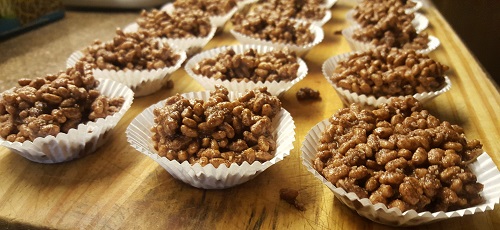
Chocolate crackles – a childhood special occasion / birthday party favourite.
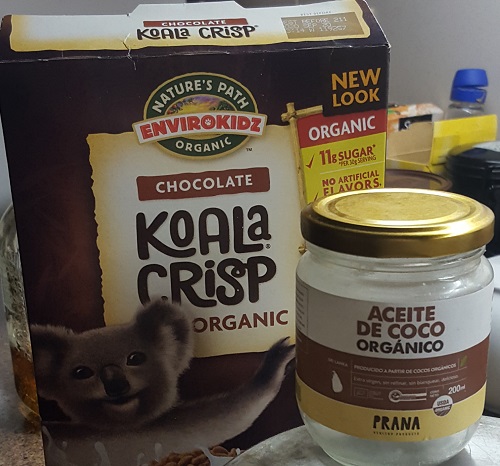
Recently he found a set of some timeless favourite classic recipes for slices, like that one with cherry and coconut filling on a shortbread base and topped with chocolate, or the classic vanilla slice. It must have stirred longings; next day he brought home some seriously yummy vanilla slice and apple slices from the wonderful panaderia down the road. And of course, in the quedate en casa / stay at home quarantine we’re in, we can’t go out to eat in a restaurant and sometimes order a dessert we’d never make at home. We do often have a couple of chocolates as we watch our tv serial at night, but this must all be be getting to him, because out of the blue, a couple of days ago Mike triumphantly announced he’d located all the ingredients for chocolate crackles, and what he bought here in Uruguay is pictured here:
Purchased in Uruguay, these Koala Crisps are very similarto rice bubbles, but already coated with a bit of cocoa; though more ‘healthy ‘ being made from brown not white rice, as in Aus. The “aciete de coco”, coconut oil, is more solid in Australia, and comes like a block of butter wrapped in waxed paper. But this combination worked marvellously.
I hadn’t given these amazingly delicious, sinfully calorie-laden things a thought for decades. Not only are our kids both middle aged, I’d never seen blocks of copha here, and don’t take much notice of breakfast cereals beyond the toasted mueslis I like anyway, so it’s decades since I thought of making some. In our day, at every kid’s birthday party they were as mandatory as Fairy Bread, about which I wrote a while back.
This classic Chocolate Crackles recipe appears on the back of every packet of Rice Bubbles in Australia:
Mix all dry ingredients in a bowl, melt the copha and add to the mixture, stir well, allow to cool and put into paper cups while still soft. Makes 24. Refrigerate.
There are signs this novel coronavirus plague originated in wild animals, moved to another vector from which it managed to cross unchecked into humans. Those details are still uncertain, but it is a fact that in just 4 months, the virus escaped from China and swept unchecked around the world, that facial masks, sanitising and social distancing are essential behavioural adaptations to ensure survival of the human race until a vaccine is developed or effective treatments become available. Many normal human activities such as visiting friends, attending weddings, graduations or funerals, going shopping, banking, schooling, medical consultations, travel, attending a concert or movie, dining out, and many more, have been changed for ever – and there will be no going back to normal as we learn to live with this new virus in the world. There are recent reports of a few positive test results from domestic pets, plus the appearance of a new more virulent mutation of the virus.
I’ve commented to several people who I think can handle the concept, that this novel coronavirus pandemic is a fascinating event in the natural history of the world. It is all being studied from so many points of view, but I didn’t consider that a paleontologist might have an interesting opinion on this modern event by referring back to civilisation-over-turning events reflected in the recent fossil record. But, this morning I came across a fascinating BBC Mundo interview with a Spanish paleontologist, Juan Luis Arsuaga which I strongly recommend reading. Although it is a bit lengthy, many of us do have more reading time these days. For the uninitiated, paleontology is the study ancient life form as present in the fossil record of rocks up to about 11,000+ years ago. The always interesting wikipedia gives what I think is this key point: “Paleontology lies on the border between biology and geology …”
Among the many scientists studying the pandemic are a huge range of doctors of course – cardiologists and neurologists; renal, pulmonary and vascular specialists, plus specialised ICU nurses and technicians are giving assistance to the infected and dying. Epidemiologists, geneticists, virologists are issuing advice on how to avoid contracting the infection, and being consulted by governments and media. Some researchers are frantically searching for drug treatments, while others engage in the worldwide race to find and prove safe and effective vaccines. Governments, politicians and economists are focused on the effects of the pandemic on society and development of policy and strategy to help their communities cope with the massive effects. Industries like the travel, leisure and entertainment have either been knocked for six, while other industries have been suddenly presented with manufacturing opportunities they never anticipated for protective and monitoring equipment.
I’ve also fecetiously commented at times that a good pandemic, like the Great Plague that swept across the known world in the 1660’s, would solve the population problems of the world, give it a good cleanout so to speak, but of course I never actually envisaged finding myself in the middle of one.! So far Covid-19 has already caused nearly 4M cases from which over 1/4M deaths have resulted. Recovery is long and slow, often leaving physical damage to internal organs and systems.
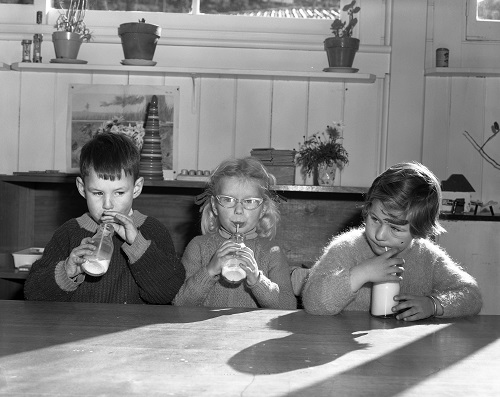
My dear friend Heather and I met as freshers at Tas Uni 55 years ago, immediately hit it off and became forever friends. Yesterday she posted one of those ‘share if you remember’ photos on Facebook, of a group of young primary school aged children standing around a milk crate, while drinking milk through straws from the small bottles they were holding. That triggered additional memories about this feature of our school days, and I thought I’d just jot them down here, as a change from ‘Plague’ issues.
Though not the photo from FB, this is equally typical. At each school I went to, the milk was consumed at our desks at the start of morning recess, about 10.30, and once we’d finished our 1/3 pint bottles and put the empties back in the metal crate, we were free to rush outside and play. (Photo credit: Tasmanian Archives and Heritage Office, item AB713/1/11012)
Studies in 1950-51 showed Australian children were receiving less than recommended amounts of calcium in their diets, and by 1953 the Australian government had fully implemented what was called the School Milk Scheme by which just over 1 million children aged up to 13, in public and private schools, kindergartens and creches in every state, received free of charge a 1/3 pint bottle of fresh milk at their school every day. The scheme was discontinued in the 1970s by the government of the day, which decided the benefit no longer justified the cost. Aussie kids’ diets had probably improved, anyway.
I began kindergarten at the age of 4, and rain, hail or shine, walked with my best friend Caroline up the hill and along a bit to our kindergarten operated in St. Oswald’s Church hall, Bain Terrace, in Trevallyn, a suburb of Launceston, Tasmania. Our adored teacher, Mrs Kerr, kept us busy with a lively program of learning our letters and numbers, how to put on our shoes and tie the laces, putting on our own jackets and coats, the importance of handwashing and other basic grooming, painting and drawing, story telling, scrap booking and other crafts, ball games and little competitions plus free play sessions out on the jungle gym, activities similar to what kindergarteners and preschoolers do today in preparation for starting school.
When I was aged 8 or 9, my class teacher, Mrs. Andrews (in a sing-song voice say “goomorningmissuhssaaandrews”) went through a phase of printing every child’s name on a waxed paper drinking straw so we could re-use it. I can still ‘see’ the tiny neat printing so clearly, so it must have been pen and ink, possibly Indian ink, because pencil would not have marked so clearly and strongly on a waxed paper straw. I think the idea might have been to encourage us to not chew the straw and treat it carefully enough so we could use it again. I don’t recall the plan lasting long; and just the very idea of using a straw for milk, then using it again a day or two later makes my stomach turn at the potential for nasty stomach upsets, of which in our youth, we really did have quite a few. The whole business of food handling, distribution and storage rapidly improved during the two decades between the 50s of my childhood and the early 70’s, by which time fridges were bigger, and Mike and I even had an additional small chest freezer out in the laundry.
Tasmania, my home state, has a cool temperate climate. Cold wet winters feature frequent heavy frosts, and sometimes snow at very low altitudes. Even summer doesn’t always feel ‘warm’, let alone ‘hot’, but everything’s relative. There were a few weeks at each end of the school year when days could be quite hot with temperatures sometimes reaching 28-30C. The milk was always delivered well before we arrived, and even if set down somewhere shady, on hot days that milk would be ‘tepid’, erk, by recess time. It was not optional to drink it – we all had to, knowing it was for our health, teeth and bones, or something. I’ve always hated warmish milk, and rarely drink milk on its own, ever, whether refrigerator cold or piping hot.
One memory we had in common was the practice of saving the silver aluminium tops from the bottles of milk delivered to homes, schools and shops in those days. We took them home, washed them and by the end of the year we had lots of them to press down over the shaped part of a lemon juicer, giving each top a little bell shape. We threaded those tops onto knotted string to make shiny garlands for the family Christmas tree. As Heather commented, this was time consuming work and was no doubt encouraged by our mothers to keep us busy for a few hours, certainly an ideal wet afternoon indoors activity. In time, the bottle tops delivered to our house were often red, and that was very nice, too. I have no idea what happened to all those garlands and don’t remember seeing them anywhere since I married and left home. Maybe they were still there the last time I had a Christmas back with the parental units, but I don’t remember specifically.
Until relatively recently in history, most families lived within short distances from other family members, tended to settle near those roots, and usually married someone from their family’s wider circle, which in today’s terms and speaking geographically, was very small. Family and old friends frequently met via both daily/casual encounters and at the hatch/match/despatch events – births and christenings, weddings and funerals. Within their town or district people met and kept in touch through involvements in their churches and community interest groups. I often think how back in history personal contact was either via face time, to use that very modern term, or by writing letters to people who were far enough away that you infrequently or rarely saw them.
Our own closest circles extend to every continent, but are principally USA, NZ and Australia where our nearest relatives live. These are our children: Ivan and his sons Zih and Ronan; Anna and her son Gavin; my two sisters and their husband; Mike’s brothers; some in-laws and some of their offsprings. Almost ‘as important’ as those people are some very old friends from my/our youth (I’m still in touch with someone who allegedly attended my first birthday party) Of course, there’s a blending and blurring of this categorisation, as some ‘best friends’ come from later stages in our lives, too, which must be true for other people who’ve also moved about as we have in our married life.
In colonial times, letters took months to travel between England and the colonies of New South Wales and Van Diemans Land. All news, including the most important family news, was at least months old by the time it arrived; and if a ship was wrecked it possibly never arrived. As a young child I wrote several times yearly to my maternal grandparents in Sydney. Mum wrote diligently, and because of the cost and reception difficulties, there were almost never any phone calls. Grandma and Grandpa Croan flew down to Launceston every few years to visit, but even so, as a result we didn’t know them nearly as well as we did the other grandmother who lived in the same town. Entering university meant going to Hobart, 120 miles away, and for the next 4 years I diligently wrote home every week, posted it on my way to the campus on monday mornings, and Mum and Dad usually received it the next day. Long distance telephony was expensive, and only for emergencies. When we moved to Kalgoorlie and the other remote Outback Australian mining towns we lived in, we were still in the habit of writing home MOL weekly, although by the 80’s we were phoning our aging parents more often. Our own family’s lives in Outback mining towns were so very different to either of the lives we had as kids, plus there were anecdotes of grandchildren to share accompanied by the latest prints of photos we took and sent every 4-6 weeks. Mike’s mother Dawn said more than once that she preferred to receive a letter; you could hold it and read it over several times, whereas you couldn’t be sure you were properly remembering everything that was said in a phone call. If she’d lived long enough I think she’d have taken to email.
That was all then. These days there are various ways you can call and see your loved one’s face on screen, so many phone apps, and then various email and message avenues. God forbid the internet should collapse under the pressure of communications like home schooling, virtual business meetings and teleconferencing, telemedicine and much more. I add to the email traffic every week by sending out a brief bulletin I compile for the close family circle on how we’re faring in Montevideo, with news and snippets from local media. It’s a way of keeping in regular touch and, of course, writing about something is one way of mentally processing it. So far, while things are certainly really, really scary, so far I don’t feel 2020 is necessarily the hardest year we’ve had to endure in our 51+ glorious years of married life. We’ve had a couple of more difficult times; but we were young then, too ….
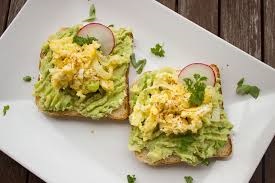
Just this morning a dear friend asked on Facebook for guidance on the right quantity of vodka to add to scrambled eggs … without specifiying whether she’d be cooking them for breakfast, lunch or dinner. Adding vodka to scramblies does seem to be a thing, according to what I found on the internet, though I never would have thought of it – I don’t read cookbooks and guides to sophisiticated living articles, where I might have come across it before now. I urged her to let us all know how they turned out – and to remember to photograph the served up results, as surely someone is already compiling a lockdown commemorative cook book! My own recommendation was to simply substitute vodka for a bit less than the usual amount of milk in her recipe. One recipe I checked after advising her was to add one teaspoon per egg !!! 🙂 It could be a nice feature dish for a family or neighbourhood brunch to celebrate the lifting of restrictions …
Something I have never seen – scramblies and avocado on toast: this whole concept is new to me, as is the thought of adding a nip of vodka to either egg or avo – that could certainly brighten up your next brunch!
Twice last week friends in different groups sent around a chain email thing asking for quick and easy recipes to make during this pandemic, shelter-in-place or lockdown that we’re all in. I thought that a bit interesting – after all, the one thing we all have plenty of right now is time, and doubt we really need ‘quick and easy’ at the moment 🙂 I don’t normally do chain letters, and confess I didn’t respond, but one request was from a young mother of two toddlers living out on a farm; and on second thoughts she might be a bit time challenged, so I’ll email one to her out of compassion – I thought of her as I made yesterday’s lunch – cheese pudding the recipe for which is in an article I wrote last year on this blog.
So far Mike and I are sticking to our tried and true favourites, and make sure the shopping lists cover the ingredients we need for them. Perhaps there’s comfort in familiar favourites. We pretty much share the cooking, and so far neither of us has gone into trying new recipes mode in the way that some people have made their pandemic projects. I’m not knocking that – we all need projects, and Mike and I each have a couple in addition to the reading we both enjoy.
Here, I must say how I ‘read’ depends on what else I’m doing at the time.
If I’m quilting or sewing, I listen to audiobooks.
Newspapers I read preferably on my desktop.
If I’m reading a paper book I usually like soft music or am ok with silence, though we’ve had a bit too much of that around this area recently – so I’ve made daily music on tv-radio part of our quarantine environment. It’s a blues station today, and yesterday I had symphony playing all day. I adore military music but there doesn’t seem to be a station there on stingray, but I’ll find some on my computer one day soon.
And finally we both read a lot on our kindles, and that tends to be in bed or on it. The screens are back lit, so that’s great, and best of all the text can be enlarged or you can change the font for more comfortable reading – a boon to aging eyes. There are limitations, of course, but we are so grateful for modern technology, and one thing I am sure of is that a cookbook on a kindle wouldn’t be nearly as much fun – I’d miss those food splattered pages that bring back many fond memories 🙂
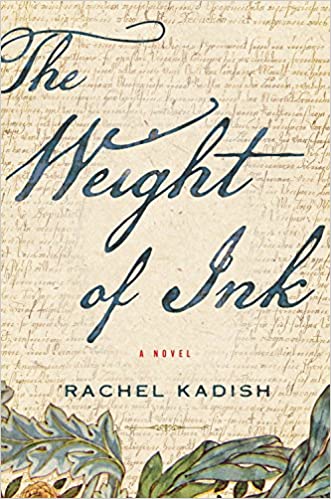
While fashioning the mask featured in yesterday’s post, I continued listening to a riveting audio book “The Weight Of Ink” by Rachel Kadish. A best seller, it won a National Jewish Book award in the USA, and is reminding me of a wonderful book I read a few years ago by Geraldine Brooks, “A Year of Wonders” That was a fictionalised account of the true story of Eyam, a village in the rugged hill country of England, set in 1666. As the Great Plague travelled across Europe and arrived in England, that whole village put itself into quarantine, shutting out all travellers, and not permitting anyone to leave the town. It saved everyone in the town. Both these books draw detailed pictures from contemporary records and acounts.
“The Weight Of Ink” does this in an interesting way, toggling back and forth from 1660 to the present day, weaving two stories into one of two different centuries connected by the thread of historians finding and then forensicially examining the revelations in historical documents from The Plague period in England: “Set in London of the 1660s and of the early twenty-first century, “The Weight of Ink” is the interwoven tale of two women of remarkable intellect: Ester Velasquez, an emigrant from Amsterdam who is permitted to scribe for a blind rabbi, just before the plague hits the city; and Helen Watt, an ailing historian with a love of Jewish history. As the novel opens, Helen has been summoned by a former student to view a cache of seventeenth-century Jewish documents newly discovered in his home during a renovation. Enlisting the help of Aaron Levy, an American graduate student as impatient as he is charming, and in a race with another fast-moving team of historians, Helen embarks on one last project: to determine the identity of the documents’ scribe, the elusive “Aleph.” Electrifying and ambitious, sweeping in scope and intimate in tone, “The Weight of Ink” is a sophisticated work of historical fiction about women separated by centuries, and the choices and sacrifices they must make in order to reconcile the life of the heart and mind.”
And now, I’m about 2/3 through the story, Ester and two other women are in a house in the city of London at the height of The Plague, and enjoying the descriptions of street activity, people’s behaviour, activity on the street, insights into how people managed financially, the role of news and rumours, the sounds, the smells, the particularities of life for Jews in Catholic England at the time, many of whom were refugees from the Spanish Inquisition … well, anyway it’s a fascinating and timely book. Still so much to read that to me it’s not possible yet to see where it’s going to utimately end. I’ll be sorry when it does.
Historical fiction is category I love reading/listening to, because I’ve always felt ignorant, having much to catch up with. In senior school our history teacher was unutterably boring in my opinion, and I could hardly opt out of her history classes fast enough when the time came to do so. As a result, it was not until after several years at university that I realised how interesting history is, but by then the dye was set for a while; my focus was on my major subjects were geography and ancient civilisations – which, of course, included a fair bit of ancient history background! But in opting out, I had in effect postponed a lot of learning. A decade later, in my late 20s, I found myself living in a tent on one of the Katherine Farms on the outskirts of Katherine, Northern Territory, Aus. (see glossary “tent period” ) There I had access to a great little regional library in the town into which I had to drive every day, plus I had plenty of time to read. Perfect. And I’ve been enjoying history and historical fiction every sincce.
What I feared might happen, did. I was between steps 1 and 2 of a repair to a back molar when Uruguay announced its first cases of the virus, and home isolation began, boom, just like that. In the following week, my dentist himself tested positive, and of course the surgery immediately closed, only reopening last week with very tight protocols, as you’d expect. I thought I’d leave it a bit longer to get stage 2 done, but two days ago disaster struck. As I chewed on something the tooth itself split. It was awkward and slightly painful when I chewed, but overall didn’t cause an aching pain. But it did mean I could wait no longer, and I was really worried that this poor old tooth we’d been working to save would just have to be pulled out after all.
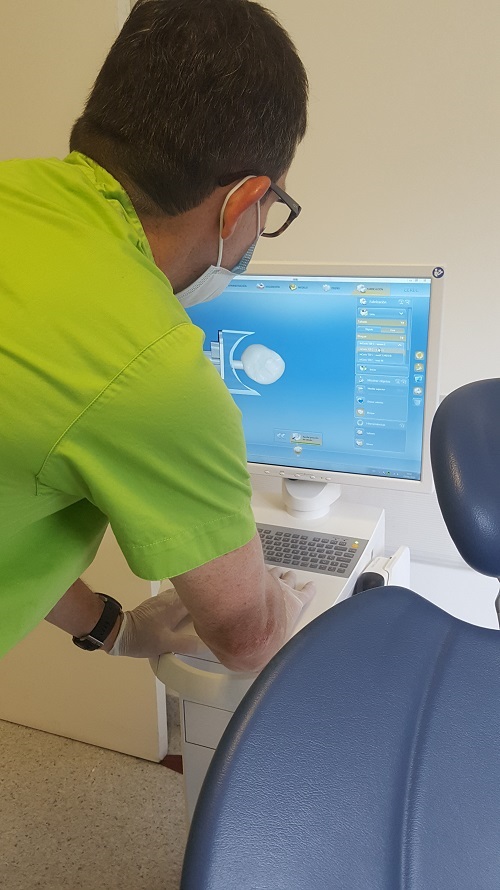
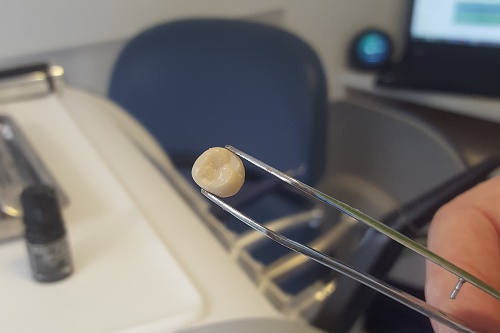
I was the first patient of the day, and I‘ll skip over the injecting, tapping, wrenching, spraying, spitting and air-blowing bits to the exciting part. Our dentist, Dr. Federico Fynn, is well up with the latest in dentistry and you can tell by the enthusiasm in his eyes and his voice that he enjoys meeting challenges like mine with finely crafted work. Today I came away with a custom fitted 3d printed and baked crown filling. Plus, although it isn’t the first time I’ve benefitted from this amazing technology, because I was the only patient there this morning, Federico had time to explain it all to me to me, watch what was happening at each stage, and take some photos. I was able to go to the room where the images and the data are compiled and processed using several small (but no doubt very expensive) little machines to produce the ceramic reality.
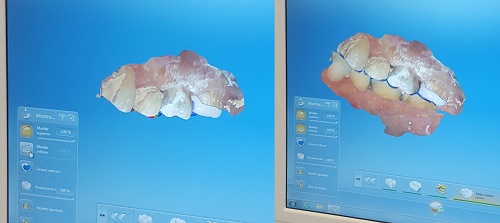
Once the cavity was clean, dry and sprayed with some opaque powder (so relax – my gums are not infected with some nasty white scuzz thing) Federico did the 3d mapping by waving a hand-held scanner in and around my tooth and immediate gums to record the data that the computer then compiled into an image of the precise shape for the missing part of tooth. Stunning.
In the left pic, the solid white shape is the needed bit of rear upper molar that has already been calculated. In the right pic, my bite was closed and scanned, so the program could work out the shape of my lower left molar, now as I write, sitting comfortably beneath the upper (white) new bit of molar.
All the information went by wifi to 3 small but no doubt expensive machines. In the first stage, Federico took a block of some material to be shaped by the drill, in a process like a wood turning lathe really, which cut and shaped the material it was holding to produce a solid form of the information that reader thingy recorded and the computer compiled. that happened in a closed machine with an exhaust system to trap the produced dust. Once shaped as per this screen –
it was removed from the little chamber, the unused bit of material was trimmed off, leaving a small white form about 20% bigger than the eventual tooth would be, because the baking process or sinterizing results in shrinkage, the rate of which the computer calculates, which is really, really amazing, I reckon. The ‘tooth’ was put on a little round plate, which, and rose up to disappear into the oven, rather like loading a space ship in a cartoon. The ‘spaceship’ looked remarkably like a domestic coffee maker, really, and inside the oven cavity is about the size of a large walnut or small fig, judging by Federico’s hand actions describing it. After baking the crown at 1600C for 20 minutes, the machine delivered it back down onto the bench. I returned to the chair for the test fit into my tooth cavity, which of course was perfect, as expected, but quite miraculous, anyway.
The material selected was a zirconium compound, tinted with a bit of whatever it took to produce this prosthesis in my own tooth colour, apparently ‘C3.’ Googling natural teeth colours and similar produces many images of colours.
That done, adhesive was applied to hold it in place, and with instructions not to chew on anything for at least an hour, I was free to go. I felt ever so grateful as I walked home in the morning sun, only 15 minutes late for my mahjong group’s weekly chat on Skype. Federico, muchismas gracias, brazos y besos virtuales!
A loosely defined group of artists here in Uruguay are decorating or doing something in some way to make a statement through face masks, or tapabocas, which here are now required to be worn by everyone wanting to go into any kind of shop. When the group began talking a couple of weeks ago, I responded that it was a good idea to channel some creativity during this period of isolation, and suggested it might even might lead to an exhibition or perhaps a fund raising auction to help starving artists, or something. Well, artists are typically starving, anyway, so maybe that hasn’t changed a lot with the Covid-19 Plague.
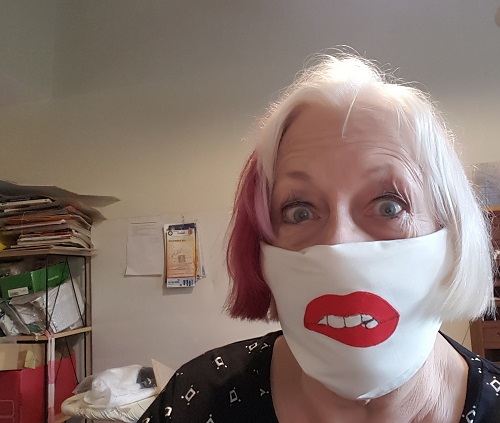
Yesterday I thought I’d better rattle my dags and produce something, as some wonderful things have started appearing on the Whats App group page. And once I started thinking and looking for ideas, I found a couple in some collections of free clipart I browsed, and this morning spent some free hours making this first one –
Just for the sake of the photo the mask is folded down to allow the eyes to really feature, so don’t give me a hard time about how a mask should be worn, OK? Ideally sunglasses or even reading glasses would be worn with these (so that I could read labels), even though walking about with them on is not comfortable, but my optometrist says I’m not a candidate for transitions.
I think it should work for successful social distancing at the supermarket, right? That is, when I do happen to step out for that some time in the future – masks are going to be with us for a very long time, I think.
Anyway I have a couple more ideas waiting in my mind, but right now I need a change of activity, including a spot of lunch. Today’s musical background on the TV-radio is ‘Rock de Ayer’ which translates to ‘yesterday’s rock’ and is lovely 50s and 60s music. Take care everyone, and wash your hands.