Moving Across The World In The Time Of Covid

Until the virus pandemic struck Uruguay in mid March, I and a group of other expat women gathered to play mahjong every week. Most of us are seniors 60-70+ and additionly some of us live with spouses and partners with co-morbidities. So since last March 13th we’ve been self isolating and unable to play, but we’ve continued to meet weekly to chat on Skype at our regular mahjong time. We’ve become used to the masks, handwashing/sanitizing/distancing/small gatherings rules and procedures of living in this pandemic, and now, with Spring here and the weather warming, some of us will be ready soon to play mahjong together most likely outside in shady venues.

Roxy, a Costa Rican, played mahjong with our group during the couple of years she and her husband were in Montevideo. In January, just as the virus was preparing to spread like wildfire around the globe, Stewart accepted an appointment to an international school near Shanghai, and it was with sadness we prepared to farewll Roxy. We always give a farewell lunch to farewell departing players, generally on a sunday with the husbands joining in. This time it was just most of the girls, on our usual day, for a pot luck lunch with masks and sanitiser on arrival, distancing and self serving everything. Of course I was a bit nervous at this first ‘hostessing’ event inside our house since the pandemic’s arrival, but it was a success, and no one brought the virus or took it away that day πŸ™‚

I’ll skip over Roxy and Stewart’s tortuous experiences of obtaining all the necssary paperwork to go to China and work. The convoluted bureaucratic process took months, involving UY government departments and several embassies, all frought with hitches and delays due to difficulties presented by the pandemic. Packing up their stuff all went smoothly, but there were several flight cancellations before they actually found themselves on one of the infrequent flights out to UK, 2 weeks’ quarantine, China and another quarantine.

They were fortunate, taking only 7 months or so to accomplish all that. Many of the international staff and students are still struggling, stranded, since January, in countries around the world. Presenting the teaching program over Zoom means long days for Stewart teaching and managing students across multiple time zones, and Roxy finds herself in the unaccustomed role of being chief cook during the week. She’s never made a secret of being a poor and not particulary keen cook, which until now was never a problem, since Stewart is very good and enthusiastic over things culinary; perhaps not surprisingly, as his discipline is chemistry πŸ™‚

Their furnished apartment was like a holiday apartment with bare basics provided in the kitchen, leaving them to shop around for more of what they need. There was a kettle and just one cooking pot, for example. Plus, one hotplate of the two was concave, specifically for the round bottomed wok, how interesting and fantastic! It’s probably an everyday normal thing for Chinese people to have a stove-top with a ‘wokplate’ and they’d have arrived with a wok in their household gear; but there wasn’t a wok in the apartment, and it took a couple of shopping trips to find one – pictured.

With all the signage on the stove top in Chinese, I have a feeling there’ll be a bit of trial and error before coming to a confident working knowledge of it!

When you move from one country to another or even across country if it’s big enough, like Australia, you expect many details of daily life will be different; and small things can become large in importance. Food labels and signs are all in Chinese of course, and so far Roxy’s found some shopping’s a bit hit-and-miss, pictures on the outsides of packaging not always being a fair guide to what’s inside! So for the moment everything is a huge learning curve, not least of which is learning to cook food in the wok, but the cooks in the mahjong group are on standby with guidance and encouragement.
Pandemic Treat – Clarissa Callesen

At last, after several workshops that didn’t really light my fuse, this one does. Today’s workshop teacher is Washington artist Clarissa Callesen, a ceramicist who has become fascinated with the sculptural qualities and potential of ‘fabric’. She’s focused on the potential of this medium to recycle and repurpose textiles.

The workshop schedule has just changed to an expanded format, each now lasting two weeks instead of one, with a second video and additional q&a sessions scheduled – giving far more opportunity for enrichment for those who want it before moving on to the next workshop. A good response to our feedback to the organisers. I’m only at 18:30 of the lesson video so far !!! and am already remembering the3D forms I used in some of my pre-quilting mixed media textile art decades ago.

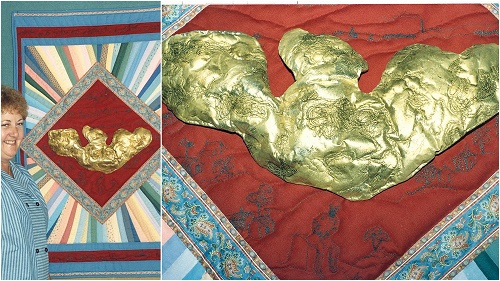
Much of what is now termed mixed media technically fits into the concept of an ‘art quilt’ as defined by SAQA, Studio Art Quilt Associates: “a creative visual work that is layered and stitched or that references this form of stitched layered structure.”Β and indeed, a number of artists are showing 3D work. But for travelling SAQA exhibitions, the logistics preclude inclusion of those 3D works. Over the years of quiltmaking, soft sculpture has retreated to the back of my mind, but this morning’s video reminded me of my most satisfying 3D moment: a soft sculpture model of the famous Golden Eagle Nugget , which was found in 1931 near the mining town of Kalgoorlie in the Eastern Goldfields region of Western Australia.

The Patchwork Pollies and the Goldfingers Embroiderers were invited to participate in a nationwide project to produce double sided quilts to form a large portiere exhibition at the entrance to the touring Australian Bicentennial Exhibition 88. As construction proceeded, our letter ‘H’ was formed by blocks of crazy patchwork, the embroidering of which enabled many people in the community to do a few stitches on work days held for that. For the reverse side we decided on a traditional quilt format of a medallion in the centre sourrounded by strips/rays of goldfields colours. Sewing those strips of fabric together in work days was another avenue for communityh involvement. It was suggested the medallion should feature something very central to the region. I don’t remember who suggested a nugget, but I certainly offered to make one somehow and agreed to free machine embroider some local motifs on the orange-brown goldfields soil of the nugget’s background. That nugget was to be added only after the quilt construction and quilting was all finished, and, typical me, despite having several months to produce that nugget, I really only tackled it about a week before it was due! By that time, we were preparing to leave town and relocate to the other side of the world, meaning our household goods including my fabrics and sewing machine would soon be all packed up :-0 Of course I’d been thinking about it, but with all the other things going on in my life, I’d serially procrastinated until, finally, with just a few days left before the deadline, I focused, sat down and made it. These photos were taken at the official handover the very day before we flew out of town.

The famed, fabulous, Golden Eagle Nugget, found near Kalgoorlie in 1931, epitomises the wealth of the Eastern Goldfields region of Western Australia, where gold nad been continually mined since it was first discovered there in 1893. A perfect inclusion on the quilted banner community project representing the region in the Australian Bicentenary Touring Exhibition of 1988.

Pandemic Treat Workshops

As the schedule of interesting weekly Stitch Club workshops continues, I have found a couple that haven’t interested me sooo much, which is OK as I have been otherwise totally absorbed handstitching the surface design of the quilt I dropped off at my photographer’s this morning. It always takes longer than I estimate to construct the work, finish the edge and attach the hanging sleeve, but at least this did not require an all-nighter as sometimes happens to meet my self imposed deadline of an appointment with Eduardo. By tomorrow I’ll have the images to resize to Quilt National size requirements, and be able to put my entry in a day before closing, allowing a little time for the system to crash somewhere. Rushing to finish an entry form at 11.45 pm is asking for disaster to strike, and here I speak from exprience πŸ˜‰

Untitled, 2020 40cm square. hand applique, raw edge, pieced strips.

The great thing about the Stitch Club workshops is that the teaching video, information about the teacher, and the recorded Q&A sessions all remain on the website (open to members of the subscription only S.C. only) so you can easily go back to one you skipped and do it in your own sweet time ! After 3 weeks of one workshop per week, the fourth week is for catching up, taking a breather or whatever, after which there’s a whole new workshop for us all. This week is the breather week, and though I’ve downloaded and printed off all the class workbooks, I’ve decided I need to blog a bit, read some books and do some thinking for the SAQA Oceania Region exhibition call for entry now out. The theme is “Oceania: Distance and Diversity” – and as I’m helping with the organising committee, I feel I should put an entry together. All those islands … all that water… I blogged of this on my textile/art blog today http://www.alisonschwabe.com/weblog/?p=5854.

Finding New Favourites

On one of my FB group pages today, someone posted: “A quick question. I need to find a good coffee for my coffee maker. Not capsules. I haven’t found any that I like yet. What options have you tried and what is your favorite and where to get it?

Members are expat residents, recently arrived or otherwise, plus people in process of coming or planning to come to Uruguay. It’s a broad group, members are from many countries, and older residents can be particularly helpful sharing information by explaining cultural and other differences, dealing with bureaucracy, housing matters, language intricacies, finding services and becoming familiar with local food. (appearance, sourcing the familiar, what to do with the unfamiliar) Food is an important element in our sense of well being, so finding what we like is a huge part of settling in, as opposed to short term visiting.

Anyone who has moved to another country knows that just when you’re starting to feel you’ve sorted everything out and are back in control of your life, some relatively minor thing will throw you into sudden confusion. Early in our stay in Denver CO, I was not expecting trouble the day I looked for powdered gelatine in our local supermarket. I carefully searched the shelves in the cooking ingredients and packaged desserts sections, but I just couldn’t find any. The woman at the information desk waved her arm towards the ingredients aisle. I returned and looked and looked, but I couldn’t find it. I eventually approached another nearby employee who kindly took me back to the cooking ingredients, and pointed to the packets of gelatine for me.

Of course I’d expected the brand to be different, but was completely thrown by the packaging differences. ‘Gelatine’ was on the label, admittedly, but in amongst a whole lot of other things with unfamilar brand names, that just didn’t register. Back home in Aus, the Davis company produces packs of 125gm, in basically white and blue packs about the size of instant dessert mix. Facing me on the shelf was Knox’s much larger, bright orange and white box containing about 450gm, looking like a pack of loose tea πŸ™‚ Finding what kind of bread we liked was a much more complex and lengthy ptocess, involving our family’s own tastes. After trying and not enjoying lots of what Americans regard as perfectly ok daily bread, we realised that those were all very sweet compared to what we were used to, and after a while eventually found that anything labelled ‘french’ or ‘italian’ was our preferred type of bread. The differences in national palates are real and interesting. The Uruguayan national palate is very bland to us, and favours sweet rather than savoury – but today I won’t launch into the ubiquitous dulce de leche.

I commented to this new arrival that there really is no short cut to finding your new favourite coffee – be brave, try everything you come across, and you’ll know it when you’ve found it.

Medical Potential In A Bowl Of Pineapple ?

You know how something niggles at the back of your mind, but doesn’t ever become clear enough to see what it is that is causing that unease?

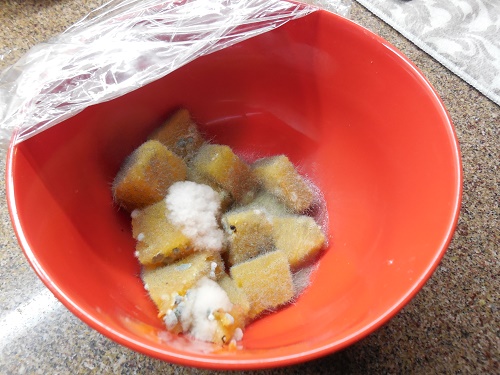
A few weeks back I had a feeling that we hadn’t quite finished off the diced beautiful fresh pineapple I’d meant to use on a pizza or something. Perhaps we changed our minds about making pizza and thus never really addressed the pineapple bits. Anyway, under plastic wrap, in time they moved to the back of their refrigerator shelf, became surrounded by things that obscured the view, and remained undisturbed for several weeks, until Mike cleaned out the ‘frig. He’s very good at that job, and so I generally leave the schedule for it up to him, as I wouldn’t want to give him the feeling I was interfering in one of his star roles.

It took us a while to realise, or should I say remember, that these several colonies of mould had developed on what was once diced fresh pineapple. I didn’t post this photo immediately on FB, because my first action was to remove this biohazard from the house. When I did get round to posting it, my dear friend Pam suggested it might have contained a cure for Covid-19, and I felt terrible that I had failed to offer this opportunity to science and the world. I’m just documenting it now so that if it ever becomes the case that mouldy pineapple contains the answer the world is waiting for, my dear friend Pam N. should share in the inevitable Nobel Prize as having been the first to come up with this potential medical research possibity.

This stage of the research can be easily duplicated by people at home, and would be interesting to see if the same main moulds appear in other people’s trials, too! Contact me if you want to share your results!

Marvellous Celery Soup

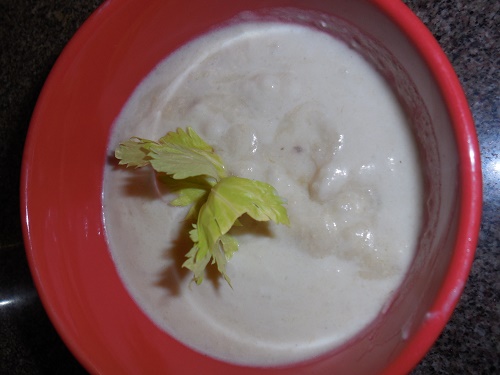
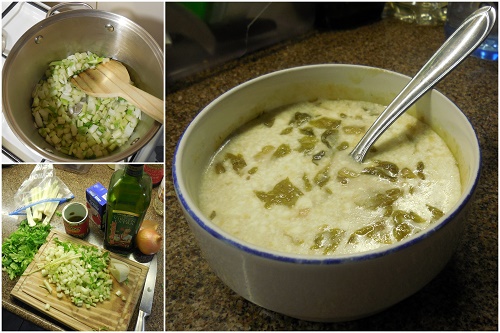
It’s the middle of winter here in Montevideo, and a few nights ago we had a hearty celery soup, accompanied by some lovely sourdough bread made by neighbour Maggie in appreciation of the kiwi fruits she and her brothers had been able to pick from our bumper crop.

The decision to make celery soup was made because we had a huge bunch of gorgeous crunchy celery that in a household of only two we were taking a while to get through. It’s not salad weather, and there’s only so much celery+dips or celery+crunchy peanut butter you can deal with in a small household like ours πŸ™‚

This beautiful celery soup was based on the BBC good food recipe with a couple of additions:

  • 2 TBS olive oil
  • 300gm celery, remove strings, finely slice
  • 1 or 2 cloves garlic, peel, finely chop or press
  • 200gm potatoes, peeled, finely dice 1cm.
  • 500ml vegetable stock
  • 100ml milk or cream
  • 1 TBS or ‘slosh’ of canned diced jalopeno
  • crusty fresh bread, to serve.

In a large saucepan, heat oil on medium heat and saute chopped vegs. Add splash of water and a pinch of salt; cook stirring regularly for 15 minutes. Add a little more water if the vegs begin to stick. Add the stock, bring to boil. Simmer another 20 minutes until potatoes fall apart and celery is soft. Add jalopenos, then use blender to puree the soup. Add cream. Adjust S&P seasoning; reheat, and serve with crusty bread – enjoy!

I mentioned this lovely recipe for celery soup to son chef Ivan a short time ago, and he commented he’s rarely had it …. I agree, it’s not common, probably because as a soup it is a bit bland. But it is high in fibre, and low in calories and carbs, a good source of several vitamins and other nutritional goodies including potassium, calcium and magnesium – so there’s good value to eating it regularly. I like it crunchy and fresh, cut into sticks and coated with tasty dips or crunchy peanut butter. To pep up the flavour of the soup, I added some canned jalopeno, but grated fresh parmesan or other tasty cheese with a pinch of chili or cayenne pepper would be fine, too.

Steak And Kidney Pie, Perfect On A Cold Winter’s Night.

By mid April the weather had cooled enough to require our first open fire, at which time we wheeled the TV in from the larger living room to its winter position in this one, the sitting room or ‘estar’, which is also where I write at my desktop computer. Now in the heart of winter, we’re in the middle of a very cold spell, and, as we do on most nights this time of year, last night we ate dinner in front of the fire. We were then in position for our tv serial, currently watching season 3 of The Last Kingdom and enjoying it immensely – it’s pretty intense, and we can normally only take one episode a night!

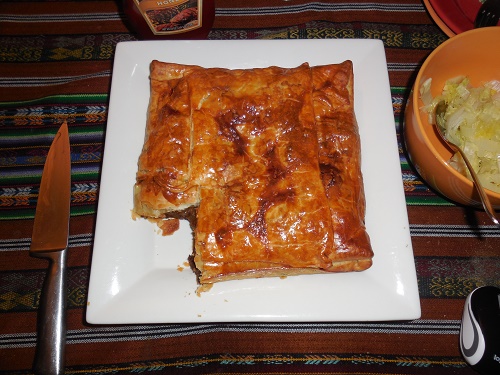
Steak and kidney pie, cooked by Mike for dinner last night.

In view of the freezing weather Mike decided yesterday afternoon he’d cook a steak and kidney pie. The result was fantastic, the pastry perfectly done (the base cooked blind) and though I’m not a big fan of kidneys on their own, the meat mix was very good, the steak itself quite tender. I have no idea of which recipe he used or which brand of pastry he bought (Uruguay) so contact him directly for further info. He’ll have the leftovers for lunch today, and I will have the leftover cheese pudding from Sunday’s lunch.

Interestingly, we were once given two square plates, as per the pic, and what comes out of the square silicone cooking dish, pan, tin or whatever, exactly fits down into the plate. The plate, though, won’t fit upright in the dishwasher and needs to be washed by hand- which is not a complaint, just an observation. I am a fan of everything possible going into the dishwasher but there’s always something that can’t go in, for some reason, isn’t there?

At this stage, mid morning, I have no firm idea what’s for dinner tonight, but it will include plenty of veggies – maybe even a vegetable bake… and perhaps some home made celery soup – we have a huge head of celery in the frig – this would be a good time to find a recipe and get it and the veggie bake under way so that I can spend a peaceful afternoon stitching.

Pandemic Treat Workshop – Emily Tull

Well that was fun!

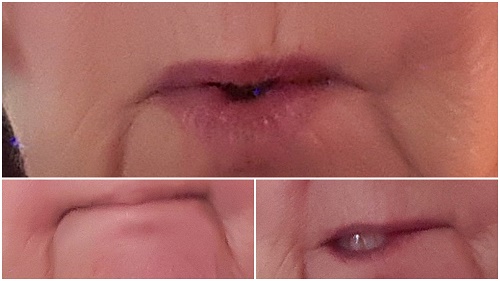
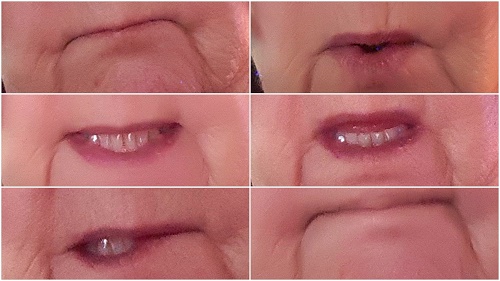
The top image was stitched first, then the lower left, and finally the lower right.

Try as I might, I just could not get those collages to shuffle into the same order, but you should be able to work them out ok. The order in which I worked them was relevant, I think, because they became quicker and easier as I went on.

They were fun to do, and although I did tune into both sessions of the Q&A, (the first at 6am Montevideo time) and picked up lots of tips and advice, I don’t plan to do a series of family faces in this style. However, I was reminded of my faith in the expressive potential of the straight stitch as a line, and seeing other people’s efforts and lots of Emily’s work was interesting.

I’ve downloaded the workbook, watched the video and looked at the inspiration book for the next workshop with Sue Stone, so I’m ready to go next week. Just now though, I’m stitching a few cream hexagons onto the edge of my long term, (40+years) Grandmothers Flower Garden quilt project while considering what we’ll have for dinner. It definitely must be something light because we had sausages and stir fried veggies plus De Voto’s single serve apple pies for dessert. I’m thinking a vegemite and cheese toasted sandwich.

My Pandemic Treat

Probably most people confined to their homes and apartments in this stressful period are finding the pandemic seems interminable. Fortunately we live in a house with a lush garden around us that is so helpful. Mike retired a year+ back, so was already getting out of the ‘leaving home to go to work’ habit, that even when done voluntarily, required a huge adjustment. For such an abrupt change to reality to as happened in so many people’s lives at the outbreak of the pandemic must have been really, really hard.

We are well and coping with life within the parameters of the new normal for seniors in their 70’s. The Uruguayan government has managed the pandemic extremely well, and recent reporting including The Economist (June 13-21) and blog.independent.org recognises that a high level of citizen compliance with public heath recommendations from doctors and scientists has been one of the pandemic’s positives here. As restaruants closed but food shops remained open, we have continued to cater at home. Pre-pandemic we dined out in restaurants generally no more than twice a week, so catering at home is part of our lives, anyway. We have had visits with a few people whose reduced contact we trust, but though some restaurants have re-opened with new protocols, we haven’t dined out yet and probably won’t unless/until it is a nice day to sit outside. Such days do occur during winter, but they’re unlikely this week.

So not much has changed for us on the food and catering side of our lives. We’ve added a daily episode or two of a Netflix series we’re following, and we’re tending to read more. Mike has found one or two extra projects, and I decided I’d sign on for a series of stitchery workshops presented by TextileArtist.org as a treat for myself.

Beginning late in may, for a monthly fee, each month subscribers presented with three week-long workshops by a famous stitcher – video, downloadable and printable workbook and ideas book, live Q&As with the tutor each friday, online discussions and feedback. The monthly cost is a fraction of daily tuition fee alone for a one day workshop with one of these people, and every month for as long as I subscribe I have access to 3 of them (the 4th is a catch up week). You can bail out any time, but so far I am really enjoying this.

One of my favourite ever textile artists, Debbie Lyddon of UK was the first tutor, and her workshop was great. we designed and made containers for something that was precious or interesting to us – shells and stones, photos and small momentoes were commonly chosen – my effort was a container to hold a satin covered horse shoe that was drpaed over my arm for luck by my mother-in-law Dawn as we walked back down the aisle on our wedding day.

A container to hold a satin covered lucky horse shoe, week 1, Debbie Lyddon .

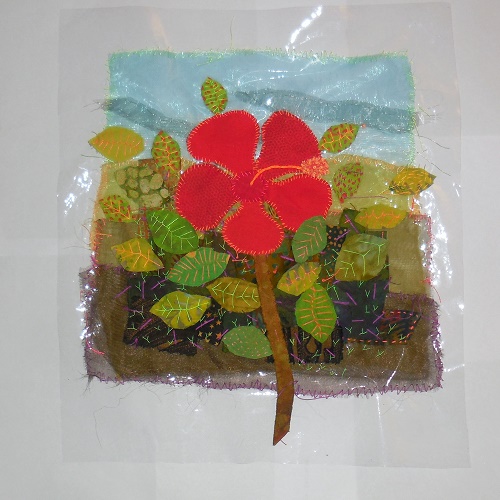
In week 2, Merill Cumeau, USA, gave a workshop on collaged fabric and stitch, with us researching and choosing a flower that we felt expressed something about our own personality. Flowers aren’t my go-to design motifs, but this was fun. I worked mine on clear plastic rather than the nylon tulle she suggested., because I have meters of the plastic I bought for some reason, and am now exploring some ideas about using it.

Red hibiscus collage in Merill Cumeau workshop, week 2.

I have no project to show for the third week’s class, because I chose to sit it out. I’ve never been a fan of jacobean style embroidery, and the project was to work some motifs using plastic waste. The teacher Susie Vickery has a stong personal commitment to environmental causesa including recycling. There were some amazing things done that week, though mine was not among them!

This week the presenter is Emily Tull, UK, a prominent textile artist particularly known for her stitched portraits of people and studies of some animal life. The assignment is to use straight stitches in 4 tones of one colour to embroider mouths or lips in several expressions – and as uninspiring as I think my own lips are (I’m sure everyone says that) – I’m going with her suggestion to take pics of our own. So these are expressions that Mike says are typical – and I’ll choose 3:

Pics of Alison’s mouth in various expressions for the Emily Tull worskhop

Competitive Foodyism

If you read cookery sections in your paper, visit Facebook or other social media regularly, you can’t help coming across people’s posts about food. Nutrition is important of course, but if most of your food is fresh and includes a good portion of veggies and fruit before cooking and serving, your nutrition should be fine. Food has always been an avenue by which people can shine, shall we say.

The pandemic largely dispensed with those ‘We’re out at xyz restaurant, and look what just arrived at our table’ kinds of posts, coming as they often did with additional (boastful?) comments on an anniversary, a cruise or some fancy new something. But – they have been replaced by photos of whatever’s been cooked at home for lunch or dinner, often asking us to respond to their question ‘So what are you having tonight?’ This is Competitive Foodyism, and often sounds a bit superior. I do quite a bit of scrolling.

But just occasionally I do read what people write about the lunch or dinner they’ve just made and posted, and it can be very educational. For example, just last week I learned (no, I knew – it just confirmed) that I must be way behind, just not keeping up, as I’d never heard of black garlic !! and got out the googler. Even after reading about it, I feel no need to try it in my own cooking, even if that sounds a non-sporting attitude πŸ˜‰ For a start, to make it the way someone described it, the house (or garage more likely) would be filled with garlic odour for several weeks before it’s ready to use ! So, no thankyou – fresh or fresh/frozen garlic’s just fine…. no, really, it is, thanks anyway.

Mike and I both cook, so though we don’t have a roster for whose turn it is to put lunch or dinner on the table, I’m sure it works out about 50-50. He likes to follow recipes and I only occasionally follow one, typically when I’m trying something new. I’m more likely to check what we have in the cupboard/frig/freezer, and take it from there. With many people working at home and now eating three meals there, many are looking for support and advice on how to manage the shopping for ingredients, cooking advice, and examples of recipes that have gone down well with the writer’s family, partner or flat mate.

But even the most careful providoring could lead to a situation of finding a bunch of ‘single’ apparently non-related ingredients on the pantry shelf, you wondering what the heck to do with a small can of diced jalapeno, a tetrapak of pumpkin soup, three cloves of garlic, a cup of beans, a can of diced tomato, an onion, a packet of dessicated coconut, a packet of potato flakes, several sticks of limp celery, a bunch of aging fresh cilantro, two slices of processed sandwich cheese, and a 300gm packet of dried dates … but if I do come across a suitable recipe for all that, I will publish it here πŸ™‚

In the meantime, some of those ingredients will make a wonderful chilli bean dish that I wrote about last year:

Bean Chili – filling, perfect for lunch of dinner in quarantine or any other time. Meat optional. Keeps well in ‘frig for several days if it lasts that long.
  • Note that actual quantities are not given in this recipe – it’s flexible. Start out with roughly equal quantities of everything except perhaps the garlic (!) and adjust according to your taste. It’s a recipe I doubt you could get β€˜wrong’ if you use the photo for reference πŸ˜‰
  • Chopped onions – saute in a little oil with …
  • A lot, a huge amount, of garlic. Then add the rest:
  • Green chilis (or substitute a small can of diced jalapeno)
  • Chicken stock.
  • Hot sauce – live dangerously with a good splosh, or add gradually, and carefully, to taste.
  • Cream
  • Add cans of white, great northern, pinto black or any other kind of beans (preferably several kinds)
  • Butter+flour or cornstarch with a bit of stock (or the juice from the can the beans were in) to thicken the sauce.
  • Very tasty grated cheese should be sprinkled on top after serving.
  • Brown some diced or minced chicken or beef in a little oil in a pan – and add a spoonful or two to the carnivores’ serves.

Lacking as it does the hottest exotic ingredients from SE Asia, outer Mongolia, Morocco or wherever the most recent must-go travel destinations were before the pandemic, it’s not at all trendy. But it’s easy to make, tasty, nutritious – and hearty enough to stick to the ribs on the cold winter’s nights which have arrived in the southern hemisphere.