
My dear friend Heather and I met as freshers at Tas Uni 55 years ago, immediately hit it off and became forever friends. Yesterday she posted one of those ‘share if you remember’ photos on Facebook, of a group of young primary school aged children standing around a milk crate, while drinking milk through straws from the small bottles they were holding. That triggered additional memories about this feature of our school days, and I thought I’d just jot them down here, as a change from ‘Plague’ issues.
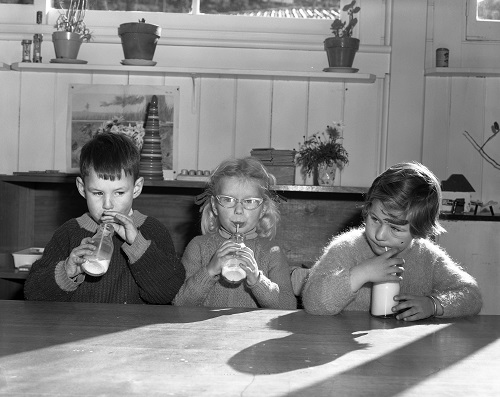
(Photo credit: Tasmanian Archives and Heritage Office, item AB713/1/11012)
Studies in 1950-51 showed Australian children were receiving less than recommended amounts of calcium in their diets, and by 1953 the Australian government had fully implemented what was called the School Milk Scheme by which just over 1 million children aged up to 13, in public and private schools, kindergartens and creches in every state, received free of charge a 1/3 pint bottle of fresh milk at their school every day. The scheme was discontinued in the 1970s by the government of the day, which decided the benefit no longer justified the cost. Aussie kids’ diets had probably improved, anyway.
I began kindergarten at the age of 4, and rain, hail or shine, walked with my best friend Caroline up the hill and along a bit to our kindergarten operated in St. Oswald’s Church hall, Bain Terrace, in Trevallyn, a suburb of Launceston, Tasmania. Our adored teacher, Mrs Kerr, kept us busy with a lively program of learning our letters and numbers, how to put on our shoes and tie the laces, putting on our own jackets and coats, the importance of handwashing and other basic grooming, painting and drawing, story telling, scrap booking and other crafts, ball games and little competitions plus free play sessions out on the jungle gym, activities similar to what kindergarteners and preschoolers do today in preparation for starting school.
When I was aged 8 or 9, my class teacher, Mrs. Andrews (in a sing-song voice say “goomorningmissuhssaaandrews”) went through a phase of printing every child’s name on a waxed paper drinking straw so we could re-use it. I can still ‘see’ the tiny neat printing so clearly, so it must have been pen and ink, possibly Indian ink, because pencil would not have marked so clearly and strongly on a waxed paper straw. I think the idea might have been to encourage us to not chew the straw and treat it carefully enough so we could use it again. I don’t recall the plan lasting long; and just the very idea of using a straw for milk, then using it again a day or two later makes my stomach turn at the potential for nasty stomach upsets, of which in our youth, we really did have quite a few. The whole business of food handling, distribution and storage rapidly improved during the two decades between the 50s of my childhood and the early 70’s, by which time fridges were bigger, and Mike and I even had an additional small chest freezer out in the laundry.
Tasmania, my home state, has a cool temperate climate. Cold wet winters feature frequent heavy frosts, and sometimes snow at very low altitudes. Even summer doesn’t always feel ‘warm’, let alone ‘hot’, but everything’s relative. There were a few weeks at each end of the school year when days could be quite hot with temperatures sometimes reaching 28-30C. The milk was always delivered well before we arrived, and even if set down somewhere shady, on hot days that milk would be ‘tepid’, erk, by recess time. It was not optional to drink it – we all had to, knowing it was for our health, teeth and bones, or something. I’ve always hated warmish milk, and rarely drink milk on its own, ever, whether refrigerator cold or piping hot.
One memory we had in common was the practice of saving the silver aluminium tops from the bottles of milk delivered to homes, schools and shops in those days. We took them home, washed them and by the end of the year we had lots of them to press down over the shaped part of a lemon juicer, giving each top a little bell shape. We threaded those tops onto knotted string to make shiny garlands for the family Christmas tree. As Heather commented, this was time consuming work and was no doubt encouraged by our mothers to keep us busy for a few hours, certainly an ideal wet afternoon indoors activity. In time, the bottle tops delivered to our house were often red, and that was very nice, too. I have no idea what happened to all those garlands and don’t remember seeing them anywhere since I married and left home. Maybe they were still there the last time I had a Christmas back with the parental units, but I don’t remember specifically.