
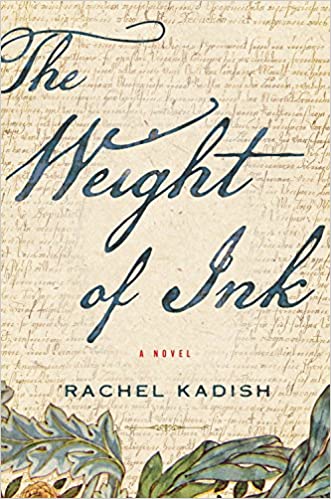
While fashioning the mask featured in yesterday’s post, I continued listening to a riveting audio book “The Weight Of Ink” by Rachel Kadish. A best seller, it won a National Jewish Book award in the USA, and is reminding me of a wonderful book I read a few years ago by Geraldine Brooks, “A Year of Wonders” That was a fictionalised account of the true story of Eyam, a village in the rugged hill country of England, set in 1666. As the Great Plague travelled across Europe and arrived in England, that whole village put itself into quarantine, shutting out all travellers, and not permitting anyone to leave the town. It saved everyone in the town. Both these books draw detailed pictures from contemporary records and acounts.
“The Weight Of Ink” does this in an interesting way, toggling back and forth from 1660 to the present day, weaving two stories into one of two different centuries connected by the thread of historians finding and then forensicially examining the revelations in historical documents from The Plague period in England: “Set in London of the 1660s and of the early twenty-first century, “The Weight of Ink” is the interwoven tale of two women of remarkable intellect: Ester Velasquez, an emigrant from Amsterdam who is permitted to scribe for a blind rabbi, just before the plague hits the city; and Helen Watt, an ailing historian with a love of Jewish history. As the novel opens, Helen has been summoned by a former student to view a cache of seventeenth-century Jewish documents newly discovered in his home during a renovation. Enlisting the help of Aaron Levy, an American graduate student as impatient as he is charming, and in a race with another fast-moving team of historians, Helen embarks on one last project: to determine the identity of the documents’ scribe, the elusive “Aleph.” Electrifying and ambitious, sweeping in scope and intimate in tone, “The Weight of Ink” is a sophisticated work of historical fiction about women separated by centuries, and the choices and sacrifices they must make in order to reconcile the life of the heart and mind.”
And now, I’m about 2/3 through the story, Ester and two other women are in a house in the city of London at the height of The Plague, and enjoying the descriptions of street activity, people’s behaviour, activity on the street, insights into how people managed financially, the role of news and rumours, the sounds, the smells, the particularities of life for Jews in Catholic England at the time, many of whom were refugees from the Spanish Inquisition … well, anyway it’s a fascinating and timely book. Still so much to read that to me it’s not possible yet to see where it’s going to utimately end. I’ll be sorry when it does.
Historical fiction is category I love reading/listening to, because I’ve always felt ignorant, having much to catch up with. In senior school our history teacher was unutterably boring in my opinion, and I could hardly opt out of her history classes fast enough when the time came to do so. As a result, it was not until after several years at university that I realised how interesting history is, but by then the dye was set for a while; my focus was on my major subjects were geography and ancient civilisations – which, of course, included a fair bit of ancient history background! But in opting out, I had in effect postponed a lot of learning. A decade later, in my late 20s, I found myself living in a tent on one of the Katherine Farms on the outskirts of Katherine, Northern Territory, Aus. (see glossary “tent period” ) There I had access to a great little regional library in the town into which I had to drive every day, plus I had plenty of time to read. Perfect. And I’ve been enjoying history and historical fiction every sincce.