
What I feared might happen, did. I was between steps 1 and 2 of a repair to a back molar when Uruguay announced its first cases of the virus, and home isolation began, boom, just like that. In the following week, my dentist himself tested positive, and of course the surgery immediately closed, only reopening last week with very tight protocols, as you’d expect. I thought I’d leave it a bit longer to get stage 2 done, but two days ago disaster struck. As I chewed on something the tooth itself split. It was awkward and slightly painful when I chewed, but overall didn’t cause an aching pain. But it did mean I could wait no longer, and I was really worried that this poor old tooth we’d been working to save would just have to be pulled out after all.
I was the first patient of the day, and I‘ll skip over the injecting, tapping, wrenching, spraying, spitting and air-blowing bits to the exciting part. Our dentist, Dr. Federico Fynn, is well up with the latest in dentistry and you can tell by the enthusiasm in his eyes and his voice that he enjoys meeting challenges like mine with finely crafted work. Today I came away with a custom fitted 3d printed and baked crown filling. Plus, although it isn’t the first time I’ve benefitted from this amazing technology, because I was the only patient there this morning, Federico had time to explain it all to me to me, watch what was happening at each stage, and take some photos. I was able to go to the room where the images and the data are compiled and processed using several small (but no doubt very expensive) little machines to produce the ceramic reality.
Once the cavity was clean, dry and sprayed with some opaque powder (so relax – my gums are not infected with some nasty white scuzz thing) Federico did the 3d mapping by waving a hand-held scanner in and around my tooth and immediate gums to record the data that the computer then compiled into an image of the precise shape for the missing part of tooth. Stunning.
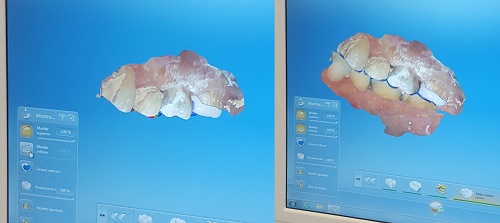
In the left pic, the solid white shape is the needed bit of rear upper molar that has already been calculated. In the right pic, my bite was closed and scanned, so the program could work out the shape of my lower left molar, now as I write, sitting comfortably beneath the upper (white) new bit of molar.
All the information went by wifi to 3 small but no doubt expensive machines. In the first stage, Federico took a block of some material to be shaped by the drill, in a process like a wood turning lathe really, which cut and shaped the material it was holding to produce a solid form of the information that reader thingy recorded and the computer compiled. that happened in a closed machine with an exhaust system to trap the produced dust. Once shaped as per this screen –
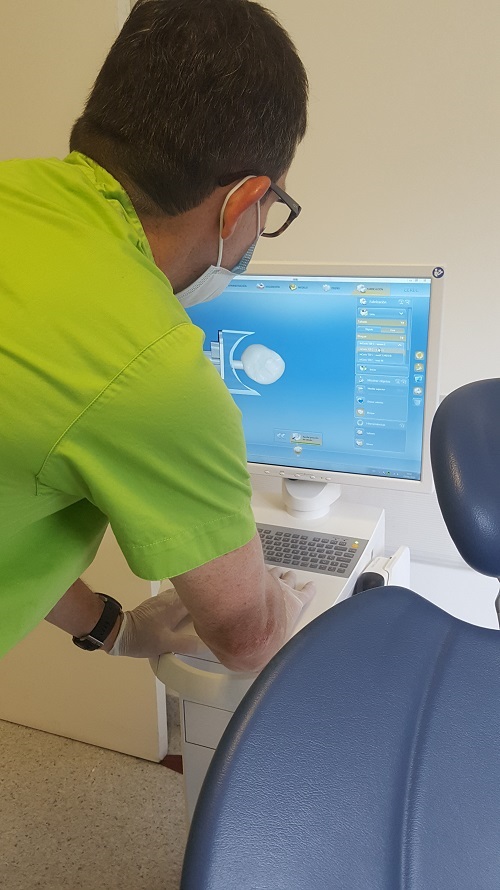
it was removed from the little chamber, the unused bit of material was trimmed off, leaving a small white form about 20% bigger than the eventual tooth would be, because the baking process or sinterizing results in shrinkage, the rate of which the computer calculates, which is really, really amazing, I reckon. The ‘tooth’ was put on a little round plate, which, and rose up to disappear into the oven, rather like loading a space ship in a cartoon. The ‘spaceship’ looked remarkably like a domestic coffee maker, really, and inside the oven cavity is about the size of a large walnut or small fig, judging by Federico’s hand actions describing it. After baking the crown at 1600C for 20 minutes, the machine delivered it back down onto the bench. I returned to the chair for the test fit into my tooth cavity, which of course was perfect, as expected, but quite miraculous, anyway.
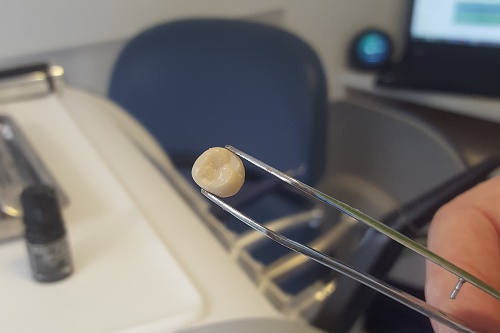
That done, adhesive was applied to hold it in place, and with instructions not to chew on anything for at least an hour, I was free to go. I felt ever so grateful as I walked home in the morning sun, only 15 minutes late for my mahjong group’s weekly chat on Skype. Federico, muchismas gracias, brazos y besos virtuales!