New Thread – 6km Of It!

Around New Year, I realised I was using up my 300m cone of neon green thread too fast to finish the hand applique on the large quilt I’d started. I’d either have to get more thread or change my plan in some way, maybe settle for something smaller. The thread was Gutermann heavy duty thread in neons- yellow, coral and red, that I bought on impulse in a store in the USA at least 7 or 8 years ago, but their website showed nothing, and they didn’t respond to my emails. Searching around the internet I did find some neon threads of that description on Desertcart.com. It was on cones looking just the same as my original ones, so it didn’t occur to me to check the actual length of thread in the written description. I happily selected one of each neon colour they had – yellow, green and orange-red. And then, thinking I should get an extra green, ‘just in case’, I added another green, so the total was 4 cones. When the parcel arrived in a timely manner, imagine my surprise when I opened it to find 4 x 1500m cones, totalling 6000m or 6km neon thread!

The small green one, now nearly empty, is beside a little-used one of my original purchase. The very slight difference between the two greens isn’t obvious, but I’m just alternating threads as I sew to ‘blend’ , JIC.

The listed cost per cone was around what I vaguely remembered paying for the earlier (much smaller) ones and of course I expected freight on top of that. However, there were various charges and costs added by customs here that took it over the total US$200 allowed for an import duty-free consignment, allowed 3 times per calendar year to all Uruguay residents and citizens. When I saw that bill I seriously considered sending it all back, though I’d have had to fork out more transport costs for that too. So I swallowed hard, mea culpa, and paid up, vowing to learn from experience. However, after I calmed down, and considering the actual amount of thread involved, plus that there’s a pandemic on and we’re not travelling, it seems the cost/m wasn’t so bad after all.

Whether by hand or machine, 6km of thread is quite a lot to sew through. This latest thread is labelled ‘nylon’ and actually sews more nicely than the original I’ve been using, which is a plus. I haven’t put it in the machine yet, but as I love topstitching as a machine quilting method, I know I’ll be making a point of using it that way. I’m loving neon colours+neutrals, and though I haven’t done any improv freehand patchwork in the past year, I am sure I will get back to it soon, and also think just having that resource to hand may spur me on to something interesting and different that I might not have otherwise contemplated.
Summer Break’s Over

In truth, the last few weeks have been little different from any other since the pandemic’s arrival here last March 🙂 Christmas and New Year came and went very quietly in isolation, with family from Australia, New Zealand, 2 locations across USA and ourselves joining for a while on Zoom. Most years we are together with some of them somewhere if not at Christmas then probably New Year or just after. It was much the same for most people our age in Uruguay, though small family groups were able to gather – unfortunately early January this seems to have resulted in and alarming spike in new infection numbers. Right now, early February, (touch wood) we seem to have passed the peak of that wave, the numbers are still oscillating between the 400s and 700s per day, though in an overall downward trend.

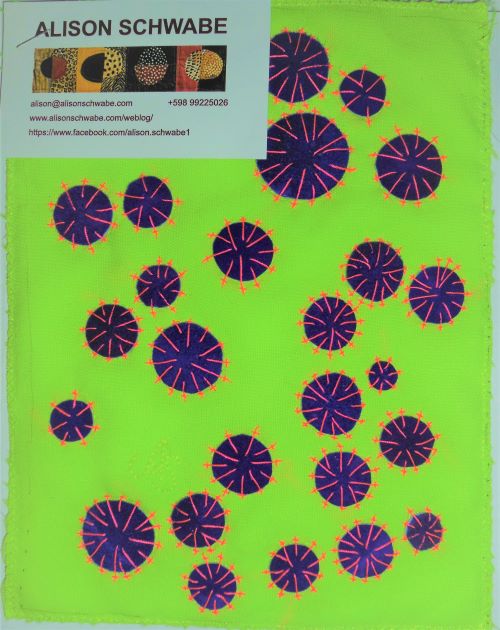
Sample “Pandemic Pattern 3″ (6:”x8”) has just been sent off to the SAQA spotlight auction. It is really bright neon green!

With the continued lack of group social citvities except online, there is ample time to stitch, and the other day I lined up a group of projects completed and works in progress (WIPs) on my pin board. While it’s hard to get a direct angle pic of that wall, I include some of the things here:

“Pandemic Pattern 2” detail, quilting in progress, for SAQA Online Auction 2021.

Also in progress are larger pieces, this next one I put aside for a while to decide what goes in the top section while I made Sunburnt Country, which I felt some obligation to make, as I’m on the organising committee for that exhibition 🙂

Untitled, in progress, hand stitched applique. Finished size to be ~90cm x 190cm

This next image is of a sample piece I made in the Stitch Club workshop by Richard McVetis:

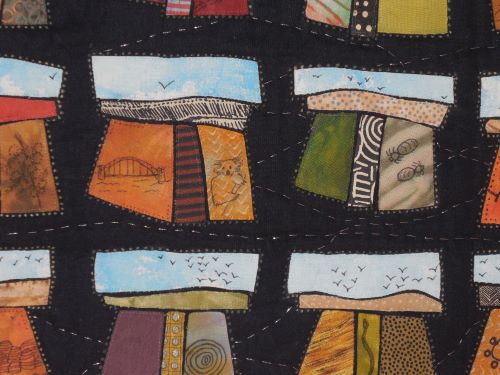
The idea of slightly pulling apart the sections of the landscapes instead of piecing them came from the Stitch Club workshop by Richard McVetis in which it was suggested we placed segments of fabric edge to edge. I applied this to the landscapes I’m always interested in, which turned out to be a really good move. Piecing the tiny little landscapes had always meant seams which showed beneath the surface and always bothered me a bit. With the help of a fusing web adhesive and setting the segments slightly apart before ironing into place show background to gives a stained glass effect with no seam allowances showing. Pleased with this I used it in Sunburnt Country:

Sunburnt Country 2021, detail.

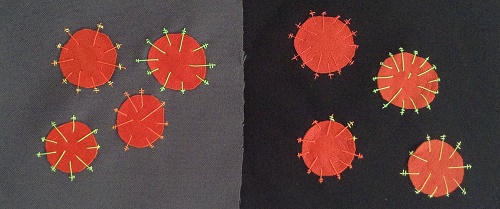
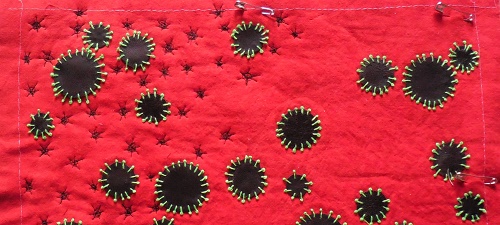
I’m currently working on a larger piece nearly 2m x about 1m, with red leather circles appliqued with neon green thread on black to represent the coronavirus virion– for the meaning of that word and the thinking behind my colour choices in this series, go to my visual diary post .

Background fabric audition (black chosen) for Pandemic Pattern Series #4, 95cm x 180cm, Hand applique, WIP.

The above sample making led to choosing black for the background and work is well underway. I’ll write separately about this piece soon, as I had an interesting time obtaining additional bright neon green thread I decided to use.

McVetis Workshop Continued

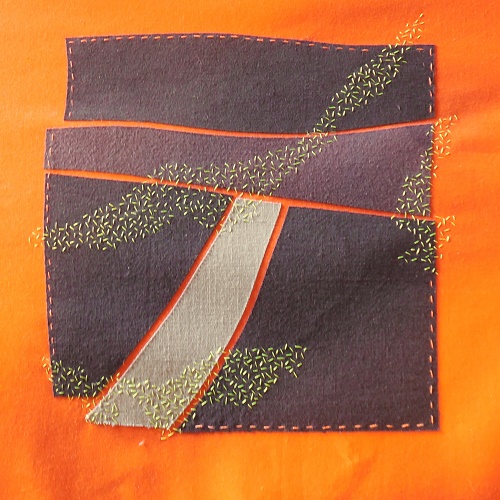
I decided to work first on the left side one, and if I’d been smarter I’d have used a thicker thread for the seed stitch… but I did want to use the flouro green and it is a pretty fine thread. Richard uses very fine seed stitch in his work, so there is that … I may do another to make a companion pair, with a ‘cloud’ of another kind of stitch filler, but I haven’t decided.

Right now I am resuming applique of the gold on black, and getting back to finish the motifs being stitched onto the little landscapes in progress.

it’s always interesting to learn how individual artists are inspired and motivated to create what they do. The next workshop, starting this coming weekend is with Mandy Pattullo, a UK textile artist I’ve been reading about https://www.textileartist.org/mandy-pattullo-from-conception-to-creation. For a prominent artist to claim to do little research before she starts making a work was very interesting, and a little reassuring to know I’m not the only one with this approach. She commented for the last 40 years she’s been ‘researching’ – by collecting postcards, photos, books and many other visuals which she pins on her board for inspiration (she might also have added Pinterest …) and all that time ideas have been formulating in her mind. I feel the same about where my ideas come from, though a big heap of my physical collection is in actual storage in Australia.

In this very stimulating series of Stitch Club workshops, it’s also interesting to me that there’s a very strong encouragement for us all to use recycled or repurposed fabric where possible in the various projects, and several of the artists have very strongly signalled that recycling is at the very core of what they do. I myself love seeking out remnants and discard bargains in outlet stores, but I do prefer to work with ‘new fabrics’ as in not repurposed. In a post by someone on a textile art organisation’s FB page this week, a member showed a very nice wool jacket she’d made for a relative, having recut and embellished a wool coat she bought in a thrift shop or somewhere. I’m not sure if the main intention of her post was to show thrift or art. A bigger question in my mind is this: does the use of recycled materials and fabric bestow some extra value on an artistic work ?

Pandemic Treat Workshop – Richard McVetis

The past week’s workshop with Richard has been challenging – very stitch texture focused, and he demonstrated a design method to prepare an interesting base for stitching. The stitches he recommended were the simpler ones – including straight stitch, button hole, long and short, seed, running and similar. These most basic stitches can be used as both outlines and fillers.

His workshop demo example was to trace the plane shapes of a building, but there were other possibilities – and two others I came up with were

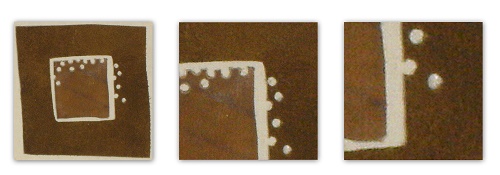
Leather block sample (L) cropped two suggested ways fo give interesting shapes.
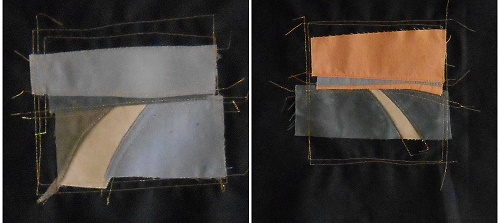
Two small freehand cutand pieced landscapes

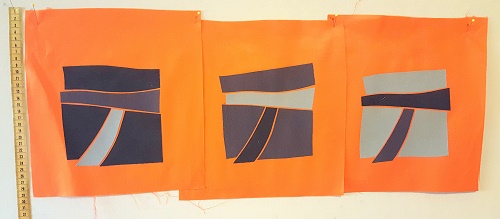
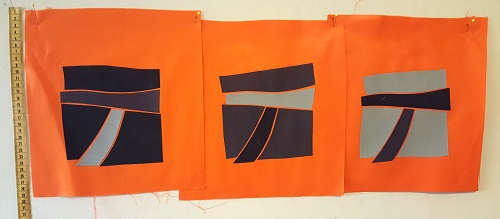
The shapes were transformed into pattern pieces for cutting the fabric shapes that were then bonded into place on a background fabric, ready to stitch. (Go here for the basics on improvisational / freehand cutting and piecing) I chose to work on a design using a set of shapes to suggest landscape, and instead of fitting them exactly edge to edge, I left the space showing orange as a line between all the shapes:

Improv cut, not pieced but bonded into place on the background fabric showing through as a line.

I hope the stitching I do will enhance and complement these arrangements – because they’re all heat set into place now !!!

Coping by Going Online

At this time of year we’re always far away from at least some of our closest family spread between Australia, USA and currently New Zealand. I’ve long given up sending gifts in the mail for a cost that equals or even exceeds the cost of the gift itself, and instead arrange delivery from a vendor close to where the recipients live – call it supporting local businesses – theirs, not ours. As I write I’m nearing the end of Christmas shopping online for this year – a full 10 days ahead of my usual schedule!

The Christmas feeling received a boost the other day, though, when the oldies music station I was listening to played Eddie Rabbitt’s I Love A Rainy Night. That song always sends me back to Christmas 1980 which we spent with Sal and Rog at Las Cruces, early in the family’s fabulous trip in and around the southwest of USA, about which I’ll write another time. As we travelled around the sights that tune was on the car radio hundreds of times, which is the weird reason I associate it with the Christmas. I just had a another listen https://www.youtube.com/watch?v=MG0e8_foDmU

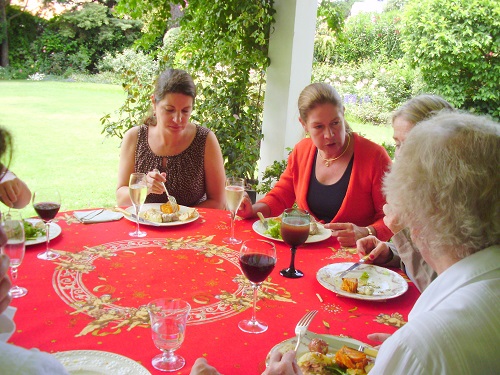
The book club I’ve belonged to for many years has always had a Christmas luncheon, usually catered, and it’s always been at Victoria’s home. Along the back of the house a very wide verandah leads out from the living and dining rooms into her beautiful garden. It has always been so lovely to help ourselves buffet style and sit around the decorated tables sharing the delicious lunch with fellow members, some of whom always brought along a visitor or two, sometimes visitors were former members. I went through some of the photos I took on those days, and sadly in the many years I’ve belonged, more than a handful have passed away or had to withdraw on health grounds. With half the membership being temporary Uruguay residents from other countries, those women have moved along, and I had difficulty remembering some of their names. They were (and hopefully still are) keen readers, great company and caring people I value having known.

The New English Book Club Christmas luncheon, December 2008

Here in Uruguay the pandemic situation has worsened recently, and some venues are again closed, activities sidelined and we’re all urged to stay at home if at all possible. We’re not in lockdown, yet anyway, but various government announcements make it clear that organisers and attendees of any kinds of events will be prosecuted if new cases are traced to them. So, in view of the pandemic, we’ve cancelled plans for what was to have been our well planned catered, socially distanced lunch out on Victoria’s back lawn. Instead we’ll be having our end of year lunch on Zoom. Lunch goodies will be delivered to us that morning and we’ll dress up and gather on screen later to eat it and toast each other for the coming year. I must make sure there’s some chilled white wine around…

We suspended our fortnightly meetings just before the start of the pandemic here, feeling we should wait and and see if the virus that was causing concern would turn up. Of course it did. A few days later the first cases were announced and within a week the whole country was in effect shut down for a while. Members have since exchanged their books by appointment with tMaureen who has the 300+ books at her house, and we’ve all been linked by WhatsApp and occasional individual meet ups. No one’s ever got round to organising meetings for us all over Skype or Zoom. Being such a huge step from how our gatherings had been since time immemorial, I just didn’t give that possibility a thought, partly because most of the reading I’ve done has been audio books while I’ve been stitching. But with this change in plan, I suggested we should try it, as we’ve all been experiencing Zoom in our own lives for a while now. The plan is to meet monthly starting in January, which might even lead to more book discussion group type meetings, which would be extra welcome.

Coping In The Time Of COVID

As new case numbers rise here in Montevideo ( 184 nationally with about half in the city) the situation is rather worrying compared to just a few months ago. That’s more reason than ever for seniors like ourselves to keep safely occupied at home. More than ever I am grateful that I am passionate about a couple of activities that take up lots of time – reading books and making textile art in fabric+thread.

Mike spends quite a bit of time reading, too, but also in tending the garden. And, as he’s doing as I write, he often lights the BBQ to cook something at the same time. as he’s moving hoses, filling the humming bird feeders, weeding and snipping, or raking fertiliser around. A few years ago I was very ill for several months and out of necessity he took over the kitchen, and though recoverd, I’ve never fully regained control of it, with the division of labour gradually settling around a 50-50 balance. During this pandemic, though, Mike’s gradually taken over more of the catering again, and this is actually fine with me, as it gives me more time for my art and the various things I write.

My ‘pandemic treat’, Stitch Club workshops, continue. They’ve become fortnightly instead of weekly, though, in response to feedback the organisers asked us to give. There’s now more time available for people like myself to explore a topic at more depth rather than whipping though a project by week’s end in time to focus on another completely different one. I’ve listened to all the tutors’ worshop videos and downloaded all the class materials for the future, just in case I feel the need to do them in the future. I haven’t done every workshop project, only the ones that really grab me, as I am spending quite a bit of time stitching on my own projects using the raw edge hand applique I’ve been developing in the past year.

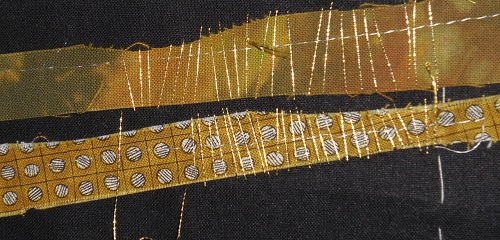
Raw edge applique with gold sample – white machine basting is removed after gold stitching is completed
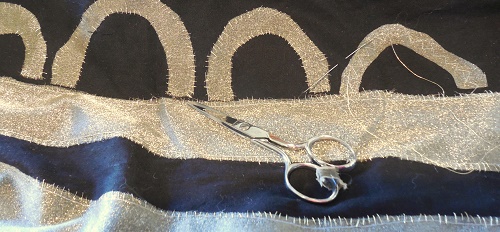
A large hand stitched work, approx. 2m x 90cm , work in progress. Basting to be removed.

Once I’ve worked through the design phase and made all relevant decisions, I then stitch along, by hand or machine, listening to a recorded book or books, until I reach the end of the project. This one will need several more lengthy audio books! I’m currently learning more about the operational skills of a successful burglar in The Burglar, a thriller by Thomas Perry. Interestingly, this year I’ve finished very few of the paper or kindle format books I started, but that’s OK. I think it’s far more important that we each do what feels best to help ourselves cope with this pandemic.

So that’s it for today – it’s warm and breezy outside, I have some hand sewing to take out onto the patio with me, and as we get to lunchtime on this saturday, I will be ready for a glass of white wine. Cheers!

Sort Of Food Related …

I’m pretty sure I’ve eaten frogs legs at least once in my lie, and think I recall the meat was rather like chicken. It never occurred to me that their skins could be tanned and make lovely fine leather, until in May 2006 I received a few frog skins – hides? as a gift from a Uruguayan fibre artist. I must say I’ve never wondered what happens to the rest of the frog, either – I mean, now I think of it, I’ve never been offered frog stroganoff with rice, or roast frog served on stir fried veggies.

Frog skins, ~12-15cm x ~~6-8cm. Note – the ‘frilly’ sections where the legs join the body will iron flat.

Anyway I’ve kept these interesting skins, and pondered occasionally what to do with this beautiful fine leather, but recently when inspiration came I couldn’t find them anywhere – until today, when they suddenly just appeared, on the floor, around the back side of my cutting table where I almost never walk, so I think they must have been dislodged from within a little pile there on the corner of the table. Anyway, they are now found, and one thing I determined right away was whether this leather can be ironed – there’s a kind of frill from that bit where the limb joins the body, and it smoothes out under the iron, beautifully. Looking up an old (2006) post in my original blog that has become my visual diary, I found a post on the frog skins, but more interesting was this P.S. I added to that post a few days later. Receiving them reminded me of an appalling but very funny experience Mike and I had one night in 1992.

I had accompanied Mike on one of his periodic business trips to Uruguay, visiting from where we then lived in Denver CO. It was lovely clear night for driving, and we were on a beautiful new modern highway, heading south towards Montevideo. Suddenly on the road in front of the car was a splat of something that looked pinkish, lumpy and yet liquid – quite like a huge pile of vomit really, then another splat, and another, and then it became a trail down the middle of our side of the road. Mike did a good job of carefully straddling it and not sliding in it as it just went on and on. It was just amazing – eventually we stopped the car to see what it was – fish guts, absolutely, no doubt about it. It was probably on its way to a processing plant to become fertiliser or stuff to go into animal feed. We continued on and then passed a group of houses with people standing outside, very puzzled, no doubt pondering the difficulty of getting rid of it, and worrying what it would pong like over the next days whether they swept it off the road or left it there …. and still the trail went on. A police car ‘raced’ past us… and another…. and finally, after about 30KM, I kid you not, there in the middle of the road were police and other people, no doubt including the hapless driver, all standing around a huge tanker truck. Clearly the trapdoor had come loose, and the whole load had gradually emptied out onto the road.

Back in Montevideo we drove through some very deep puddles to wash the underside of the rental car. But, pheeeeew! by the end of the next day the stink was terrible and we simply had to turn that car in for another – of course splatters got up into the engine and all kinds of places, didn’t they? I doubt that vehicle was ever the same again no matter what they tried to do with it, as I’m sure every time the engine warmed the horrible smell would return.

A Morning Outing, 2

On friday morning last, I needed to go shopping or run a few errands as our American friends say. My favourite specs had to be realigned after I sat on them. I needed certain sewing needles and some embroidery threads in blues. From the stationary shop I wanted blue acrylic paint and printer inks. I wanted a few non-medicinal things from a large pharmacy chain that stocks different lines from the smaller one we have barely 100 steps from home. I hadn’t been into a mall for several months, and really felt the need to browse a bit while hunting for some new joggers.

This paragraph sounds a bit Jane Austenesque, a modern version of a passage in one of her famous novels that all detail the minutaie of daily village life in Regency England. Mike offered to ferry me around – parking in Carrasco’s a total nightmare these days and I have difficulty driving our vehicle, anyway. The first stop was the merceria, haberdashery store. It’s probably been there for ever, as on an early visit to Uruguay in about 1990, I shopped there for safety pins and hand sewing needles. That was an interesting experience, knowing as I did perhaps 30 words of spanish at the time. Someone probably helped me with the basic words, I guess, and then summoning up my courage, I ventured into the shop to buy what I needed. The shopkeeper took out a packet, opened it and asked how many I wanted, and I thought she was asking how many packets I needed. I was hand quilting a big project at the time, and as needles do wear out and get lost, I thought two packs would be a good idea, JIC, just in case, and responded with “Dos, gracias.” (two, please) To my utter amazement she selected two needles, placed them on a small piece of blue butcher paper, folded it up and looked up signalling she was ready for my next item, safety pins. No surprises there – the group of about 10 were all locked onto one pin. So last friday, as we neared the shop, I reminded Mike of that story, and hopped out.

In all the years I’ve been living in Uruguay, every time I’ve returned from Australia or the USA I’ve always brought back some of my preferred brand of thread in the basic colours I use most of, plus packets of machine and hand sewing needles. I have a good stock, JIC, and honestly doubt I’ve bought needles here in all that time. The woman who served me was possibly the daughter of the woman who served me 30 years ago, but I have to tell you that in that merceria, anyway, the system remains unchanged, and again I was blown away !

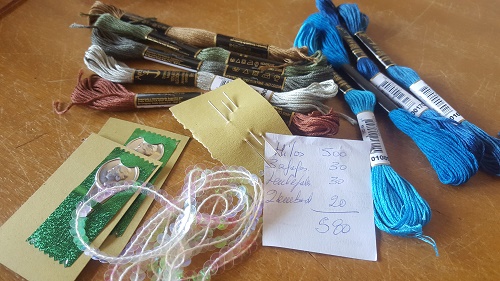
As you can see, I bought 7 skeins of embroidery thread, 2 needle threaders, 1m of pearlescent sequins and 3 needles. The total came to $U580(pesos) or US$13.60, meaning the needles were about US 23c each.

According to the docket, the needles cost $U 10 (pesos) about US 25c each. There were several drawers and boxes of packets of needles, but they weren’t out on display, and I’d loved to have had a rummage. However, this time I could ask why she sells needles individually and not in packets – and her answer was because they’re imported and therefore expensive. I should have realised.

Capers, Yummmm

Endive leaves with cream cheese, smoked salmon, capers and lemon wedges.

Last night we had some smoked salmon on endive leaves with cream cheese and capers. Mike noticed this new Uruguayan product in the supermarket, and bought some to try because we’re always keen to support local products when available. Verdict – being fresh not frozen, it was smooth, tasty and sliced a bit thicker than the imported frozen Scandinavian one we’ve bought in similar sized packets. It’s a little more expensive, but it was so nice we’ll buy it again. He noticed smoked Uruguayan sturgeon is now available, too, so we’ll try that sometime soon.

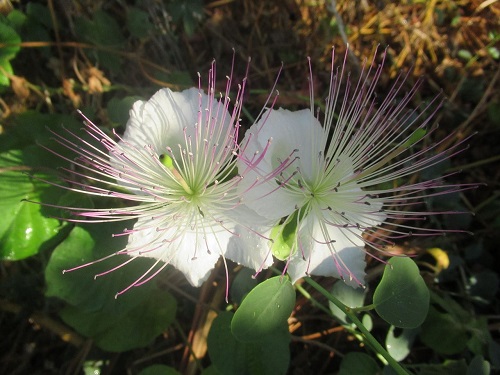
Just by coincidence, yesterday on the FB page for people doing the Stitch Club workshops (which I mention here frequently) a student in the current workshop posted some photos of the plants she’d found locally and was planning to use in her project. This gorgeous pic really caught my eye, and I was delighted to read it is the flower of the caper bush – we use capers a lot in our salads and some dishes.

Flower of the caper bush; photo courtesy Jane Waterland.

Pleased to find the capers I enjoy so much have such a lovely flower, of course I went to wikipedia https://en.wikipedia.org/wiki/Caper where I leared a great deal about them. Capers are the buds, which if not harvested and pickled at that stage continue to flower and form the fruit ‘caper berry’ . You can just make out two green unripe caper berries on their long stems in Jane’s photo.

Wiki goes on and on – there is an amazing amount of info about these pickled plant parts that we enjoy but I had no idea about. Scrolling down there are sections on propogation, setting up an orchard, capers in history, and alternatives (include marigolds and nasturtiums) and more. Mike commented just now that he’s asked at several nurseries in Montevideo, but so far hasn’t found any caper bushes for sale in Uruguay. Time to put the feelers out; our friend Stephanie recently found us a gooseberry bush that is doing really well in a large pot on one of the upstairs balconies.

Moving On From The Callesen Workshop

The 2-week Clarissa Callesen workshop concluded at the end of last week, and the Stitch Club schedule has moved to a Vinny Stapley workshop. It all looks lovely, but I have put it aside for a while, as I’m more focused on a project of my own right now. One of the terrific aspects of The Stitch Club workshops is that you can download each week’s workshop video, project work book and Q&A sessions, and go into them later when it’s more convenient. Clarissa’s was terrific – and I completed two works, each in the 10cm x 15cm range.

This workshop reminded me of stuff I did years ago but haven’t pursued, and both of course decorated by hand stitch, which is one of the major themes of these workshops. In this pandemic, I am one of the fortunate ones who has extra time to spend doing hand stitch, which I love.

I’m helping on a committee that is organising an exhibition in conjunction with a SAQA Oceania Regional conference in NZ in May, 2021. It has a theme, “Oceania: Distance and Diversity”, and though I’m not a big one for themed exhibitions, this one is broad enough that I can continue on with art I enjoy making and have it fit into the parameters of this entry call – 40cmh x 60cmw, while obviously being an ‘art quilt’ under the accepted SAQA definition. I’m planning a piece that includes tiny pieced landscapes against background, inspired by a line in our national anthem – “Our home is girt by sea…” (which could apply to all 14 nations in the Oceania region)

I love working this way, as there’s something very zen about sifting and selecting colours and textures, strip by strip, to compose a tiny landscape. There is no pattern for this kind of thing – it’s what I refer to as freehand piecing , better known as improvisational piecing. Basically for every seam select two pieces of fabric, place one on top of the other both right sides facing upwards, and rotary cut through both at the same time, sew, iron and repeat, seam by seam v- detaild instructions + diagrams are in the above link to my textile art related blog. My iron’s within reach, just beyond the RHS of the photo. At this scale it is certainly fiddly, but listening to an absorbing Harry Hole mystery (Jo Nesbo’s “Knife”) I really don’t notice the time passing.