

Last night we had some smoked salmon on endive leaves with cream cheese and capers. Mike noticed this new Uruguayan product in the supermarket, and bought some to try because we’re always keen to support local products when available. Verdict – being fresh not frozen, it was smooth, tasty and sliced a bit thicker than the imported frozen Scandinavian one we’ve bought in similar sized packets. It’s a little more expensive, but it was so nice we’ll buy it again. He noticed smoked Uruguayan sturgeon is now available, too, so we’ll try that sometime soon.
Just by coincidence, yesterday on the FB page for people doing the Stitch Club workshops (which I mention here frequently) a student in the current workshop posted some photos of the plants she’d found locally and was planning to use in her project. This gorgeous pic really caught my eye, and I was delighted to read it is the flower of the caper bush – we use capers a lot in our salads and some dishes.
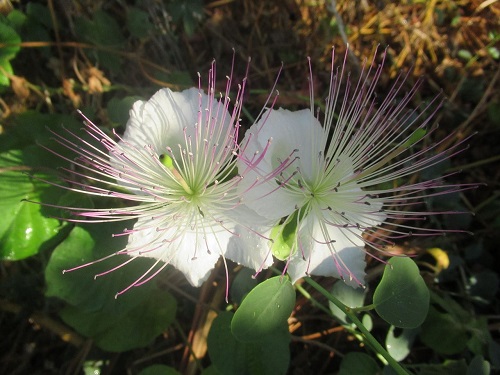
Pleased to find the capers I enjoy so much have such a lovely flower, of course I went to wikipedia https://en.wikipedia.org/wiki/Caper where I leared a great deal about them. Capers are the buds, which if not harvested and pickled at that stage continue to flower and form the fruit ‘caper berry’ . You can just make out two green unripe caper berries on their long stems in Jane’s photo.
Wiki goes on and on – there is an amazing amount of info about these pickled plant parts that we enjoy but I had no idea about. Scrolling down there are sections on propogation, setting up an orchard, capers in history, and alternatives (include marigolds and nasturtiums) and more. Mike commented just now that he’s asked at several nurseries in Montevideo, but so far hasn’t found any caper bushes for sale in Uruguay. Time to put the feelers out; our friend Stephanie recently found us a gooseberry bush that is doing really well in a large pot on one of the upstairs balconies.