“Nothing Stays The Same For Ever… “

… is one of my oft-declared mantras… and since my last post there seems to have been more change than usual. I began this post a few weeks ago and it was put side for some Life stuff.

In many corners of the earth there are serious floods, fires, storms, droughts, attacks, skirmishes, invasions and all out wars – which in Ethiopia is now accompanied by spreading famine. There have been the usual departures of beloved world figures including celebrity writers and performers. Thanks to NASA, we’ve begun to receive brilliant, unprecedented, photos of what space looks like when you get way, way out there! Amazingly, a satellite sent up into the skies late late year collided as planned, with a small meteorite about the size of The Great Pyramid, both objects hurtling through space at just 14,000 miles an hour – mind blowing. The past two and a half years of Covid pandemic has exacerbated normal levels of problematic difficulties affecting parts of the world at any one time. In so many places around the world, people have taken to the streets, and in Iran both men and women are braving the authorities by open noisy violent protest against not just the death of Mahsa Amini in the hands of the dreaded Morality Police, but this unrest is spreading nationally and internationally, and is about more than ‘just’ the wearing of the hijab by Iranian women. And, of course my comments include the terrible war being waged by Russia against Ukraine, with resulting severe destabilisation of much of Europe and the Western world.

But in the last few months, the single event with the largest impact on the most people has been the death of Queen Elizabeth II, after her remarkable 70-year reign, celebrated in June with several days of Platinum Jubilee events in the UK, and all the Commonwealth countries. Queen Elizabeth’s death was followed by days of ritual, pomp and ceremony, covering her funeral and burial, plus at the same time, defined by detailed and historically significant minutae, the process of her son, Charles ascending the throne and becoming King Charles III. The TV commentary particularly on the BBC was fascinating. Additionally, we had endless discussion about particular royal family members, often accompanied by speculation where facts were not known, about the related adjustments to the line of succession, and the shuffling of titles and accompanying changes in roles and duties.

Even with my personal republican inclinations, the passing of this most unswervingly dedicated, long-reigning queen is one of the most significant historic events in my lifetime. I was a little girl of 5 years’ age when Mum announced one morning that The King had died, and Princess Elizabeth had become Queen Elizabeth. I barely understood all this princess and palace stuff and had no idea what a coronation was, but in the following 16 months until that event, I took a great deal of interest, and was a full bottle on The Royal Family by the time of QEII’s Coronation Empire tour which brought her to Tasmania, our corner of Australia. There was no TV in Australia then, so besides listening to memories and information from my grandparents, parents and their siblings, I consumed a steady diet of pre-coronation and Royal Family articles in the Australian Women’s Weekly, and we listened to radio. I remember leaning on my elbows spread out on the floor in front of the radio and following the whole coronation thing with a magazine centre spread of an illustrated map of London. I followed the commentary avidly as she set out in the magnificent elaborately beaded gown, in the golden coach with Phillip at her side, riding from Buckingham Palace, along various streets to Westminster Abbey. From there someone described the whole scene of courtiers, lords, local and European royals and Empire VIPs. After the long service and crowning ceremony the procession wound through the streets back to the Palace for the Balcony Wave to the assembled cheering crowds.

On August 28th last, in breaking news on all major networks, around breakfast time here in Montevideo, it was announced that doctors were concerned for the Queen Elizabeth’s health, and at she may have already been dead or about to pass, but it was not until early afternoon here that her death was officially announced, as there were many groups of people and authorities to be officially informed: the Royal Family itself, The Palace, the British Government, the governments of those commonwealth countries of which she was Head of State (like my own, Australia) the Anglican Church, senior military, police and security forces, and more. Special programs began appearing on our TV screens once her death was officially announced, and continuous coverage began and continued, on and on and on, for days, in all the print and digital media formats you can think of.

She’d steadfastly reigned and ‘been there’ for so long, that it was easy for people to assume she’d be there for ever and so many people expressed the shock they’d had. There was so much ceremony, beginning with lying in state in Scotland, followed by transportation down to London, the 4-days of lying in state for the general public to pay their respects. ‘They say’ over 250,000 people queued for many hours, in a line often 10 miles long, to pay respects to her coffin lying in state. I imagine it might have been more. The commentators were marvellous, informing us of all the detailed arrangements for her funeral and burial.

It was an important world scale event, and I did admire her, sharing with others considerable sadness at her departure. But, honestly, though it was all fascinating, and I’m grateful for modern TV being able to bring important events right into our living rooms, I was seriously overdosed, quite exhausted, by the first few days of all this. So after that, until the actual funeral service and processions on Monday September 19th, which I watched in full, I resorted to edited highlights each evening, and was hugely relieved when the BBC and CNN returned to regular programming on 20th. That didn’t last for long though – Hurricane Ian, force 4, then swept a devastating path across Cuba and Florida bringing havoc to Atlantic coastal areas, and (just for a few days) breaking news coverage again shoved normal programming aside.

The process of constant change around us has been the essential theme of much of my art, particularly for the Ebb & Flow series of art quilts which I doubt I’ll ever complete and abandon. Just this week I again used the wandering lines that in my mind characterise change, in the making of this years small donation to the Spotlight Auction that takes place at the SAQA annual conference – I’ll publish the online link closer to the time – but here’s the image of the work I put together:
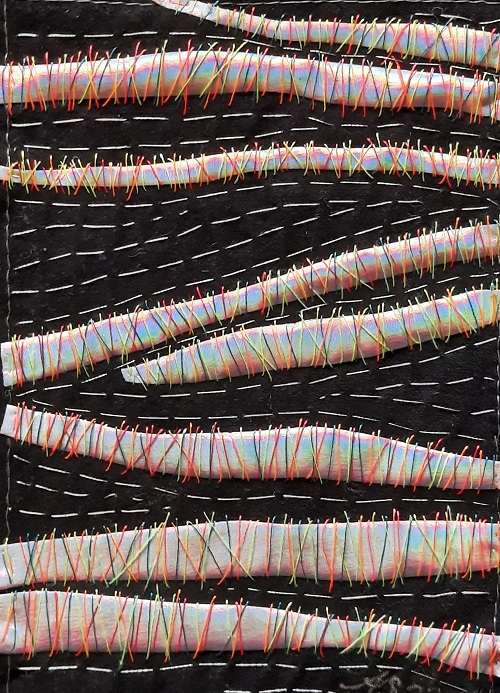
Ebb&Flow 30, 6in x 8in. Donation to the SAQA Spotlight Auction, April 2023.

Life Can Be Untidy And Complicated

In late late 1997, Mike and a colleague were funded by a group of Australian investors to search for gold in Uruguay, start a company to mine it, and hopefully make everyone a bit of money. That stake money was for hiring a few people here and carry out mapping and sample surveys, certainly not for moving the Schwabe’s household stuff to the other side of the world, and just then we couldn’t afford it ourselves. Our lengthy experience in the mineral exploration industry had long ago taught us that any speculative venture of this kind could all suddenly end, and so we decided to leave our house ready to walk back into if needed. After all, as Mike confidently claimed back in 1997, it was going to be a quick job, in and out, just two or three years…. yet here we still are.

So began a series of house sitters, beginning with the daughter of a friend, then her friend, then Mike’s niece who began sitting while studying nursing. She was followed by several more sitters in turn, always on personal recommendation from someone we knew, and each did a wonderful job living in our house, using our stuff and taking care of everything. It was an unusual arrangement in the details, but it worked well for us. Time rolled on, the place was always in good order when we turned up for a visit. The final sitters were unwed when they first moved in, but by the time we sold 7 or 8 years later (to them), they had produced three young children, and of necessity acquired more stuff, as you do. One reason we sold was because apart from needing to do some serious upgrades to bathrooms and the kitchen, now being decades older we’d realised we’d buy a different kind of house in 2020 than we did in 1994.

The full story of this quilt, is at http://www.alisonschwabe.com/weblog/?p=1503 It hung along a wall upstairs in our Perth house.

We had everything coordinated to quickly work through the house to clear our stuff out of drawers and cupboards and the places where it had gradually migrated to over the years. Not surprisingly, my sewing room in particular was loaded with stuff that had gradually been moved there to free up living space in the rest of the house. We had only a few days to get our stuff sorted before the packers were due, so we worked hard and fast with the help of a friend, discarding and donating mountains of clothes and household stuff – the removal company packed them in donation boxes which they delivered to charities. We got a bulk bin delivered to the front lawn and filled that with rubbish for the tip. After those few days the packers arrived, deftly packed all that was left including our best furniture and goods, and sent it on its way to the removal company’s storage depot to await our next instructions. Three years later those have not yet been issued!

Anyone who has downsized will confirm that you always save things that eventually you hand on or throw out, so we realise we’ll dispose of more stuff as/when we unpack again. I didn’t have the time to go through my sewing room as I’d have liked to, but I can vividly picture what was there. On visits back to Perth I often brought a few things back with me, notably favourite fabrics which I tore in half and left one part behind. I brought over just a few special books, and had magazine subscriptions redirected. Now I only subscribe to digital editions of fibre art magazines, and there’s so much other interesting stuff online, anyway. It’s years since I bought a textile art book, and here in Montevideo I’m probably ready to pass some or many on. I should organise a book sale…

In that room were also some lovely linen and Aida cross stich fabrics in several colours, all of which I’ve kept for the 30+ years since my cross stitch phase. There was a decent sized drawer of embroidery threads, including the Danish Flower Thread I was so fond of using back in the early 80s before we went to USA and I became immersed in quilt making. Who knows, I may again be interested in cross stitch, but if not, they’ll be snapped up by someone in the embroiderers guild or similar groups.

Jessica Grady – A Terrific Stitch Club Workshop

I recently signed on for another 12 months of Stitch Club workshops – go here for more information about it. My regular readers will remember this monthly subscription is my Pandemic Treat to compensate a little for not being able to socialise normally or travel to visit the offsprings. The cost is approximately equal to 2m of good quality fabric that I’d buy in a quilt shop if I could get to one! Though having said that, my work has changed so much, that it really doesn’t matter at the moment that I can’t buy quality cotton fabrics here in Uruguay. I’m using other stuff though perhaps not for the purposes I originally intended them to be used.

This is the first workshop I’ve done this year and it is a blast. Jessica Grady is a UK textile artist who uses a wide variety of waste materials to craft her highly textured embellishments she puts onto her fabric compositions with stitch. This first pic is the materials I gathered up in a few minutes rummaging around in my studio:

Card, several plastic things, bits of fancy fabrics whose planned use I never got around to, little gold stars, tea bag made of mylar, clear plastic marked with permanent pen. the green unwoven fabric lined a gift hamper.

She devised a set of little exercises for us to cut up shapes from out materials and layer them fastening with stitches and knots:

One of the great things about the Stitch Club workshops is that every workshop has a page where people can put of photos of what they\re doing or have finished. One fellow student cut some rectangular and square shapes from glossy cardboard, perhaps a shoe box or something, and using heavy bright thread stitched them all down in an overlapping mosiac kind of arrangement. That struck me as something that could be done with small fabric shapes as a surface design or texture on an art quilt/textile wall hanging, and so I did this little sample to capture that idea.

Shapes held in place by straight stitches, finished with a french knot in the centre. The stitched area is approx. 4cm x 5cm.

And somewhere in all this it occurred to me that cutting mylar tea bags into shapes for applique could look interesting, too –

A Chilled Soup And A Stitch Club Workshop

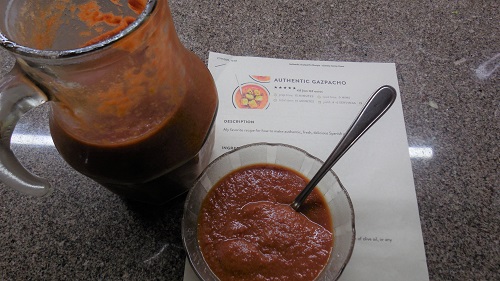
Warmer/hot weather has reminded us this week that summer’s almost here, and a couple of days ago it made me think of Gazpacho. This wonderful chilled Spanish soup is made of pureed tomatoes, red and green capsicums, cucumber, fresh garlic, some sherry or wine vinegar, onion, a slice of sodden day-old white bread without crusts for thickening, S&P to taste, and a few other ingredients. Very Mediterranean and no doubt healthy. I zoomed it all up in the food processor. and because it’s too early for my favourite Roma tomatoes, I used a jar of tomato puree instead.

As I write this post I’m waiting for the soup I made a couple of hours ago to chill down further for a light dinner tonight. We’ll sip as we watch our current Netflix serial – Season 3 of NARCOS Mexico. Gripping. It’s a shame it’s not stinking hot, but we’re having it anyway. I haven’t made croutons, but might whip up some toast if Mike wants it, otherwise, no. It will be on the menu regularly now that summer’s almost here.

In the past week, prominent UK textile artist Emily Jo Gibbs has been presenting one of the Stitch Club workshops. She uses layered sheer fabrics to provide areas of colour and adds beautiful detail using fine threads and various stitch techniques. Her intricate studies of people and still lifes are quite detailed and delicate – qualities most people would not normally associate with my work, but I’m loving this workshop anyway! Emily hand stitches with a single thread, usually sewing machine threads, achieving very fine stitch patterns.

  • It was suggested we tackle two exercises, each approx 8″ x 10″
  • the first of shapes arranged into a composition and the raw edges stitched down into place;
  • and the second ditto, but with a layer of organza over the top of the whole arrangement to contain the raw edges without necessarily needing to stitch on every edge. Of course, the overlay somewhat mutes the colour beneath.
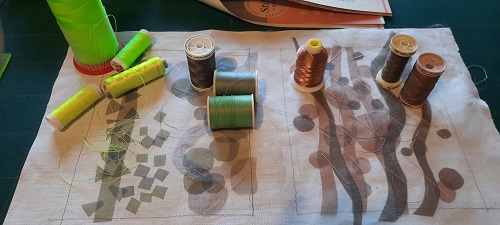
Thread auditioning for the two compositions

I auditioned some threads, thinking the raw edge one (on the left) would be nice with my trusty florescent neon threads, and on the other I’d use metallic and plain threads.

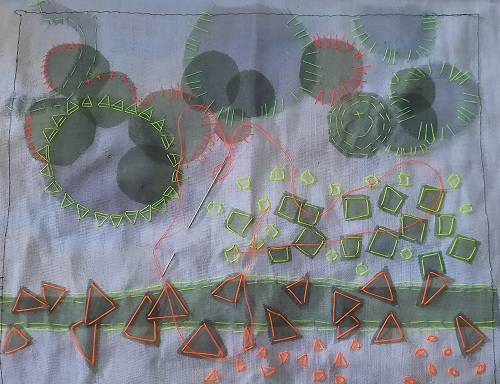
The stitched composition with raw edges – the background is actually white – sorry about the bluish cast.

In my first exercise, I’m essentially building on some of the samples I made in my SAQA 100 Day Challenge, about which I regularly wrote about on my other blog, http://www.alisonschwabe.com/weblog/?p=7124.

Second composition under a top layer – metallic stitching started but I’m not really enthusiastic with it yet.

This second exercise is currently not exciting me too much yet, but I’m thinking about it and will finish it off this week with the fine stitch patterns it needs. When I’ve achieved that, I’ll call it a day. The workshop’s second week explores painting on overlays to increase complexity in designs, but I’ll pass on that bit, being keen to continue with the surface design of the new piece I’m working on:

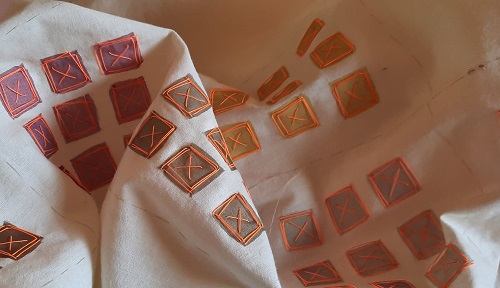
A new work in progress – surface design of squares approx. 1.5cm, fused to the cream fabric, and then stitched with heavy duty neon nylon thread.

Much more information on this new work is on my other blog, at http://www.alisonschwabe.com/weblog/?p=7124

In the 100 Day challenge, I found that small squares in paint and organza with a single stitch around each edge really appealed to me and have become a bit of an obsession 🙂

From Day 100 – stencilled squares, stitched with metallic thread. 3.25sq.in

A Recipe From My Teen Past

For no particular reason that I can think of, a few months ago I thought back to a recipe that one of my best school friends’ mother used to make so often that whenever we turned up at Caroline’s house, there was always some in their kitchen or on the afternoon tea table. I possibly have the recipe in storage – but it’s been so long since I’ve seen most of my recipe books that I don’t recall, and who knows when I’ll see them again?

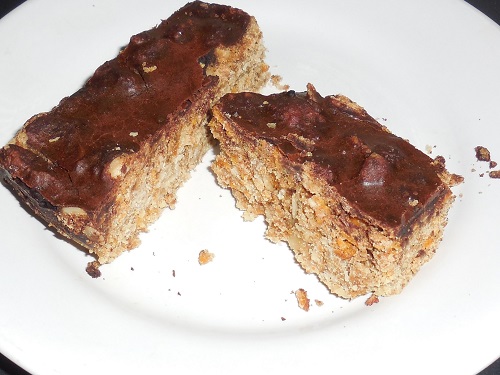
When Caroline recently turned 75, and her husband sent photos of the party we’d have attended if we’d been on the other side of the world, I suddenly wanted to make some of Mrs Fletcher’s Chocolate Iced Biscuit Base, so I emailed my birthday wishes and at the same time asked if she still has that recipe. Back came a scan of a well-used page in Caroline’s handwriting, and within a couple of days I had made it, and I knew as soon as I could smell it cooking that it was going to turn out perfectly! Well, actually, even though you could hardly go wrong with this, I do confess since it said “mix all dry ingredients” I blithely tossed in the cocoa instead of keeping it aside for the icing! But anyway, I melted a bit more butter, and measured out more cocoa for the icing – and it still tasted like I remember from all that time go. Containing rolled oats, cornflakes, brown sugar and butter, it’s very like one of those breakfast or snack bars around these days, but of course it contains all natural ingredients, just as our mothers always used.

Mrs. Fletcher’s Choc Iced Biscuit Base

Mrs Fletcher’s Choc Iced Biscuit Base

2C cornflakes, 2C SRF

1C coconut, 1C rolled oats

1 1/2 C brown sugar, 10oz melted butter

Mix all these ingredients, add melted butter and stir in to bind. Spread mix in baking dish, and bake at 350F for 1/2 hour.

While still hot, spread with this icing: Sift together 1 1/2C icing sugar, 2T cocoa, 1t instant coffee. Add 2-3 drops vanilla essence, and some boiling water (start with 1T, adding more gradually)

Stitch Club Workshop – Shelley Rhodes.

The workshop just ending has been particularly inspirational. Shelley Rhodes is a UK fibre artist whose mixed media work features fabric+paint+ various markings+stitch. Shelley suggested we chronicle a walk, and that there were various ways people could approach that – by going on a particular walk, recording markings of lines and shapes on our prepared fabric, do the same from a remembered walk, and for the mobility challenged a stroll in our own garden or nearby local park would serve the purpose. I referenced some of the many photos I’ve taken on my walks along the Carrasco beach down the years.

One of the things were were encouraged to explore was using some related text or written words. Our line and texture markings were to build an abstract, non pictorial record of patterns of lines and shapes we saw on our particular walk. Some people’s results were very successful, but others found doing anything non-pictorial very difficult.

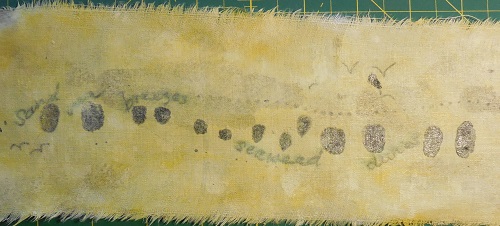
In this first pic, I did some sand ripple markings and a few ‘beach’ words, but they then blurred when I added another layer of paint over them.

By that time, too, the paint had made the fabric too tough for me to hand stitch through, so I resorted to free machine embroidery:

Painted and free machine stitched, ~5cm x ~25cm

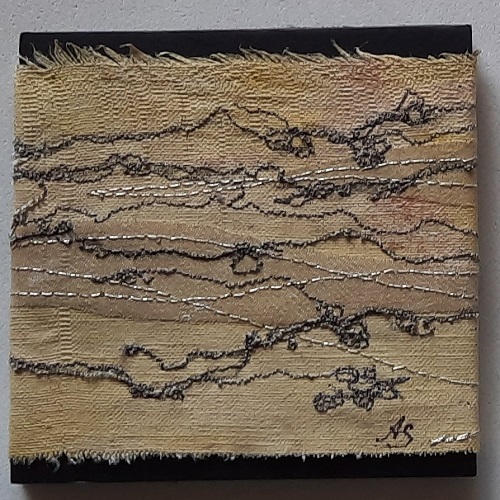
The next couple of pieces were both cut out of another long strip, again too stiff to hand stitch through, so I machine stitched. Each section was mounted over foam core, which I didn’t realise came in colours until I went to buy some last week. Naturally I chose some black in addition to the white, and love the effect of the torn edges against it. I made a note to tear and possibly fray more thoroughly before painting in future.

The small size, 3.25sq.in, of these two pieces, is so that these little samples also fit into the 100 Day Challenge I’m participating in with SAQA Studio Art Quilt Associates.

I’m posting many of these on my instagram page @schwabealison, as the challenge’s FB page is only visible to participants. I’m killing two birds with one stone here...

Pandemic Treat Workshop (Gwen Hedley) Plus A Great New Foody Travelogue Program

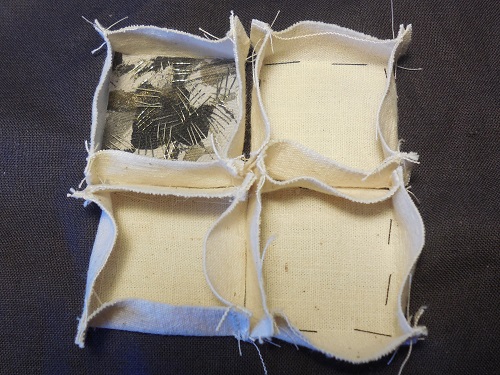
We began Gwen’s workshop by painting marks on fabric in 2 colours and then cutting sections, overlapping them and using stitch to blur the boundaries between different colours. A detailed account is on my other more textile art related blog. Where I became waylaid was trying out a presentation idea I discovered on Pinterest months ago, feeling this could be a good time to have a go at it. I’m very pleased with the result, and can envisage a whole lot of little shadow box things with paint and/or stitch squares tucked into them and fastened to the base.

With various projects in progress, I have found it ok to watch workshop videos but I don’t always follow through all the suggested classwork. Quite a few of the lesson technique topics I’ve ‘done’ over the decades I’ve been making textile art, but the videos and Q&A sessions are important, because there’s always something new to be learned from every teacher. Gwen Hedley’s art has always been a favourite, and I did tackle her workshop, though I got a bit waylaid with the presentation aspect.

After weeks of promotional publicity by CNN for a new series, this morning we enjoyed the first episode of Searching For Italy featuring American Italian Stanley Tucci – a hugely informative program, food/culture/geography/travel, with segments on Naples and places up and down the coast, mostly. In the poorest section of Naples a new cuisine is emerging as Romany immigrants and very poor Italians on the edge of the city working together developed a very successful food kitchen sharing recipes, and which has turned into much more than a local food kitchen. It is now stil la food kitchen for the poor, but also a very popular large restaurant business the profits from which provide funding and facilities of child care for residents’ children- amazing. The whole Campania region was enthralling. We learned that pizza was more like an empanada originally, and deep fried to prevent people becoming ill during cholera epidemics in C19 and early C20. It was fascinating to see how Stanley’s pizza expert mate made the pizza base – flour, water, yeast and salt – adding only fresh mozzarella, San Morenzo tomatoes salsa, and a little freshly grated pecorino cheese. I’m going to give starting from scratch a go sometime soon. We’ve often been puzzled about what passes for “pizza” here in Uruguay, where a big portion of the population has Italian roots – but this explains the absence of the large variety of toppings that typically adorn the North American style pizzas we’re more accumstomed to, and that we ourselves assemble. We saw how it important rabbit is and how it’s cooked on the island of Ischia off Minori on the Amalfi coast, and being afficionados of rabbit, which is farmed and available for sale here, we’ll have some of that very soon: it’s winter, time for some.

It was a nice way to start the day, but it will be repeated at other times, too, and we don’t really want to get into watching TV still in bed from 8-9am on weekday mornings – but, on the other hand, why not? The pandemic’s still on. It is still bad here, with most departments still in the Harvard Index red zone, although numbers suggest there’s an over all gradual decline. Vaccination is being rolled out fast and efficiently, and taken up with good responses, over 70% of the population have received at least one shot, ~40% both. Mike and I got our second shots last week, it’s a good feeling.

The Pandemic’s Progress, and Mike’s Easter Desserts

We spent our second Pandemic Easter in and around home, in the capital city of a country that was fast becoming the leader in Latin America of the number of new covid infections per 100,00 people, among the worst in the world. The numbers have now started to trend down, but as I write the whole country is still in the Harvard index red zone, which is a great shame considering how well Uruguay did all of last year until November, when the numbers began to rise, continuing through the summer. And all the associated statistics – numbers in intensive care, deaths, etc., followed with the time lag their numbers always show. Hardly surprisingly, the Brasilian variant has exploded here to be a major factor in that sudden rise. Found in just 15% of new cases in January, now, in early May, the variant is showing in 85% of new infections, which is why we’ve kept our heads down really low!

But, spirits lifted with the arrival of vaccines and commencement of the vaccination program at the end of March. This is starting to be reflected in the numbers now, oscillating but trending down. The distribution followed the same kind of pattern other countries are following, the very elderly and medical people first with and younger ages gradually. Our own age group, the 70s, had to wait a while until the Pfizer vaccines arrived, they being considered best for us. Mike and I recently had our first shots, and in mid June will get our second doses. It’s a good feeling to at last being able to look forward to a few months’ time which we’ll be able to have some in-person social activity including dining out and consider some activities like museum visits. I’m in no rush tohugh to return to theatres. I am postponing my haircut until after the post vaccination waiting period, by which time my hair will be shoulder length, way too long and the colour streak almost really faded, but then, I’m not out and about socially at the moment, anyway!

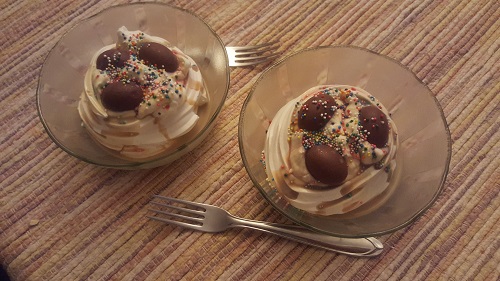
To treat ourselves at Easter we got a very nice chocolate Easter Egg, and some little individual ones that Mike used to decorate this dessert confeccion he came up with. He purchased some merengue cases, filled with whipped cream topped with a slosh of Kahlua. As the merengue cases were reasonably large, the cream was a bit much for me, but the combination of flavours including honeycomb filled eggs was delicious. Possibilities to explore here are smaller cases with perhaps fruit puree topping with a slosh of kirsch, or instead of cream in the centre making some patisserie cream topped by the fruit puree. Uruguayans would probably consider a layer of dulce de leche under the cream, but we’re not culturally adapted enough to consider that!

Eggs For Breakfast At The Schwabes 1

Some time back Ivan sent me this video on ways to prepare eggs: Every Way To Cook An Egg (59 Methods and if you have half an hour to spare on a rainy afternoon or something, I recommend this fascinating and at times hilarious video, with some great ideas and serious flops included – anyone for hard charred eggs from the Weber? Or how about, um, egg lattice, cooked rigid in a waffle iron?

Most mornings at chez Schwabe, we each arrange our own breakfast, and for visitors, depending on how well we know them and what’s going on, we encourage them to help themselves. Mike often poaches an egg on toast, or has some left over something on toast. My own normal breakfast, 6/7 times per week, is about 1/2 cup of toasted granola and a handful of toasted plain almonds topped with about 100gm, about 1/2 cup, of fruit yoghurt.

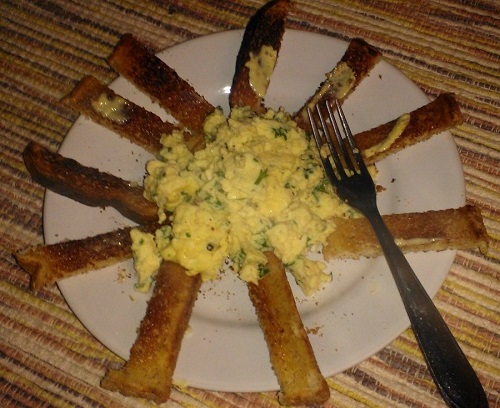
Now that we are both retirees, ‘weekends’ don’t mean so much as they used to when he was still working, but we do still tend to have some meals and other little rituals pinned to saturdays and sundays. Generally on one of those days we have a cooked breakfast, made by whoever has most hankering for their favourite egg dish. Mike generally makes excellent scrambled eggs served on toast. Sometimes there’s cooked tomato or bacon with it, but usually not. And, on cooked breakfast mornings we always have freshly brewed coffee, whereas my 6/7 beverage is green tea with a dash of orange.

Mike’s scrambled eggs

Mike’s scramblies are made this way – and I quote:

  • Put 2 eggs per person in a ceramic bowl,
  • add milk,
  • whisk,
  • then microwave at full bore for 2 minutes,
  • stir with a fork,
  • add chopped parsely,
  • cook 2 more minutes,
  • stir again with fork, and
  • if necessary cook another minute,
  • then serve on/with hot buttered toast, S&P or Tabasco to taste.

———————————–

I checked other people’s recipes on the internet, and the amount of milk or cream ranged from 1 tablespoon per 2 large eggs to 6 tablespoons for 4 large eggs, so obviously this is flexible, but my rule of thumb for good scramblies that don’t go watery at the end is “a little less is more” when adding milk or cream. And, of course, there are heaps of things you can add to scramblies, but we both like them straight, with a little S&P or a sprinkle of Tabasco added at the table.

Dragon Fruit and Pandemic Updates

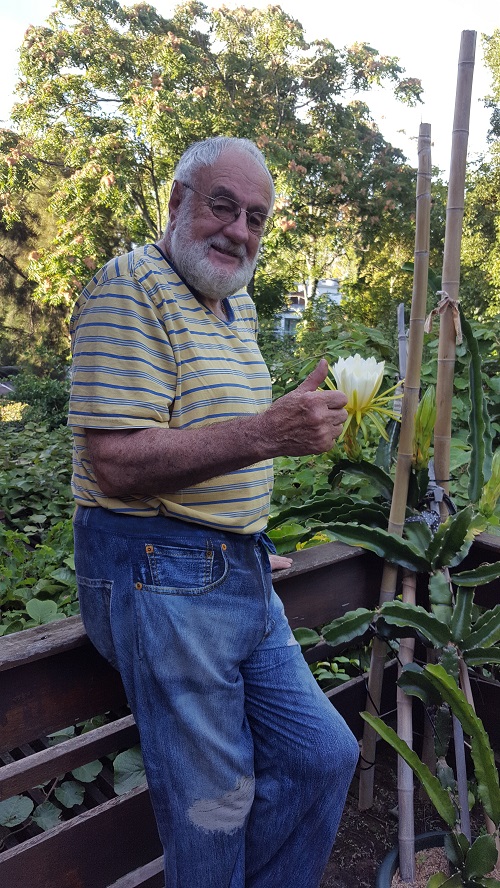
This time last year, Mike bought a couple of young Dragon Fruit plants which are thriving, side by side in pots on the terrace outside my first floor studio. He bought two different varieties, one with red fruit inside and the other with white. A couple of weeks ago, one of them produced 5 beautiful flowers, and one will open on the other plant in a couple of days’ time. However, we have no idea which plant is which 🙂 and whether these flowers will actually produce fruit, but we’re patient.

These next pictures are of Dragon Fruit that Mike recently bought from the market and ate – that’s a teaspoon beside it. I don’t especially care for them, but they’re quite beautiful.

I took this photo of the outside and the cavity left after eating the other half, purely because of the beautiful colour scheme potential.

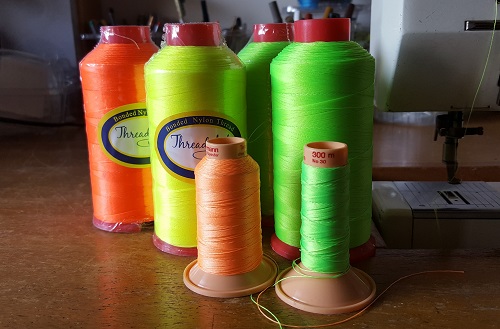
Since my last post, I’ve done a fair bit of stitching, making inroads to the 6km of thread, so now there’s a visible difference between the partially used cone of green and the untouched one, and I’m happy to say this quilt, Pandemic Pattern 4 is totally finished.

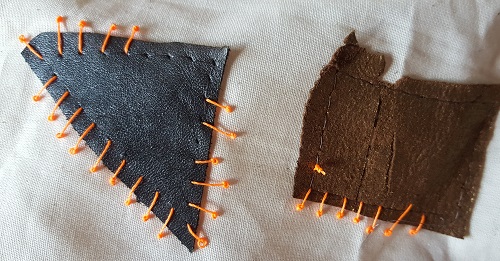
I’m sample making for the next in the series, which will feature appliqued leather coffin shapes with orange neon stitching.

In continuing pandemic conditions, there’s still plenty of stitching time as social activity is still minimal for our age group at least with the number of new covid cases has recently risen alarmingly here since January, and with the approach of Semana Tourismo known elsewhere as Holy Week, growing concern at the appearance in 6 or 7 departments,of the much more contagious Manaus variant, P.1. currently raging up in Brasil. The minute we could, we registered to get the vaccine, and are waiting to be allocated appointments.