“That’s A Real 60s Recipe… “

When packing our best stuff to put in storage after selling #3 Doric St. last year, I found and brought back with me the horseshoe my mother-in-law, Dawn, draped over my arm for luck as we walked back down the aisle as Mr. and Mrs. Schwabe on 11th January 1969. Our wedding photo is beside one of the horseshoe today. Probably there’s been some slow chemical action from the rusty horseshoe inside the satin ribbon covering it. Tiny safety pins still hold the ribbon in place, but the little bits of plastic orange blossom that used to hide them have gone. Now showing effects of aging, it’s still ‘lucky’.
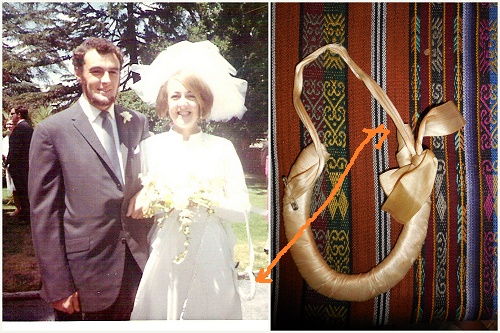
51 years on, the satin ribbon covered horse shoe shows a patina, shal we say, acquired over time since 11.01.69. It’s still lucky though.

On the night of our own 51st anniversary, last saturday we attended a party of Elizabeth and Pedro’s friends and family to celebrate their Golden Wedding Anniversary. They only decided at more or less the last minute to hold it, and consdering it was organised over just two days, helped by a lot of people, it was a marvel. As soon as the invite appeared on our Whats App screens, the mahjong girls immediately offered to each take whatever Elizabeth needed, and everyone else did the same. The order of the day was “finger food for appetisers, mains and dessert” so some of us took befores and others afters, and there was masses of each. The main course was choripan – bbqed sausage in a bun with optional salad pieces plus a couple of sauces, salsas including tomato sauce. People took salad crudites and dip platters, potato crisps, crackers and cheese, sliced salami and cheese, many lovely fingerfoods, including some spinach fritters with a tangy dipping sauce. But my cheese ball was the only one.

I bought about 400gm fresh parmesan, which we use instead of a tasty cheddar which we haven’t found here. As I was grating it all (food processor) I decided I’d use the whole lot, make two, keep one for us. (Note this freezes well for a week at least) In the end however, I thought considering the likely number of people, I’d make it all into one and take the lot. Good move as it happened – it was popular and all polished off by the end of the evening. Several people said how much they liked it, and someone commented he hadn’t seen a cheese ball for many years, calling it “a real recipe from the 60s”. Easy to make – can’t think why it hasn’t come to mind for decades.

To the grated tasty cheese in a large mixing bowl, I added a good quantity of finely chopped spring onion/shallott tops, about a cup of pickled red pepper/capsicums strips chopped, 2/3 to 1 cup of chopped green olives, some slivered almonds, about 150gm of roquefort cheese, a few good shakes of hot pepper sauce, and enough mayonnaise to bind that all up to a firm mixture. This one didn’t have ham, crumbled bacon or salami in it, but those are options. So is fine chopped and drained pineapple. Really, anything tasty goes well. The only hard work in the recipe is mixing it with a wooden spoon, but this could be squished together by hand, too. I lined a 2-3L basin with plastic film and firmly pressed the mixture into it.
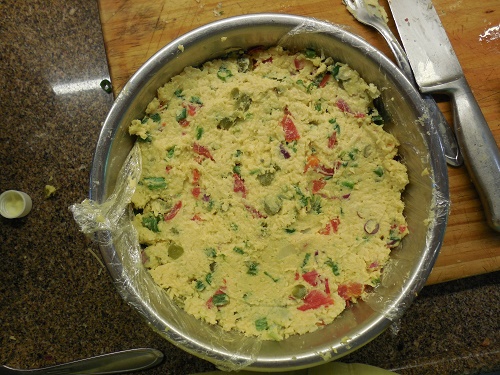
Considering we had a 1 and 1/2 hour journey on a hot night to get to the party, I then put that in the freezer for about 2 hours to firm up. Just before we left home, I turned it out onto a cutting board (put board over bowl, turn over and lift bowl off, leaving cheese ball on board) coated it with Philly light cream cheese (used a whole pack but did have one in reserve) and pressed crushed cashew nuts into all that. To transport it I turned it back into the bowl (do the bowl/cutting board manouevre in reverse) covered it with clean plastic film and placed it in a bag with a pack of crackers and a serving platter with my name on the underside. By the time we arrived, it had thawed, and it was but the work of a moment to assemble for the table. (once again, plate over top of bowl, flip over, lift and remove bowl) Wipe away loose nuts, surround with plenty of crackers. I’m sorry, you’ll just have to take my account of the making and presenting of it on faith, as I simply forgot to take any more pictures!

Several people told me they liked it, and someone commented he hadn’t seen a cheese ball for many years, and surely this must have been a recipe from the 60s? Ivan our chef son, said he remembered me making them occasionally when he was very young. In about 1967-8, I had a set of recipe cards for pre-dinner drinks and party nibbles, and this was my favourite. My fellow student flat mates and I were into nice, quality entertaining, where we dressed up in our long frocks and served martinis in recycled cheese glasses, accompanied by sophisticated nibbles before sallying out to ball for the evening. Long dress parties and balls were almost a weekly thing in those years.
Could I have Your Recipe, Please? #2

A while back I blogged on this subject and shared a family recipe known as Aunty Joyce’s Ginger Slice. I don’t jealously guard too many recipes today as now there are so many ways people find recipes and formerly exotic ingredients. The internet brings everywhere to us, and modern food distribution takes food ingredients into areas far distant from where they are produced, for use while they are still relatively fresh.

As I child growing up in Tasmania, I had never seen or heard of an avocado. I was aged about 30 in Kalgoorlie Western Australia when Mike brought two home from the fruit & veg market that cost $2 each, a lot of money in the late 70’s! Once over that sticker shock, and finding nothing in the cookbooks I had (where were very eurocentric) I went next door and asked a neighbour, Penny, who’d once lived in Fiji, how to prepare them. What she told me I still think is the nicest way to eat an avocado. She told me to cut them in half, remove the pip, cut diagonally crisscross into the flesh, sprinkle with a little s&p and a little white vinegar ad eat with a teaspoon. In Queensland during the Great Depression avocado was termed ‘Poor Man’s Butter’. They’re a lot cheaper these days, highly nutritious, and available ‘everywhere’. Of course we avo as a spread on crackers, toast or a salad roll, as is plain, or with a couple of additives. We’ve filled the cavity with spicy mixtures of crab and prawns. We’ve teamed it with goats cheese and wrapped parceled in smoked salmon. When we add fresh chilli, lemon juice, garlic, cilantro, finely chopped onion and tomato it becomes guacamole, which of course originated in Mexico and central America, and is now popular around the world.

I googled cookbooks in 2019 and from just skimming down the search results, key words like nutritional, international, expert, sophisticated, simple, happiness, healthy, ambitious, inspired and diverse pop up; so I gather that cookbooks are as popular es ever. In addition, there are all the popular cooking TV shows, often entertaining and always educational, featuring celebrity chefs who also put out books on their cooking philosopy, style of cooking, best recipes and views on nutrition. Nutrition is a big driver to recipe selection these days as home cooks want to prepare healthy nutritional recipes that look gorgeous. It’s popular to get a group of people together to go to a cooking /dining event where everyone learns and then eats together what they prepared. People go on cookery holidays, enrol in classes, and trawl the internet for recipes and online demos. Recipes are everywhere, and people are interested in experimenting with cuisine.

Which brings me to a recipe shared by a Mount Isa days friend, Christine, who made it for dinner while visiting us in Perth some years ago. Though I clearly remember how she made it, I don’t remember what she called it, so I just refer to it as that mascarpone and date cheese cake.

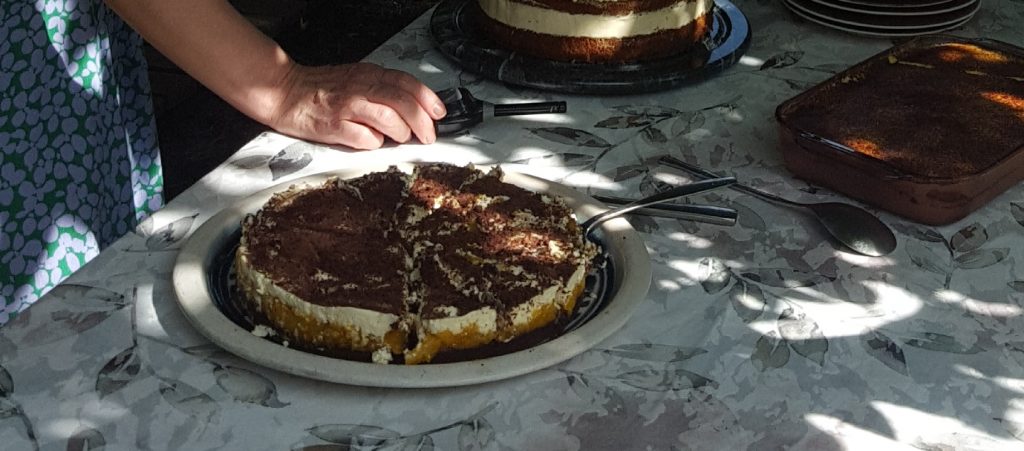
Mascarpone and date cheesecake – many variations by changing the fruits marinated in orange juice .

It’s always popular, and the last couple of years a couple of groups I belong to requested I bring it to our end of year luncheons. To make it, first reduce a pack of plain chocolate biscuits to fine crumbs in the food processer, (or however you do that) then add enough melted butter to bind it all together. Press into a spring form tin and put in the freezer to set firm. Overnight I marinate about 1/2 to 2 cups of finely chopped dates in orange juice, and drain the fruit well before spreading it out onto the chocolate base, covering that with room temperature mascarpone cheese topped with grated semi sweet dark chocolate. Dried apricots are a fabulous variation, and I’ve also done marinated sultanas, chopped dates, raisins and blanched almonds – sort of like a fruit mince recipe. The possibilities are many, therefore, and it’s original name and the quantities really don’t matter much. Chris is a keen gourmet cook, and has always used her many elegant cookery books (unlike yours truly who has some she rarely uses) and every time I make the original or one of my variations, I always think of her.

Fairy Bread Day 2019

Though we only heard of Fairy Bread Day, November 24th, a year ago, it’s an Australian thing now in it’s 24th year. Earlier this year I mentioned Fairy Bread in an article on the lost art of hand sliced bread. We both had FB ourselves as kids, and made it for our kids. Mike remembers when he was young helping Uncle Digger on the farm, that Aunty Betty would bring morning and afternoon tea out into the fields, and it would be FB, fresh scones and bottles of sweetened black tea. To celebrate FB Day, yesterday we had some FB out on the terrace with a glass of wine as the dessert course of lunch.

FB is so simple to make that a child can enjoy preparing it, as even the knife to cut it into the traditional triangles doesn’t need to be any sharper than the one that spreads the butter, so Twinkletoes can make a plate of it all by him/her self. FB is perfect for kids’ birthday parties, morning and afternoon tea, breakfast, midnight snacks, welcoming and farewelling events, school lunches, picnics, convalescent food, family slide nights – in fact any time is perfect.

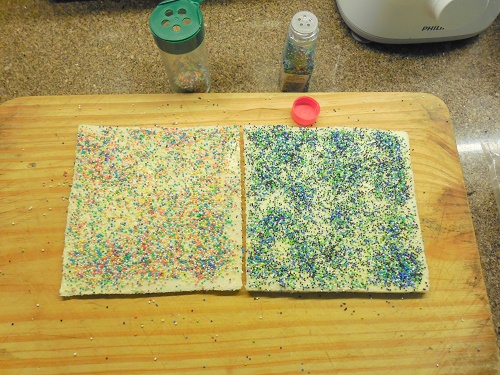
Purists insist that Hundreds and Thousands, 100s and 1000s, are tiny little balls of brightly coloured candy and are therefore crunchy, and I am a bit of a purist myself, married to another purist. However I recognise that many people prefer the stronger flavours of chocolate or coloured sprinkles. (the 1.5mm – 2mm long and pastel colours) And, in yesterday’s fairy bread, we used two sets of non-traditional 100s and 1000s Mike found in a US supermarket last visit.

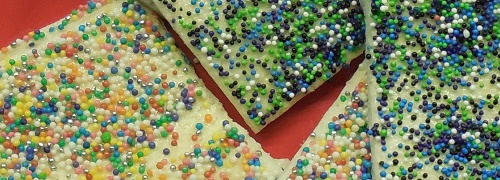
Little silver balls in the multicoloured brights! The blue/green/white ones leave tongues and lips stained, just like licorice . They look too small to have such a great effect.

The green/blue/white/navy ones tasted nice leaving us with dark tongues and lips as if having eaten licorice – there’s something pretty powerful in those little things !!! The others, brightly coloured and very traditional have the novel addition of tiny little silver balls – aren’t they gorgeous?

To make fairy bread

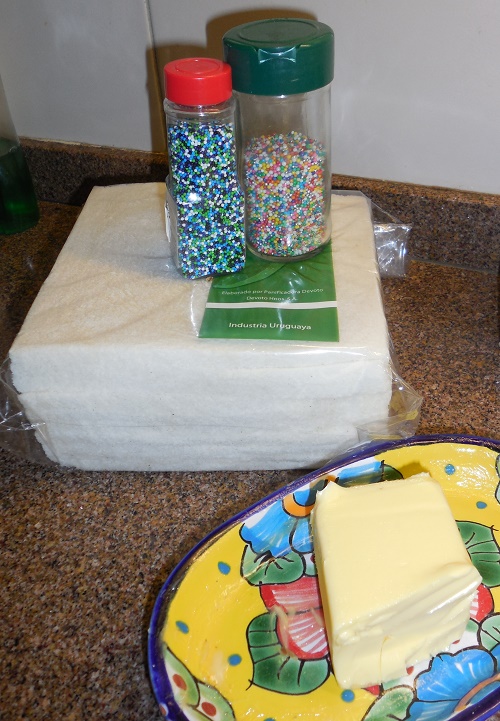
You’ll notice that there are no crusts on this white bread, as required by true fans of FB. One of the best facts about Uruguay in my opinion, is that supermarkets sell packs of 8 large thin slices of both brown and white bread, perfect for making sandwiches, asparagus rolls and obviously, FB. When I was young and Mum was catering for an event that required plates of sandwiches, she would buy fresh square loaves at a particular shop and have them machine sliced to take home. Once she’d filled the sandwiches, she trimmed off the crusts and either store them in the ‘frig or lay them out on plates under a clean slightly damp cloth to keep cool and fresh until serving. If thin sliced white bread isn’t available, use what you have for a less fancy version. I know there are people who will prefer brown bread – what can I say except ‘If you must …’ Yesterday somewhere I noticed a photo of a family group with cookie cut bread shapes covered in FB – innovative, and not necessarily wasteful, because as Mike pointed out, you could use the offcuts of bread in a Cheese Pudding, or in a dish of Trainsmash.

The ingredients, – butter, white bread, and 100′ and 1000s. There is no acceptable substitute for butter.

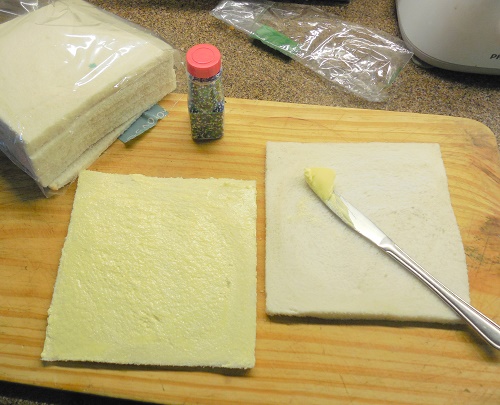
Spread the softened butter thinly, going right to the edges.
Gently sprinkle the 100s and 1000s , then cut squares into traditional triangles – the best tasting shape, but oddly some people enjoy squares. but I can’t think why.
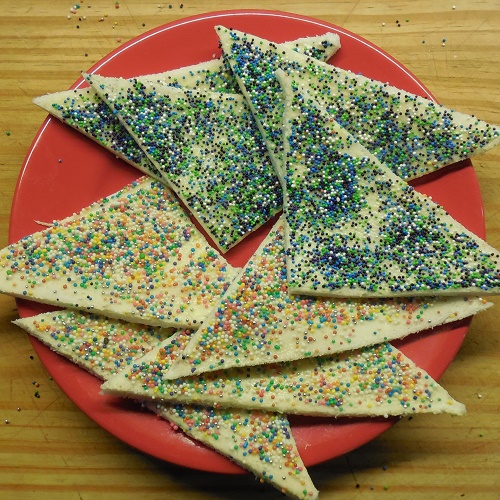
Traditional Fairy Bread – on thin white bread, crusts removed for fancy occasions, left on for every day. Traditional shape triangles, believed to be the tastiest shape for a fancy event or venue.

Now we made ours the very traditional way. Other people do some wonderful things with 100s and 1000s, so for ideas go to and scroll past the first few promo pics to see pics that people have sent in showing how they enjoy FB, and use 100s and 1000s in other ways, too. There are lots of images online if you google FB. Fairy Bread Day is November 24th each year – it is a fundraising event for Starlight, an Australian charity for sick children, should that be something of interest to you …. www.starlight.org.au

Lamb Jottings 2 – Put Another Chop On The Barbie

When we were young parents, living in Outback mining towns, our main social groups were mining industry colleagues of Mike’s and their wives, plus people in our sporting clubs. Like lots of Aussies today, we’d often BBQ on weekends at someone’s home, gather in some park or go out into the bush, so the kids could run themselves ragged in the fresh air. At other times we’d all get babysitters and gather around someone’s BBQ for a night of conviviality and uninterrupted adult conversation.

Either way, people usually brought their own meat unless instructed not to; it was all cooked together and everyone felt free to eat whatever was on the platter no matter who brought it. Rump steak or t-bones were popular, and sausages or ‘snags’ mandatory but probably supplied by the host. When we lived in Mt. Isa, Far North Queensland (1977-81) I remember someone indignantly complaining to me next day how someone had brought lamb chops, not beef, to their BBQ. Quel horreur! In the huge beef producing state of Queensland, in those days at least, ‘meat’ meant beef, and in some parts of that state lamb was not considered appropriate to take to a BBQ. Try this for an enjoyable read about Australian BBQs and what is typically served wherever you are. Some current etiquette for the Pommie newcomer or visitor, is here The West Australian, dated 2017 and I think people from other countries would find it helpful, too.

Personally I think lamb chump chops are the best and most versatile chops. ( I just learned here where those come from ) They’re marvellous on the BBQ, better than rib ones, in my opinion, and as kids we liked nothing better than to take a chop and a sausage, some bread and butter, S&P, and a box of matches, and head off out along the beach or into the bush for whatever adventure we were doing that day. When we got hungry we’d light a fire, skewer the chops and sausages on green branches, and cook them over the camp fire. This was a winter school holidays activity, when the Tasmanian bush was damp and green, with most rain falling in Tasmania between late April and September. In late spring and the summer months, outdoor fire bans cover most of Australia, meaning you can’t light any kind of fire out in the open; and indeed because of the danger of flying sparks, I wouldn’t even light one inside a house in a fireplace, either. As I write, Australia is suffering horrendous bushfires in areas that have totally dried out due to the severe drought in many regions. Fires are burning in areas that have never burned in recorded bushfire history. “Unprecedented” and “catastrophic” are words Aussies are hearing daily, and it is pretty scary this year.

I remember one year, at Greens Beach with a group of 8 or 9 friends walking along the beach to a distant point to picnic, swim and sunbake. We were all old enough to know better, but with a wind blowing which we failed to take into account, we lit a fire to cook our meat. In a flash the fire escaped into the nearby low scrubby vegetation, and we frantically grabbed our beach towels to successfully beat the flames out. It was a very close call, and a nearby farm was not burned to the ground that day! Our panic subsided, but we all felt subdued and suitably chastened. Though no one commented on our return, I’m sure someone must have noticed the smoke, and I think of this every time I read or hear of bushfires.

Lamb Jottings 1 – The Weekly Roast.

I just read a BBC website item outlining how archeologists, culinary historians and cuneiform experts have been “working to recreate this dish and three others from the world’s oldest-known recipes. It’s a sort of culinary archaeology that uses tablets from Yale University’s Babylonian Collection to gain a deeper understanding of that culture through the lens of taste.” A fascinating article, so you could make a cuppa or pour a glass of wine and settle down to read it if you have interest in things archeological or culinary. I’m sure modern cuisine across the region contains as many cultural links, as do the myriad of languages spoken by a large portion of the world’s population..

Lamb is a major, if not the major, meat eaten all across around the Mediterranean, north Africa, the Middle East and the Indian subcontinent. But more than that, you can probably say it’s on the menu wherever sheep are raised – so that includes Iceland and Scandinavia, South Africa, and of course Australia and New Zealand, plus much of rural southern Latin America including Argentina, Uruguay and southern Brasil (I had some divine lamb there in September in Gramado where I was teaching – see earlier posts) When we first started coming to Uruguay, lamb wasn’t available in supermarkets and city restaurants. To eat lamb you had to go out to the country/campo, when until relatively recently it was considered gaucho food – meat cooked and eaten by workers on the estancias/pastoral stations/ranches or farms; because when Uruguayans talk of ‘meat’ they’re talking about beef . However, now it’s on city and country restaurant menus, and available in supermarkets and butcher shops/carnicerias all over. Uruguay is a major producer and exporter of quality wool, up there with Australia, New Zealand, China USA and other producer exporters.

We lived in Denver Colorado for a number of years, and found lamb was not popular in the middle of the country, but popular over in the eastern part, particularly the New England states; but I believe it is now becoming more popular across the USA. We lived in the south east part of the city close to the Denver Tech Centre, and while lamb was not on sale in the local supermarkets, a 20 minute drive would take you to a specialised, gourmet, independent butcher, Tony’s Meats. I’ve just checked and am pleased to see Tony’s is still operating, and their website looks sumptuous. Several times I ordered legs of lamb and cooked Aussie Style Roast Lamb for special occasions, including Christmas. Our family have never really enjoyed turkey, and I only once ever had it divinely cooked, at the home of one of daughter Anna’s early boyfriends where we were invited for Thanksgiving.

Lamb is prepared untold numbers of ways including roasting, grilling, stewing, currying and mincing; with various spices, flavourings, vegetable and grain accompaniments varying according to region and culture. Just now I read it’s gaining appeal in the USA these days, so I’ll keep my eyes open next time we visit to see how it might be appearing in MD, MO and CO. In the true tradition of dishes and family cuisine being passed down, I cook lamb the several ways my mother did, and in this series of posts on lamb I’ll share with you how Mum cooked it and influenced my cooking of lamb, too.

First, the weekly roast was often a leg of lamb. A large leg of lamb was placed upside down in a baking dish with a good dollop of dripping from previous roasts, and put in a hot oven for about 30 minutes while the potatoes, probably onions, and parsnips in season, were peeled and cut to uniform pieces. After that time, these veggie pieces were rolled around in the melted fat, the leg turned over, the oven door closed and the temperature turned down to medium/low.

These days I don’t roast with the dollop of saved dripping!!! I prep the veggies by rolling each piece in some oil before placing in the pan, and don’t do anything to the lamb itself – lamb contains enough fat under the skin and through the meat and this emerges with cooking. so there’s less fat/oil to pour off the meat juices before using them to make the gravy. I happily make gravy using Gravox which is an Australian gravy powder and we usually have a stock of if here in Montevideo. But if it’s run out, I make gravy with either flour or cornflour plus meat juices and the water from the green vegetables added, and a teaspoon or two of vinegar improves the flavour too.

Other vegetables – We often had what I found is called trainsmash, that tomato onion breadcrumb dish I mentioned in one of last year’s Christmas posts. Greens included beans, cauliflower, brussels sprouts in season, and peas, though we never had broccoli – I kind of think Mum might have called it ‘migrant food’ ( she was a bit of a snob) but it might have been that little was grown in Tasmania – I never heard of broccoli until I was a married woman living on the other side of the country. We enjoyed nice baked pumpkin in season.

The traditional English mint sauce was always served with our family’s roast lamb, as it is today. It’s nice with lamb grilled or barbequed, too. Into a ceramic small jug or bowl, put about half a cup of finely chopped freshly picked mint, a teaspoon of sugar and about 1/4 teaspoon of salt, pour over that about half a cup of boiling water and a similar amount of vinegar. Leave the salt out if there are people on no salt, as it can be added on the plate if desired. Leave this to stand so the flavour develops.

Although Mum probably ordered the meat by the pound and probably always the same weight, but depending on the number of eaters, what was bought was always expected to leave plenty of cold meat, too for … well, I’ll write another post for all that – stay tuned.

Travel Broadens The Mind: Gramado, Brasil.

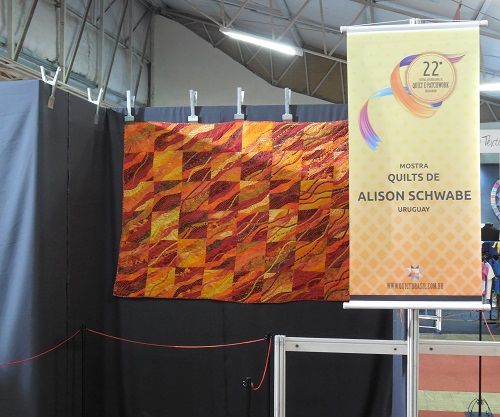
I was recently teaching classes at a major patchwork and quilting event, the 22nd. Festival of Patchwork and Quilting, at Gramado Brasil. The day before the opening I arrived in the town’s event centre to deliver some of my quilts to hang in an exhibition featuring myself and another featured Master Quilter, Marina Landi of Sao Paulo Brasil.

Once the quilts were delivered, I was free to explore the town to become a little acclimatised linguistically and culturally. The weather was frightful – foggy, cold and very wet. Though I had appropriate clothing, it was miserable out, and eventually I took myself into a cafe for lunch, several cups of coffee and a good read on my kindle. I ordered orange risotto:

Orange cilantro risotto – delicious ,and it was easy to recreate at home

They looked like prawns, but were small pieces of chicken, and you can see the chopped cilantro; there was finely chopped onion and I’m not sure what else beside the moist orange flavoured rice. But once home back here in Montevideo, I brushed up on how to cook risotto, included a bit of parmesan cheese and a slosh of white wine, and my version turned out remarkably like this, tasting every bit as good.

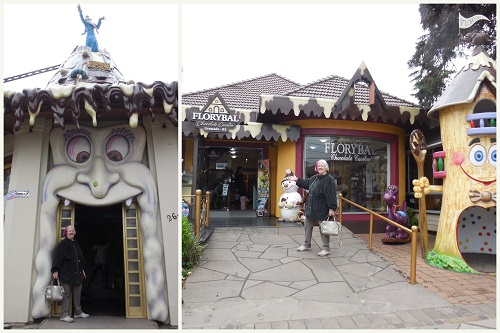
From a textile and teaching point of view I have already written several posts on my other blog, here and here and several posts before that about the preparations. From the first mention of my upcoming trip to Gramado in the southern state of Rio Grande do Sul, people began telling me how beautiful the city is, and how marvellous chocolate is there. Chocolate is big business in Gramado and the surrounding area, and in every main street are many shops decked out in eye-catching Disney-like style vying for your business! But everyone was right – the chocolate is good, even though my choc palate is neither refined nor demanding.

Well, this is just to say I’ve been there! Other places had classier looking facades.

Other food notes from this trip –

  1. previous travel in Brasil led me to expect delicious looking cakes available for breakfast, and my hotel in Gramado was typical, with about a third of the breakfast buffet being cakes. Although they looked great, I just can’t eat cake for breakfast – I’m not such a sweet tooth. Instead, I selected the wonderful fresh fruit salad, whatever eggs they had and a nice tomato with onion thing that was available each day, and of course juice and coffee.
  2. Churrascaria restaurants are fairly well known, where waiters wander the restaurant with various BBQed meat, chicken, sausages, hearts, and other animal products on skewer. When a waiter approaches with something you’d like, he slices a bit off directly onto your plate. There’s either a salad bar or small dishes of salad arrive at your table. When you’ve had enough to eat, there’s a marker on the table that you set to let the wandering waiters know you’re done. An interesting variation on this theme was roving waiters with platters of pizza slices, which a fellow teacher and I really enjoyed.
  3. One day for lunch a few of us went to a restaurant where we were each given a plastic token/card as we went in. We selected what we wanted from a huge smorgasbord array of hot meats, vegetables, cold collations, salads and desserts, took our dishes to a weighing station where our cards were scanned, and this was repeated each and any time we returned for something more. As we left we simply presented our cards for a final scanning, and each paid for the weight of what we ate. This might not be new to all my readers, but I thought it was great!
  4. Is this dessert or salad? At the end of the salads section and the beginning of fresh fruit and desserts section. was avocado in halves or wedges, with passion fruit pulp spooned all over it. Whatever your thoughts though, give it a try – it was divino!

The Appeal Of Fresh Scones.

A recent book club meeting/morning tea was at China’s, (pronounced Cheena) and her wonderful scones were on the table again this time, with butter and lovely plum jam instead of the divine lemon curd aka lemon butter/aka lemon cheese she put out last time. They reminded me, I haven’t made scones in eons because I really still don’t understand the flours in Uruguay, and have a love/hate relationship with the oven, anyway.

However, looking for self saucing lemon pudding recipes as posted previously, I found a hand written scones recipe inside the back cover of my 1998 copy of the CWA Cookery Book & Household Hints about which I wrote a few weeks back.

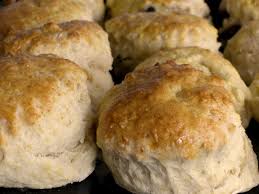
One of the things I had to make for my Brownie Cook’s Badge was scones, and mine were good. I learned how to work the butter in by hand, using finger tips only, and working quickly so it didn’t melt while you were doing this. |Adding the milk had to be followed by quickly mixing with a knife – there’s no time to muck around while making scones. Gran always used the same old knife to mix hers. It was a kitchen knife or maybe even a carving knife, with a very old yellowed bone handle and an extremely worn down blade – who knows what shape it started out with, or what its original size was. Once quickly mixed the dough had to be turned out onto a floured board to be quickly and lightly rolled or hand pummelled. Using either an old glass or a cookie cutter for round shapes, or just cutting the dough into about 1″ thick squares or diamonds, these shapes were placed on a lightly greased oven tray, brushed with milk and popped into a preheated hot oven for about 10 minutes. They were taken out and wrapped in a cloth to cool without drying out. I used to be good at scones, and must have lost my touch for lack of practice.

On one of our many visits to Tasmania, possibly while we were still living in Kalgoorlie for the second time, so pre-1987, I think, Mike and I visited the Westbury Maze Tearoom on someone’s recommendation. I’m not sure exactly why we didn’t do the maze – perhaps it was because we only had time for the afternoon tea part! For some reason we’ve never popped in on subsequent visits to northern Tasmania – but the pictures of the maze look so good I think we must next time we go (we still have family and a few of the oldest, best kind of friends there) I am certain I wrote that actual recipe on a piece of paper years before, and years later sometime transferred it to this book to make sure it didn’t get lost.

Scones Recipe From The Maze Tearooms Westbury, Tasmania.

  • 7 cups self raising flour
  • 1 small carton fresh cream
  • 1 can lemonade
  • “some milk” – add in just enough to bring it to the right consistency
  • quickly mix, roll out, cut etc
  • cook in hot oven 10-15 minutes

Now, this makes quite a few scones, but they do freeze, just fine. But I needn’t have worried about the freezing of extras – they were like rocks and went straight into the bin. Despite Mike’s warnings I was certain that I’d written the ricipe correctly. But the ‘plain flour’ I’d written was so wrong, and clearly should have been SRF or had some baking soda in it. But I honestly thought, no, I felt sure, that I was right and that the lemonade in the recipe provided the necessary leavening.

Mike proved his warning was right by making another batch the next day, and those were gorgeous, which was quite irksome. Mum never swore, and ‘irksome’ was one of her favourite disparaging words, talk about understatement. We all know there are just a few sneaky people who cheerily hand on a recipe but leave out an essential ingredient, so it could have been industrial sabotage … or it could have just been poor note taking on my part, more likely I have to admit. I emailed the said tearooms for confirmation of the recipe, but for whatever reason they didn’t bother to reply, so never mind, they won’t miss us when we don’t pop into their maze.

Our Radio Diet – The ABC Only !

There was no TV in our part of Australia until I was already 13; and when it came to our house it was firmly rationed by our parents. Three times a year Mum rented a set for the school holidays, and three times a year it went back to the shop the day we returned to school. And even though it was school holidays, we were absolutely not allowed to eat in front of the TV except on sunday nights, when we could take our crumpets, toasted sandwiches or similar light meals to the set. At all other mealtimes the TV had to be turned off, and we all had to sit up at the table. The radio however, was never turned off for meals, unless we had non-family visitors.

Most families including ourselves had just one radio in the house, and ours was on a dining room bookshelf just around the corner from the kitchen. People still gathered around a radio to listen together. I found a photo of the exact model online, but not being able to find who holds the copyright to the photo to get clearance to post it, can only suggest you click this link to see the photo of what Barry Humphries most probably would have described as a beautiful piece of furniture. It was an AWA, a long trusted brand in Aus, acknowledged by many to be the best. About 30cm h x 50cm w and maybe 30cm deep, it was covered with fine wood veneer and some fascinating boucle fabric in front of all the valves and inner controls to let the sound come through. When you turned it on, it hummed softly for 1-2 minutes until the big valves inside were warm enough to bring the voices or music to us.

That radio was on from first thing in the morning to last thing at night, and we were never allowed to change the station from the local Australian Broadcasting Commission’s station, 7NT, to a commercial one. It was as if that tuner was welded into place. Not that it hurt us to miss programmes like The air adventures of Hop Harrigan, Biggles, The Drama of Medicine, Night Beat, When A Girl Marries and the weekly hit parades that some friends were starting to listen to. And of course we changed stations to listen to those if Mum and Dad were out for the night as our much loved baby sitter, Mrs J, didn’t mind. Our parents listened to war time hits, musical and movie scores, and modern non-rock music, plus classical favourites often in the form of broadcasts of orchestral concerts. We itched for some freedom of choice, but in the late 50s to 60s, it was accepted that children had little choice in anything, really, compared with the latitude most kids have today … as observed by every wrinkly generation since Plato’s time.

Much changed with the remodelling of the kitchen in the late 50s. All new kitchen cupboards, right up to the ceiling in places, were painted with black frames and drawers and doors of three shades of dusky pink. We got a new kitchen table with fancy white wrought iron legs, whose flecked laminex matched that on the benchtops. Matching wrought iron chairs had upholstered cushions in pink vinyl. New lino on the floor was black with little squares of colour. A crowning touch was a black and pink AWA radio with gold trim very like, if not exactly like, this 50s beauty. It sat on the counter at the kitchen’s ground zero where the kettle also lived and boiled water for tea umpteen times a day.

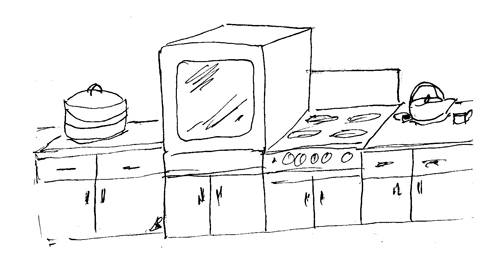
With the remodelling came new, modern electrical appliances. I don’t remember the new fridge, really, but the new stove and oven unit was pretty glam. I think it had to be specially ordered – and always seemed so sensible to me. Though I’ve scrolled through pages and pages of stoves and ovens, antique and vintage, I haven’t found anything much like what we had – so this is a from memory-and-not-to-scale sketch:

In real life it was level and square! The cake tin on the bench was above the hanky drawer.

On one side was the set of 4 hotplates, the controls might have been at the back though I drew them at the front – and beneath them was a warming drawer. Beside that, not under it, was the oven with a nice slide out grill tray. The cook didn’t have to bend down to put things in and out of the oven then, and an extra convenience was that the open oven door could be pushed back into the structure, all very well thought out. And beneath the whole unit was a cupboard divided into narrow segments that permitted platters, baking trays and other flatware to be stored vertically. Mum was a marvellous cook and did justice to this renovated kitchen. It was great for that era, and far better than most kitchens I’ve ever had, with the exceptions of Denver and Perth.

On Good Table Manners – It All Depends On Where You Come From

The other day in company with my mahjong friends, the conversation turned to picking up a bone off your plate and nibbling at it to chew the last meaty bits off, or slurping out out the marrow as quietly as possible. We’re a pretty international lot, and in addition to my Aussie self, we include a Costa Rican, a couple of Argentinians, a couple of Americans, and English woman who was born in Bolivia, and a couple of South Africans, one of whom grew up in Lebanon. Overall, as in most groups I’ve ever been part of, our Everyday and Best Behaviour manners have a lot in common, and I can’t think of any deficiencies worth commenting on – but then, being a laid back Aussie, I might be perceived to be a bit behind.

But, to take the bone conversation further (and I have no recollection of how we got to that point) it turned out there were varying degrees of what people had been taught were serious faux pas. The meat on the bone thing ranged from someone saying they never do. (surely she was fibbing – I mean, not even in the privacy of her own kitchen, really? 😮 Someone said she only gnaws the bones of those delicious little choppies of the rack de cordero (french rack) from a particular local restaurant. Someone else only chews bones at home, and another gave an almost frenzied demo with elbows raised, bone in both hands, lips curled back and barred teeth chomping rapidly. My contribution was that my mother insisted that ‘If you really must chew your bone, it should be held with one hand only.’ Someone said that was what she’d been taught, too, and a couple responded to that with slightly raised eyebrows! So, it all depends where you come from.

On the weekend we had lunch in a local restaurant and at a nearby table was a couple who were speaking in portuguese, meaning they were most likely Brasilian. I came across one wonderful set of images of various hand holds . Clearly certain styles predominate on each continent, but there was actually a photo labelled ‘how to eat like a Brasilian’ and that handhold was exactly what our neighbours were using.

Table manners have always been important, but in our less formal lives with different meal styles, some have changed and others disappeared. Add to that the fact that people move around the world much more, and faster these days, taking their manners with them – noticing and maybe adopting something along the way.

Mum was pretty pedantic, a bit of a snob really, and now that I think of it, she did most of her travelling in those parts of the world where English etiquette prevails – or Asia, where of course it’s chopsticks all the way. I don’t recall whether she was competent with them, or not – but wherever she would have travelled, it would have been right on the beaten track of course, and she’d have been offered a fork, as most non-Asians are if they can’t manage chopsticks. (I always accept gratefully) I certainly recall that in the matter of table behaviour, she was not at all tolerant of anything beyond the British way of holding your table irons.

To me, it has always been that the really important good manners are mostly about consideration for one’s fellow diners. Eating with your mouth closed, not waving your arms while holding cutlery, elbows off the table, slurping soup, and far far more. I can feel a post coming on about my favourite/worst dining table peeves.

If this topic interests you, I came across a wonderful blog on manners and social behaviour that covers an enormous range of issues particularly aimed at people who want to ‘get on’ on a personal level in business – but so much of it applies to us all. Mike and I try to give the young heathens in the family regular doses of this approach – which is one of the underlying tenets of this blog, of course – but as we don’t live anywhere close to either of them, at times it seems as effective as King Canute’s stand against the tide. Still, as time goes on, as with all parenting and grandparenting, we have sometimes been gobsmacked by one of the offsprings uttering something showing that something stuck between entering one ear and coming out the other. We live in hope.

“1954, The Year The Queen Came”

I was aged seven when we moved from #9 Forest Road over to #6 Bifrons Court in Launceston, Tasmania. By moving day, renovations to our new house were still not finished, and so for several weeks between moving out of the old and into the new, I stayed with the Mitchells, Ro stayed with the Stewarts and little Sal stayed with Mum and Dad at Gran’s. We were all within a few minutes’ walk of each other, and Ro’s and my schools.

It was while we were all thus scattered that the newly crowned Queen Elizabeth II and The Duke of Edinburgh came to Launceston on the Commonwealth Tour following her coronation the year before. The whole country was abuzz with excitement, and we all knew our relevant part of her itinerary off by heart.

Most exciting of all was the fact that her route from the airport was along High Street, crossing Adelaide Street just 200m from Gran’s house. For days before the big day our excitement rose in step with the timber stands that were constructed along the town sections of the route to allow people to get a good view. On the morning of February 24th , she would fly in to the Launceston airport, travel by open car to the Town Hall for a civic welcome and lunch. In the afternoon at York Park several thousand children would welcome her by performing a musical calisthenics display.

From every school in and around Launceston several children were selected to perform with hoops and maybe bean bags, basket balls and other equipment – I just remember the hoops which were a coming cool thing – I’d never seen them before starting my new school. Calisthenics is a word you don’t hear much these days: The name calisthenics is Greek in origin, a combination of the words ‘beauty’ and ‘strength’. Calisthenics is recommended for general good health, light exercises designed to promote general physical fitness. Such activities were very popular at the time as they still are in some countries on large public scale. Mum used the term ‘physical jerks‘ in a slightly disparaging tone for some reason, I think … Anyway lots of people today would go to thai chi or pilates to do the same kind of activity, producing the same benefit of improved wellbeing and fitness.

10 or 15 girls were chosen from our school to take part. They practised for weeks, and a few days before the big day they staged a dress rehearsal of their routine in front of the whole school. We grade 2’s were thrilled to be walked across to The Big School and sit cross legged on the floor right in front of the stage, so we had a great view of it all.

We had plenty of time for lunch and and a review of the morning’s events in minute detail before settling down in the loungeroom to listen to the broadcast from York Park.

There was still no television in Australia, so we grew up listening to radio accounts of events, or reading them later in newspapers and magazines. Lying on the floor in front of gran’s radio, I listened spellbound, mentally picturing the 2500-3000 other children on the York Park Oval, all moving in well rehearsed time to music. I felt so proud of those girls representing my new school, Broadland House, in the display for Queen Elizabeth II and Prince Phillip.

I think it was there that Prue, a daughter of my old kindergarten teacher Mrs Kerr, as a daughter of Legacy, was to present a bouquet to the Queen. A few days before this event she fell out of a tree, as kids do, and broke her arm so was sporting a plaster cast, which the radio commentators thought was ‘such a shame’ – a silly comment when you think about it. I’m sure in her 67+ years on the throne Queen Elizabeth II has been presented many bouquets by children with limbs in plaster.