Recently at book club, we got talking about lemon butter, lemon curd and lemon cheese – I think they’re pretty much the same thing but if not, these all go well on scones and as cake fillings. Then the conversation at our end of the table turned to the universal appeal of lemon flavoured puddings, cakes. icings and drinks.
Monica mentioned she has a marvellous lemon sponge pudding recipe that amazingly includes a packet of lemon jelly crystals, but because she keeps forgetting to bring back jelly crystals from the US, she hasn’t made it in ages. Red, greeen, orange and blue are definitely available here, but she might be right about lemon. Of course, we could try powdered gelatine with some kind of lemon zest/juice/essence combo that might do the trick – lemon colouring’s no problem. I know Mike, who does much of our shopping, will now be on a mission to check out various places, and if it’s here, he’ll find some. Brain flash – I could try it with orange jelly crystals instead of lemon!!
Anway, I turned to Maureen and said this all reminded me of Mrs.S, a grandmotherly woman who came in on someone’s recommendation to give Dad a hand caring for us the couple of times in consecutive winters that Mum was hospitalised with pneumonia. We were all at school, so I think I was about 12. Mrs. S came in early each weekday afternoon to be there when we arrived home from school, and I remember we all liked her. She probably did several things to keep the household ticking over, like hang out or bring washing in, and maybe do a little school shirt ironing, though I could have done some of that by then. But most of all I remember what a good cook she was. After the first time she made her lemon self-saucing pudding for us, we begged her to make it every day!!! She did make it pretty often, but she also made other things, none of which I remember like that lemon pudding.
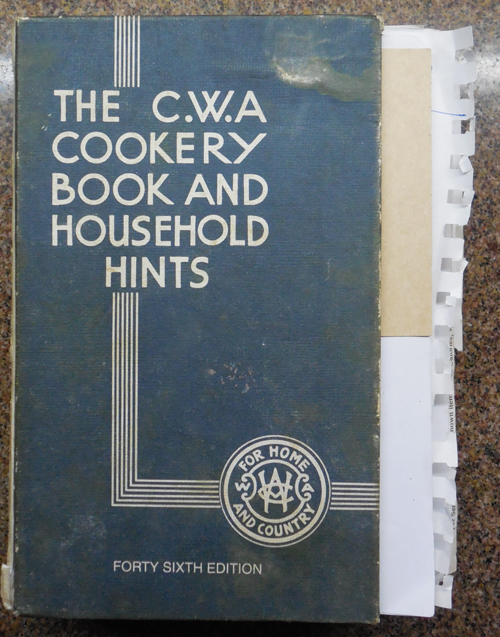
After all this time, I don’t have her recipe – doubt that Mum wever got it from her because she certainly never made it, and amazingly looking just now couldn’t find one in the CWA cook book I mentioned on June 4th last, either. There were about 8 or 9 lemon dessert recipes there, but none of them remotely like Mrs. S’s.
However, Mike and I agree this self saucing lemon pudding recipe sounds about right – and there are lots of images to give you the general idea of the lemon sauce in the bottom of the dish topped by a layer of baked sponge cake on top, served with whipped cream and/or vanilla icecream. If I ever do get around to cooking one, if it turns out ok I’ll put the picture in here. But puds and cakes are not my forte, and so I’m not making any promises on this one!
Writing recently in The Australian newspaper, Bernard Salt, my favourite social commentator wrote on what he calls Activist Retirees , a relatively newly identifiable population cohort in Australia, saying: “Oh, yes, for at least a decade now this new tribe has been silently, purposefully, militantly assembling in suburban lounge rooms plotting their next adventures between pots of tea and plates of pikelets. And if you don’t know what a pikelet is then you’ll never be admitted to this group’s most sacred and secret meetings.”
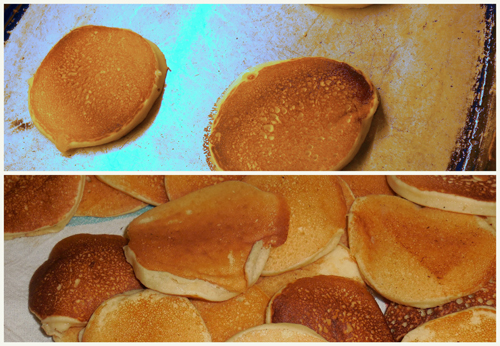
Pikelets – learned from our grandmother and still enjoyed these days. Quick and easy to make; served for morning or afternoon tea, fresh with butter or, like scones, with jam and cream.
Bernard’s tendentious comments frequently draw heated reader responses – and one reader declared “Bernard, get with the times! Pikelets are my grandmothers generation and I am 60! I have taken up adult ballet!” Edgar’s wife.” I think she’s a year or two older than Bernard – and this got up my nose a bit, showing “Edgar’s wife” to be a recurring type I’ve noticed in the Australian’s readers’ comments pages – a bit smug, a little pretentious, seeing herself as a style leader, while meekly tucking her own identity into a side pocket of her husband’s. This kind of implied ownership by husband is very old fashioned, in fact it was out of fashion when I was a girl. My mother used to give her name as “Mrs. Eric Padman” not ‘Marie Padman’. I always thought it sounded a bit hoity toity, but as there were several other Mrs Padmans in the city, I guess it made a little sense, but I doubt even she would have signed what is in effect a brief letter to the editor as “Eric’s wife.”
Contrary to Edgar’s wife’s contention, pikelets are absolutely not just of our grandmothers’ generation. As young people begin to cook for themselves, admittedly less and later these days, eventually they’ll discover pikelets, pancakes and griddle cakes are essentially all the same thing, quick and easy to make, they’re really economical and versatile. It’s why this kind of food has stood the test of time whether Edgar’s wife was paying attention or not. When I googled each of these, I also found crumpets mentioned as they too are much the same ingredients. The batter is poured onto a flat hot greased surface – in our case a pretty beat up electric frypan. (For crumpets the mixture’s poured into a ring on said hotplate) They don’t make crumpets here in Uruguay. It’s time though, to try out the rings we recently bought, as winter is starting to close in. We need some toasting forks to use in front of the fire …
To make pikelets the way Gran Padman did: Beat an egg with 1/4 cup sugar, 3/4 cup milk, 1 cup flour, teaspoon of baking powder, and 1 oz butter optional. Gran added freshly grated nutmeg. Mix until smooth, and cook in spoonfuls on a hot buttered griddle/hotplate. Yes, we learned at a very early age how to mix the batter. Under supervision and standing on a chair, we learned how to let the mixture run from the spoon onto the hot plate: from the tip of the spoon if you want round ones, from the side if you want ovals. Turn over with a thin spatula when bubbles appear begin bursting at the top, and place onto a cake rack when golden brown on each side. Depending on how runny the batter is, a tablespoonful will produce a pikelet about 5cm diameter – but if you make them larger (use a bigger spoon – trial and error) – you can call them pancakes and slather with syrup or honey, serving with fruit, or with eggs, bacon and hash browns.
It’s always a bit flattering to be asked for a recipe. These days I don’t hesitate, but in the past I have been a bit protective about my repertoire of favourites. In our university days, when I was flatting with Jane and Heather, and then The Two Cathys, we all knew how to make meals like hearty soups and stews, roasts and grills, with emphasis on making the food go as far as possible for the lowest cost. Minced beef, vegetables and rice came round frequently in various combos and disguises, such as nasi goreng, savoury mince, curry and rice, meat loaf, rissoles, Greens Beach Special, spaghetti bolognaise, pastie pie and chilli con carne – no, just kidding with this last one, which we’d never heard of until our first visit to the southwest of the USA in 1980 .
On arriving in Kalgoorlie just after marrying, through the next 20 years in remote Outback mining towns, I developed quite a collection of favourite recipes, some of them pretty fancy, and with that came a hesitancy to pass these recipes on. (These days I don’t mess so much with fancy cuisine – no one else does, either – a good development.) Sometimes ingredients were a bit hard to come by, certainly, but the main thing, I think, was that in those days of frequent dinner parties and potluck events, morning and afternoon teas, tennis afternoon teas, canasta days and sunday lunches, we were fairly often catering for close friends and visiting outsiders. In such small communities I guarded my few special recipes as ‘different’, no one else had them – and of course there was no internet to consult. It meant I never met meet my own recipes coming and going, and perhaps cooked better/or not as well as my version !! If pressed, when asked for a recipe, I’d cheerily say I’d be happy to give it to them the day we left town; because it was a given that we too would move on one day. Interestingly, by the time it was our turn to leave, most often that person had already gone, and presumably forgotten about the recipe anyway. So I apologise to anyone from my past to whom I failed to pass on a recipe as I’d said I would ! If one or two reading this care to identify yourselves, I’ll do my best to rectify that promise !!
Last week it was my turn to host the mahjong group. We arrive at or close to 10.30 for coffee, tea and enjoy a brunch together before playing until early-mid afternoon. Last week I put on a couple of different quiches freshly backed by the T.I., some fresh fruit, biscuits and cheeses and some of Aunty Joyce’s ginger fudge/slice which I have renamed Alison’s Ginger Fudge:
I lined the tin with plastic to make it easy to lift out to cut into squares. Re-wrap to keep in the ‘frig.
I lined the slice tin with some non-stick plastic for easy lifting out for cutting. The girls enthused about this tangy recipe. (I might have been a bit heavy handed with the ginger …) Anyway, I told them I would share it. Some of them talked of ‘fudge’. When I googled ‘ginger fudge’, I found nothing exactly like it, and what there was sounded very sweet, more in the line of confectionary, really.
Writing about Ken, the cook at the camp in our early tent days reminded me of my best ever cookbook, of which I actually have two copies. One’s in storage at the moment, this one is here in Uruguay, as I have always taken a copy with me for any long term residence as a piece of essential survival gear.
Relatively new looking, the 46th (1998) edition, of this West Australian classic, first published in 1936.
The first chapter of the book is an interesting one – “Catering” has recipes for things like Pea Soup for 120, Curry for 50, Potato Salad for 100, and catering for 300 people at a Public Stock Sale. For a dessert at Wedding Breakfast for 100, in addition to 16 dishes of fruit salad, you’ll need 16 dishes of trifle, which requires 3 gallons (12 litres) of egg custard, (and custard powder could be used instead of eggs) You’d also need: 6 sponges, 2 tins pineapple (presumably large, and diced or crushed? it doesn’t say) The recipe lists a bottle of sweet sherry, which doesn’t seem enough to me 🙂 the day before you’d need to make at least 6 jellies, plus have enough whipped cream and blanched almonds on hand. Quantities are not specified for these, so I’d need to ask around, but I imagine any CountryWoman would know, just by looking in her store room, whether or not she has ‘enough’.
Back in the late 50s and through the 60s our national psyche then admired anything and everything imported from ‘overseas’ versus the home-grown product, including technology, clothing, food, beverages, art, antiques, cars and more. Our cultural cringe would still take a couple more decades to wither, and perhaps it’s still never completely died. Even while I was still at home with the family before going off to university in Hobart, however, foreign influences were gradually being absorbed into what had been predominantly British cuisine in Australia. Mum led the way among her friends with trying something new, foreign and presumably sophisticated, principally from post-WWII Europe, France and Italy in particular. The Cold War had set in, and so there was some interest in Eastern European food, too. For some of their dinner parties Mum made Borsch, and Beef Stroganoff, and Hungarian Goulash, and everyone dressed in suits and dinner dresses.
Reading down the chapter titled ‘Here And There’ there are recipes purportedly from many countries, though it’s not straight forward, if this kind of thing ever is. For example, under America there is ‘American Chicken Chop Suey’ and also “Hawaiian Curry’ … hmm. There’s a scattering from ‘Arabia’, Austria, Belgium Germany Hungary, a few from Italy, Jamaica and ‘Jewish’… and as I headed to the page with Russian recipes looking for Beef Stroganoff, (which I’m taking to a farewell lunch for one of the mahjong girls this coming sunday) my eye was caught by ‘Neapolitan Tripe’ in the Italian section.
I’ve never been to Italy, but tripe isn’t something I’d associate with that country. I scanned the recipe to see how it differed from Mum’s ghastly offering in white onion and parsley sauce. I couldn’t believe my eyes !! “Neapolitan Tripe“ is exactly what my friend Fiona Palmer’s mother cooked one morning in about 1957 when I’d been playing at her place – Mrs Palmer asked me to stay for lunch. As we sat down, she said “I hope you like tripe?” I totally hated tripe! However, being brought up to eat what you’re given when you’re out, I smiled enthusiastically and hiding my dismay, took a mouthful of what looked nothing like ‘tripe’ to me, wondering how much I could politely leave …. But it was fabulous, and I have honestly never had tripe as good since. I remember suggesting that Mum try making it that way. Did she ever ask for the recipe? Did Mrs Palmer refuse to give it? Who knows, but it just never appeared at our place. Not long after that Mr. Palmer moved to a mainland parish, and within a few years Fiona and I lost touch.
I’ve never forgotten it, and tried without success to make it a couple of times, but I will use this recipe soon 🙂
Neapolitan Tripe
625 grams tripe
1 TBSP chopped onions
3 tomatoes
fresh grated nutmeg
2 bacon rashers
1 level DSSP ‘shortening’ I will use oil
1 clove fresh garlic
pinch mixed herbs
S&P to taste
Cook tripe until tender, then cut into strips. Saute onion and crushed garlic in oil, with peeled and diced tomatoes. Cook until these are soft. Dice bacon, put half in the bottom of the dish, cover with tripe and tomato mixture, toping with the remaining bacon. Grate nutmeg over, bake uncovered for 15 minutes in a moderate oven. Mrs Palmer used a shallow pyrex dish, and I vaguely think she might have added some sliced big field mushrooms, it’s just an impression – but if they weren’t in season my memory is wrong, as in those days in Australia mushrooms were very seasonal.
In the first few years we lived at #6 Bifrons Court, Launceston, Dad’s study was a very nice upstairs corner room with good view over the street.
#6 Bifrons Court, our family home 1954-84.
Unlike Mr Bennett of Pride and Prejudice, who never gave up his study, probably under pressure from Mum our father did eventually relinquish his, converting it to a bedroom so each daughter had a bedroom/study. He retreated to the downstairs rooms to read in peace, listen to the radiogram or watch TV. It is interesting how the usage pattern of rooms in that house changed with family needs.
For some years Mum and Dad rented a beach shack for part of the summer school holidays. In the late 50’s Mum’s parents died just months apart, leaving her some money, part of which she used to buy a block of land at Greens Beach, and Dad and Mum arranged for a small house/shack to be built. As a result, we were able to spend the whole summer, plus winter school holidays and long weekends down there. Dad, though, always took his 4 weeks’ annual holiday from Christmas to late January, and I now realise it might have been a nice respite for him as we three and Mum spent time ‘down at the beach’, while he worked during the week and joined us for the weekends. He certainly couldn’t afford to take time off from his practice several times a year. It’s interesting to talk of being ‘down at the beach’ since you drive northwards from Launceston to get there, and to me, north is ‘up’. We drove back up to town by driving southwards 🙂
Dad’s batching was no great hardship I think: his mother, Gran Padman, lived just up the hill, and his Rotary club had a mid week dinner meeting. I’m sure Mum left a bit of suitable food around, so he wouldn’t have had to cook too many dinners. With a sandwich at the office for lunch, weekday breakfasts were his main daily catering experience, and I’ve written elsewhere about Dad’s cooking prowess. He enjoyed telling everyone the entirely believable story that once while batching he ran out of bread for toast to put his poached eggs onto – so he put them on Clix biscuits/crackers !! Whenever he talked about ‘batching’ it all seemed to be a bit of a fun, self catering, making-do adventure thing, always emphasising the potential to improvise creatively in a pinch, problem solving, I guess, a good influence in my life.
As I entered the final year or two of school, sometimes my plans or needs were incompatible with the rest of the family’s, and I did not want to go ‘down to the beach’, so was allowed to stay in town with Dad. Part of the deal was to cook an evening meal for us both, to be ready when he came home from work. I loved doing that grown up thing, as by that time I was becoming quite a reasonable cook and recipes turned out either like Mum’s or looked like the picture in the book.
One night while batching with Dad, he suggested we have dinner at The Brisbane Hotel. I was thrilled. In those days, so different from today, only adults dined out at such swish venues, and always without kids, so this was to be a real treat. I wore my sunday best winter clothes – the coral coloured fine wool dress, stockings, my first ever high-heeled black shoes, plus my new coat. I don’t especially remember what I ate, but I’m sure the menu would have included soup of the day, roast of the day, and either jelly and icecream, or apple crumble with whipped cream. What I do remember is the hotel dining room tables set with blindingly white, impeccably ironed table linen, really shiny cutlery, glassware, and gold-rimmed and logo printed plates. The waiter pulled out my chair and pushed it back in, treating me exactly like all the adults in the room. It was an unforgettable evening with my father.
I can see this man’s face so clearly, but just can’t remember his name, so I’ll call him Ken, a name that would have suited this rough diamond. At the start of the Tent Period (glossary) the team’s budget allowed for a camp cook, and Ken was appointed. He was ideal. He was good natured, respectful and always prepared to roll up his sleeves and help with something that needed to be done, whether it was in his job description or not. He was used to living away from town and city comforts, employed in jobs like cooking for shearers and drovers, and so he technically had a home wherever his swag was currently laid out, though you could also categorize him “of no fixed abode”. In the Wet Season when he was usually not working, I imagine he had friends or family somewhere he’d stay with, I just don’t remember what he told me about that part of his life – and maybe he didn’t. Lots of people out bush prefer to keep their private lives to themselves until they get to know you well, if they ever do.
Ken had worked cooking for shearers’ teams for many years. Sheep shearing is physically demanding, and large teams of people (yes, women shear these days too) move around the Outback sheep stations in shearing season, clipping everyone’s flock. They have to be fed three solid meals a day and smokos. If a property has a smallish flock that only requires a couple of shearers for a day or three, the farmer’s wife and family do all the catering. But large stations with 25,000, 40,000, or 60,000+ sheep in a good season require a larger catering effort, and teams of caterers move around, too.
Ken cooked breakfast in the mornings; eggs of course, with various other things, bacon, toast, and I don’t remember what else, but they were hearty. He packed the lunches for everyone, heaps of sandwiches, fruit and cake or biscuits. Once they rolled out of camp he took a smoko and a bit of time off before starting after lunch to prepare the biccies and cakes for the next day, and then start the evening meal for the 15-16 people in the camp, including myself. (I prepared the kids’ meals, and fed them early around 5-30 – 6pm, just before the team arrived back each evening) Everyone woke early just after sun-up, began work early, took time off in the hottest part of the day, and finished for the day late in the afternoon. It was always really hot. Once back in camp, people took showers, had a couple of beers, ate dinner and did a bit more relaxing, reading, playing cards, yarning over a few beers took place until about 9-30pm when the generator went off and so it was lights out! We lived by farmers’ hours more or less. Having breakfasted and got equipment organised and the radio schedule done, the geos and fieldies left the camp at 8am and were gone for the day, arriving back around 5.30 or 6pm. During all that time it was just Ken in camp, with myself and the two kids, Ivan (4) and Anna (9 months). Apart from the generator plugging away from about 6am to 9.30pm, the stillness in the bush around us took a bit of getting used to, but I came to value it enormously.
Ken’s swag included a good radio which he had on all the time wherever he was – a soul mate. Out bush everyone worked 6 days. I don’t know about Ken’s time allocation – he always had saturday afternoons off. On that day, after lunch he’d shower and change into a nice shirt and long pants, put on his snappy straw hat, and listen avidly to the saturday races broadcast over the radio, quietly downing a few beers during the afternoon. It was just as if he’d gone to the track, really. He followed the horses keenly, knew the form of horses and jockeys, and I’m sure had arrangements with a bookie in town.
That all lasted for just a month or so. I don’t remember why, exactly, but one day Ken was helping with something that involved a vehicle. Unfortunately as he stood on the running board of the slow moving ute, a branch flipped up, breaking his ankle. He was taken to hospital in Darwin and he was not replaced in the camp. Instead we were joined by two more fieldies. There was possibly something budgetary in all this, including that Ken’s cooked breakfasts might have been unnecessarily hearty, anyway. We changed to get your own, pack your own lunch, with everyone taking turns to cook the evening meal. We missed Ken after that, but interesting people continued to come into the camp, and I’ll mention more from time to time.
This post was scheduled to appear several days ago, but didn’t, and I neglected to check… and so I must have a word with my tech consultant 🙂
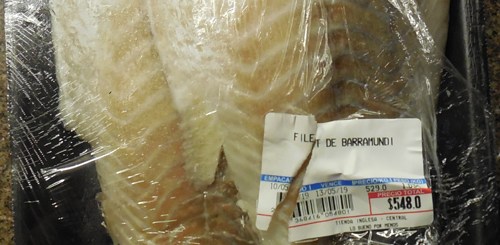
Mike did not expect to see our favourite Australian fish, Barramundi (barra for short) in a local Montevideo supermarket yesterday!
Price / kg – in pesos UY $548, dollars US $15.60, AU $ 22.30
Having lived outside Australia for so long, I haven’t eaten barra for years, let alone thought about it, so Australian Barramundi is one of the last foods we’d expect to see here; and eating it again brought back heaps of 40+ year-old memories. Barramundi thrives across northern Australia, in rivers, coastal shores and estuaries, and lagoons aka billabongs. When we went north for what I now call our Tent Period, (glossary) we’d never heard of barramundi. We were blithely ignorant of most things about life in The Top End, which was so far away and isolated that most Australians had little knowledge of life up there. When we announced we were going north with a 4 year-old and a babe in arms, some people were genuinely shocked we’d even consider it, as Darwin was still a difficult place to live after the battering of Cyclone Tracy the year before.
We first encountered barra in 1975 when we went out to spend the field season in what is now Kakadu National Park, some years before it was gazetted as a national park. My geologist husband Mike established a uranium exploration camp at a spot named Bora Springs (which you won’t find on any map) but it’s somewhere between the East and West Alligator Rivers, a bit north of Munmalari Station. (glossary) Once I got over the acute culture shock at suddenly finding myself in an isolated tent camp way out in Woop Woop, admittedly with a couple of ‘mod cons’, a term I hesitate to use lest you get the impression it was a Motel 6, (glossary) I really did enjoy this amazing period in our lives.
In Outback terms there were several large billabongs ‘nearby’ (half to one hour away) teeming with barra and fresh water crocodiles, which we now know to have been very young and small at that time. A government organised culling program ceased about 1973 since when these little ones have grown huge and several people and dogs are taken by them every year in the very billabongs where we used to wallow on sundays, fishing, drinking beer, splashing with the kids and cooking BBQ meals.
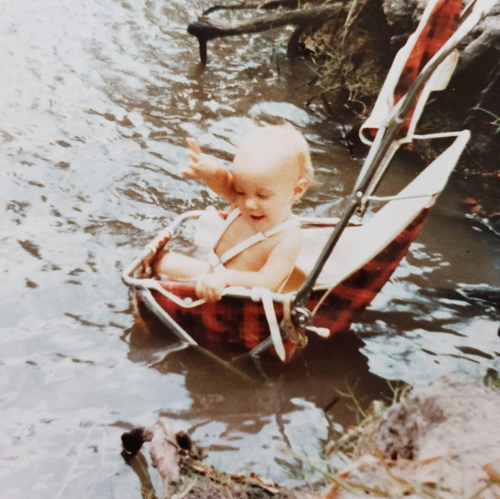
1975 – Anna, 10 months, pusher tied to a tree on the bank, was happy for ages splashing at the edge of a billabong. No one would ever, ever, do this these days ! We wouldn’t be there, either!
If you saw that Aus Outback movie Crocodile Dundee , those characters are no exaggeration; and if you haven’t seen it, I thoroughly recommend it. Very interesting ‘colourful’ people turn up in field camps, and everyone brings interesting stories with them. Into this camp came geologists, geotechnicians, field assistants, and mechanics, including Mick the truck driver who brought the weekly provisions, spare parts, last week’s newspapers and the long-awaited mail, and while in camp he serviced the generator. Well, Mick usually arrived weekly, but one time the creek was up, and a couple of other times he was too hungover to come our camp and get to the next one on schedule; so after sleeping it off at the previous camp, he unloaded our stuff there for someone to drive over and collect, and took a short cut over to the third camp – think triangle.
Initially in the very isolated camp, there was a cook on the team, Ken met with an unfortunate accident and had to be hospitalised to have his badly broken ankle set. After that the catering staffing was changed. Mike decided it would be better use of financial resources to have a couple more field hands than a full time cook, so from then on everyone was expected to rustle up whatever they wanted for breakfast (plenty of options available) make their own sandwiches for lunch and take fruit and bought biscuits if they wanted for lunch and smokos during the day. Everyone now had to take their turn to cook the evening meal and help wash up, and though not an employee, I took my turns, too, which only seemed fair. The new fieldies were two Aboriginal men, Ted and Ray. In their early 30’s, and clearly good mates, they were both great cooks. I don’t remember which one did this fish recipe I’m about to share, as they did everything together, and I only ever remember them as Ted’n’Ray. When either had their turn cooking, dinner was either barra, or red faced buffalo (glossary) which they brought into camp a couple of times. On those occasions, Mike was told to clear off for the afternoon and while he was gone, they brought the carcass in to the camp, butchered it and filled the freezer. When Mike returned at sundown, no questions were asked and no information given. That meat was always sooo good – as top export grade beef should be !!! However, to return to the barra, subject of this post.
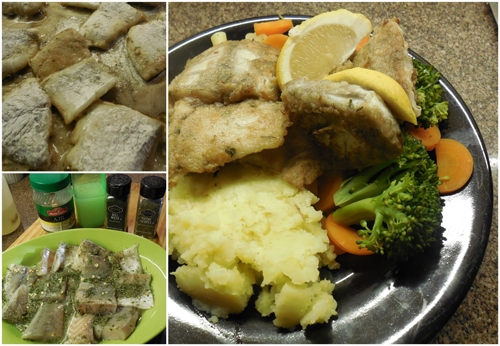
Ted’n’Ray’s barramundi; mouthwatering and easy to prepare; needs to marinate 2 hours before cooking.
Ted’n’Ray’s Barra: Barramundi is a medium large fish, and the fillets from fish caught in the wild were about 2cm thick. These fillets were a bit thinner, but no matter, it all worked as I remembered. Here’s how to prepare what we had for dinner last night:
About 2 hours before they were needed, fillets were cut into square pieces approx 3cm x 3cm
and set in a dish with plenty of lemon juice+mixed herbs+a small amount of v.finely chopped onion+plenty of chopped parsley.
They were turned over after about an hour and again just before
draining
then tossed in flour with a bit of S&P.
I cooked them in a hot frypan with a little butter+oil
Served the pieces immediately with mashed potato and other veggies.
It was very good. What we Aussies know as ‘mixed herbs’ isn’t commonly marketed in USA or Uruguay, so what I used was some dried dill, ajo y perejil (garlic+parsley) lemon juice, and I forgot the onion, so perhaps it didn’t need it anyway 🙂 The take away from this is, of course, experiment with your herbs and find your own preferred mix. The fish is delicious, so whatever you use should not overwhelm the natural flavour. Any cod- or perch-like fish with big segments that hold together well when cooked should be good with this method. Mike went back to buy more barra this morning – it was all gone! But when it comes in again next week, we’ll be there to purchase a pallet of it 🙂
For decades what I had always thought of as a French Omelette apparently isn’t French at all! I don’t know if mine has a particular moniker, but it seems it’s not French, at least; but that’s ok, it ties in with the way I learned to make one.
Soon after Mike and I met, he showed me how his mother, Dawn, made omelettes, which he said were French (and certainly the word is French) and anyway, why would I disbelieve this man I would marry one day? His family lived on a farm with plenty of laying hens and a couple of cows, so eggs and fresh farm butter were both plentiful; and just as well, with four young mouths to feed. They had their eggs the same ways we did in my family – scrambled, hard boiled, soft boiled, poached, and fried, with or without toast and other foods like bacon, sausages, tomatoes, and mushrooms. But interestingly I don’t remember Dawn ever making an omelette like this when I was around, and perhaps they were mostly a breakfast thing.
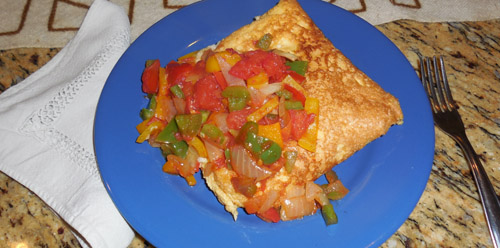
Yesterday our son, Chef Ivan, of Kansas City, emailed me a great link to all you need to know about making a French Omelette My response was to say that today I’d make what I’ve always thought of as a French Omelette, take a pic or two and send them, and so I made this omelette for breakfast this morning.
I googled ‘French Omelette’ hoping to find some kind of confirmation of my view, and on the images page, without reading all the recipe links, what I found was that there’s a huge, infinite number, of omelette styles that their makers call French ! Some of them even look distinctly like scrambled eggs, and several have bread in them which puts them into the cheese pudding category, in my view! And then I found a Julia Child video on Youtube – OMG Meryl Streep got Julia’s actions and that dreadful voice down to a t, and it was as much as I could do to watch until 2:23, by which time I already knew what she regarded as a classic French Omelette, and mine’s not close. She said her video would cover lots of other kinds of omelettes, but frankly I didn’t have the stomach for any more of that voice. So anyway, this is what I made for our breakfast this morning!
You need 2 medium eggs per person, separated; an approx walnut-to-small egg sized dob of butter for the frypan; S&P to taste; a good sprinkle of grated parmesan or other very tasty cheese. This morning I added 2 cups of a vegetable salsa, though, and once you do that, in my lexicon that omelette becomes a Denver Omelette. For the salsa – finely dice onions, saute, add diced tomatoes and capsicums/sweet peppers, as I did this morning. But you could also add veggies leftover from last night’s dinner, and maybe that little bit of left over gravy, or some tomato puree with a little garlic – anyway, stirfry whatever you have all together and you’ll come up with something good to go over the omelette.
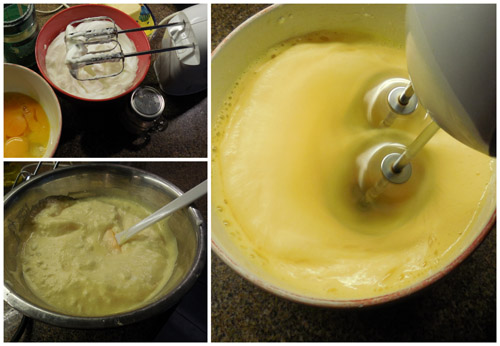
The eggs were pretty small, and as my bumble fingered separating resulted in 5 being broken open before I had 3 totally uncontaminated whites in the red bowl which really whipped up to a good volume and very stiff (see above) In the white bowl are the 3 yolks with 2 whites+yolks – pretty much equalling 4 medium eggs, so that was ok. Now, as the result of beating, the yolk mixture in the pic grew to more or less the same volume of the whites, by which time it was clear these two mixtures would not fit into the one bowl for folding, by hand, lower left. So watch for that 🙂
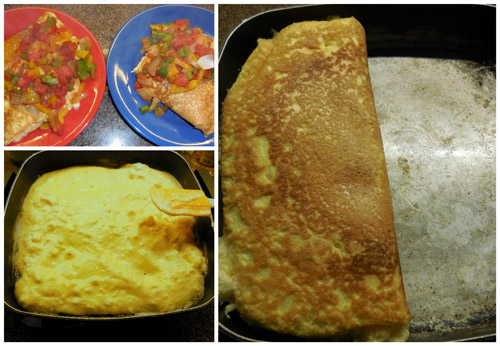
Into the heated medium heat pan with melted butter, you need to smoothe the mixture out to an even thickness. Cook on low-medium heat while you cook the salsa. (unless you did that first) After about 5 minutes sprinkle the cheese – not too much or it will flatten the air out of the omelette – which is why I recommended finely grated very tasty cheese so less is more, or at least enough. When the edges are shrinking away from the sides of the pan, fold one half of the omelette over the other half, divide that and place on the plates, put salsa over each portion, and serve immediately. For a Denver Omelette many would say that veggies plus diced ham are served inside the fold of the omelette: but that wasn’t how one of our favourite breakfast places served it while we lived there 30 years ago.
Mum’s omelettes were more like in the video, with a bit of stirring stopping short of scrambling the eggs, and ending up almost like a pancake, really. But certainly, once we were all teens, with at least one of us on a diet at any one time, and all wanting different things, Mum at last settled for tea and toast for herself, and left us to cook or prepare whatever we each wanted for breakfast. In time we all moved away from cooked breakfasts to the cereals, especially muesli, with yoghurt and fresh fruit that were making inroads to the Australian cuisine. With our own family we tended to have eggs and other cooked things for breakfasts on the weekends, when there was more time, a tradition Mike and I continue to this day, though for retirees this is really no longer relevant!
Some time back Ivan also sent me this video on ways to prepare eggs: Every Way To Cook An Egg (59 Methods and if you have half an hour to spare on a rainy afternoon or something, I recommend this fascinating and at times hilarious video, with some great ideas and serious flops included – anyone for hard charred eggs from the Weber? Or how about, um, a kind ofegg lattice, cooked rigid in a waffle iron?
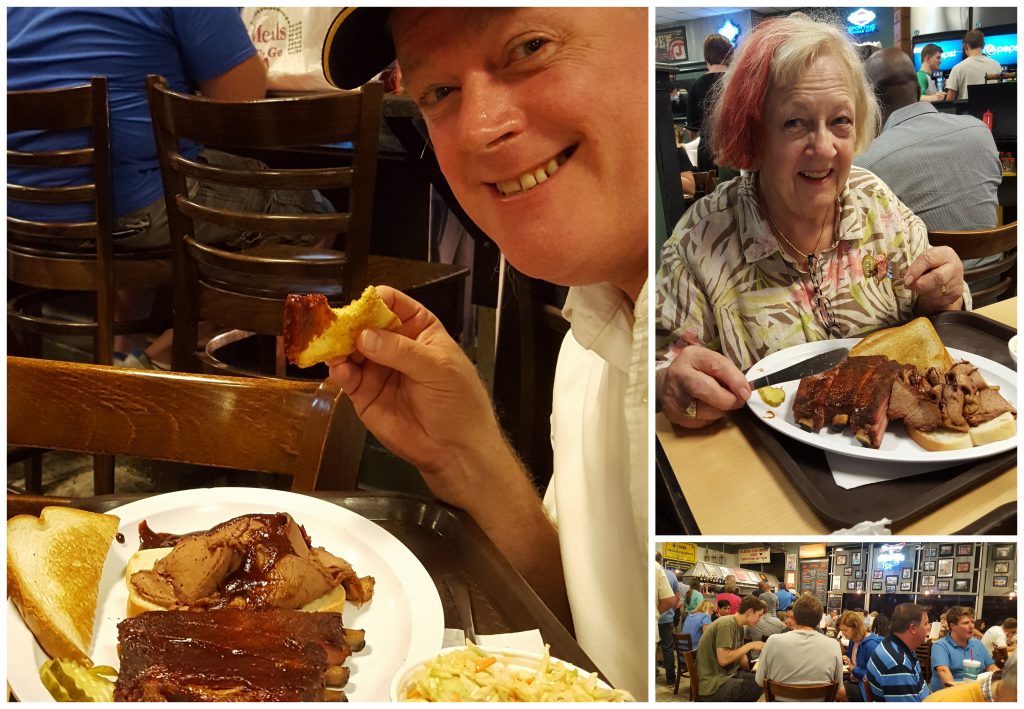
One of the things you must do in Kansas City is eat a feed of BBQ, ribs or brisket or both, served with toast, sliced dill pickle, and the house’s bbq sauces of course, and most places have a choice of several flavours ranging from smokey mild to very spicy and smokey. To go with that you can choose sides of fries, corn, mac’n’cheese, beans, coleslaw, or corn (kernels or on the cob) There’s almost no salad in view, and the only hope of a green veg is the cabbage in the slaw which is prolly white, anyway. All across the ‘South’ from Chicago to DC, Charlotte to New Orleans, places specialising in BBQ are usually referred to ‘joints’, often cafes, and only sometimes ‘restaurants’. The wonderful joint we went to was not ‘fine dining’! Whatever its style, though, each place serves variations of this meal with their own BBQ sauce recipes, carefully guarded and handed down from one generation to the next. KC has a long tradition of fine BBQ cuisine.
A meal in a BBQ joint is predominantly a feed of meat with sides of starch. Servings are not small! It’s less a dining experience than a feeding experience, with no lingering at the table, or sobre mesa, in the dinner rush hour.
You could drink wine with this, but generally BBQ ribs are washed down with either a beer or cold tea (erk) … Cold tea is pretty popular in the States, especially all across the South when it’s really hot and muggy like the night we went with Ivan to this one on the edge of KC. I’m sorry, I don’t remember the name of it, but if you’re visiting that area you’ll have fun trying to find your favourite among the many the locals will recommend to you.
There is divided opinion on whether the ribs should be parboiled before being baked or grilled and I can only say that Mike does lovely ribs, and his are parboiled before baking. Whenever and wherever we have them, I always think of Fanny Flagg’s 1987 book – Fried Green Tomatoes at The Whistle Stop Cafe. In the movie of the book there is a great scene in which at one point the guy in charge of making the legendary BBQ served at the cafe (it’s always man’s work – notice?) is clearly boiling up bone and tissue body parts of a hated male character who met a violent end and, was thus never found. The detectives looking for him arrive at lunch time, and finding him not there, sit down and treat themselves to a meal of the cafe’s bbq before leaving to continue the search. Do watch the movie if you don’t know it. You don’t actually see the violence, it’s all cleverly implied.
Now when settling to write this post, I made an online search for the fried green tomatoes recipe given in the book, as my copy is, naturally, in storage. Googling for it I didn’t even get as far as the recipe before my eye was yanked by this entry on the googler page – a Classic Lesbian Movie? Now that I think of it, and the time in which it was written, yes, it was. Though the strong bonds of affection were plain, I just didn’t think further to what that might really mean. Then. I think we have the movie DVD somewhere – but there’s always Netflix, anyway. I feel a viewing coming up – maybe tomorrow if it rains as forecast.
Back to the fried green tomatoes: I made them in Denver a few times, but context being everything, I sort of forgot them in the 25 years since we left there. And though we visit USA regularly, neither of our kids nor any of our friends serve them, and they’re not on the menus of places we typically go when visiting there (we love Mexican …) However, if you are keen to have some, as I now find I am after this afternoon’s writing, I found the original recipe, including tips, here: and I really like this food website, so thanks Tori Avey.
On thursday morning I found this email message from my sister Rosemary at Nerang, Gold Coast, Australia: “… I just said to John that I couldn’t imagine why Pickled Gizzards had missed the smoked cod mornay we always had on Good Friday, and after detailing the ingredients, he protested that I had never, ever made it !!! so now I will. Tomorrow, from memory, unless you have the actual recipe?” Of course I phoned her immediately, even before getting out of bed! I could see and smell Mum’s mornay immediately. The discussion revealed our memories of it differed in a couple of details: Ro felt it never had peas in it, but I differed. I’d forgotten the parsley, though I really should have remembered that Mum put parsley in or on pretty well everything. I don’t have the actual recipe, and don’t think I ever did. It’s just another of those wonderful family dishes learned from watching in the kitchen, which you sometimes make the way you think you remember, and that doesn’t really matter. I’m sure that’s a main way recipes evolve over the years.
While we talked, a little question was forming at the back of my mind which became clear by mid morning: How could I possibly have forgotten about this important dish in my life? And the answer is geographical. It just didn’t appear in shops and supermarkets in Outback Australia (Kalgoorlie, Post-cyclone Tracy Darwin, Katherine and Mt. Isa) and wasn’t in our Denver supermarket. Everyone I asked here agreed with Mike that it is not available here in Montevideo, either. I’d love to hear if any local readers know otherwise!!
The smoked cod referred to was South African, and Australia imports quite a bit of it. This week in Australia, Woolworths had it on special and their ad has a nice pic of how I remember it in our kitchen. The painted orange coloured fillets were fairly dry, sent home from the deli in white paper. Mike remembers as a little boy going into Ingles’ grocery store in The Quadrant, Launceston, with his grandfather. A wooden box of smoked cod fillets was always on the counter top, and he remembers that being rather smelly.
I really recommend “Cod: A Biography Of The Fish That Changed The World” by Mark Kurlansky that I read some years ago now and loved. Kurlansky has published more including one on oysters on the half shell and another on milk, I’m a bit behind… so many books, so little time.
I had no luck finding a recipe quite like Mum’s, but some were close, typically featuring potato rather than the rice in her recipe. Smoked cod mornay was one of her great informal entertaining standbys; and sometimes when she had company for an actual dinner party she’d dig out the empty scallop shells, put individual serves of her mornay mixture into each, cover with breadcrumbs dotted with butter, bake and present the shells on small plates as an entree, to be eaten with a fish fork only. (American friends – in most of the English speaking world the French word ‘entree’ refers to an opening course that you call a ‘starter’.)
Barcalao – fillets of salted cod from The North Sea and other very cold places, are on sale in Montevideo markets now – literally heaps of them. Dry and rock hard, they smell rather dank and fishy. Not knowing what to do with them, I’ve always walked past them, but now I do know how to prepare this fish, I will buy again some time soon. Mike obtained this one plus the bottle of liquid smoke flavouring from our local major super market so I could try to make some semblance of Mum’s smoked cod mornay dish in time for dinner on Good Friday.
From lower left anticlockwise – soak, drain, and remove bones and skin, right. This last step was very messy, as (1) lots of bones per flake or unit of meat in the lower part of the fish especially, and (2) it all gets gooey on your hands as the fish is very gelatinous!
Lower left – add cooked rice say 1-2 cups, a large quantity of parsley or, as I added for colour, a cup of frozen mixed veggies, and 2 cups or whatever you think of a rich cheese-laden white sauce. If you don’t know how to make it from scratch, try this one that sounds yummy. Otherwise, if you really must, just reach for your favourite white sauce mix packet. Upper left mix all that together, and right, top with breadcrumbs and dobs of butter before baking in a medium hot oven until the top is golden brown.
Now you might be wondering ‘ But what about the smoke flavouring essence?’ and that’s a good question! I remembered it 6 minutes after I’d put it in the oven 🙂 After consultation with my resident assistant chef I decided that although I’d tasted it before placing in the oven and found it was very nice, I really had forgotten entirely about the smokey flavour it was meant to have, a major purpose of this whole exercise !!! So after a few seconds’ hesitation, I pulled the dish out, removed what I could of the breadcrumb layer, stirred in what finally amounted to about 1/4 of the bottle to get what I thought was a right level of smoke flavour, and then replaced the breadcrumbs, adding a bit more with a little more butter.
Verdict:The flavour was great, but though moist and creamy, the colour of the mornay ended up very similar to the breadcrumbs’ colour ! which of course was crunchy 🙂 sigh. I’ll make it again, and try adding a serious quantity of the smoke flavouring to the fish while it is being gently poached. This will make the fish pieces a bit browny coloured, admittedly, but the mornay might remain creamy coloured (with multicoloured bits in it) I’ll update here if that makes any difference.