The Pandemic’s Progress, and Mike’s Easter Desserts

We spent our second Pandemic Easter in and around home, in the capital city of a country that was fast becoming the leader in Latin America of the number of new covid infections per 100,00 people, among the worst in the world. The numbers have now started to trend down, but as I write the whole country is still in the Harvard index red zone, which is a great shame considering how well Uruguay did all of last year until November, when the numbers began to rise, continuing through the summer. And all the associated statistics – numbers in intensive care, deaths, etc., followed with the time lag their numbers always show. Hardly surprisingly, the Brasilian variant has exploded here to be a major factor in that sudden rise. Found in just 15% of new cases in January, now, in early May, the variant is showing in 85% of new infections, which is why we’ve kept our heads down really low!

But, spirits lifted with the arrival of vaccines and commencement of the vaccination program at the end of March. This is starting to be reflected in the numbers now, oscillating but trending down. The distribution followed the same kind of pattern other countries are following, the very elderly and medical people first with and younger ages gradually. Our own age group, the 70s, had to wait a while until the Pfizer vaccines arrived, they being considered best for us. Mike and I recently had our first shots, and in mid June will get our second doses. It’s a good feeling to at last being able to look forward to a few months’ time which we’ll be able to have some in-person social activity including dining out and consider some activities like museum visits. I’m in no rush tohugh to return to theatres. I am postponing my haircut until after the post vaccination waiting period, by which time my hair will be shoulder length, way too long and the colour streak almost really faded, but then, I’m not out and about socially at the moment, anyway!
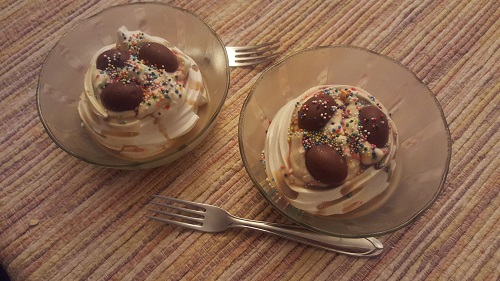
To treat ourselves at Easter we got a very nice chocolate Easter Egg, and some little individual ones that Mike used to decorate this dessert confeccion he came up with. He purchased some merengue cases, filled with whipped cream topped with a slosh of Kahlua. As the merengue cases were reasonably large, the cream was a bit much for me, but the combination of flavours including honeycomb filled eggs was delicious. Possibilities to explore here are smaller cases with perhaps fruit puree topping with a slosh of kirsch, or instead of cream in the centre making some patisserie cream topped by the fruit puree. Uruguayans would probably consider a layer of dulce de leche under the cream, but we’re not culturally adapted enough to consider that!
Eggs For Breakfast At The Schwabes 1

Some time back Ivan sent me this video on ways to prepare eggs: Every Way To Cook An Egg (59 Methods and if you have half an hour to spare on a rainy afternoon or something, I recommend this fascinating and at times hilarious video, with some great ideas and serious flops included – anyone for hard charred eggs from the Weber? Or how about, um, egg lattice, cooked rigid in a waffle iron?

Most mornings at chez Schwabe, we each arrange our own breakfast, and for visitors, depending on how well we know them and what’s going on, we encourage them to help themselves. Mike often poaches an egg on toast, or has some left over something on toast. My own normal breakfast, 6/7 times per week, is about 1/2 cup of toasted granola and a handful of toasted plain almonds topped with about 100gm, about 1/2 cup, of fruit yoghurt.

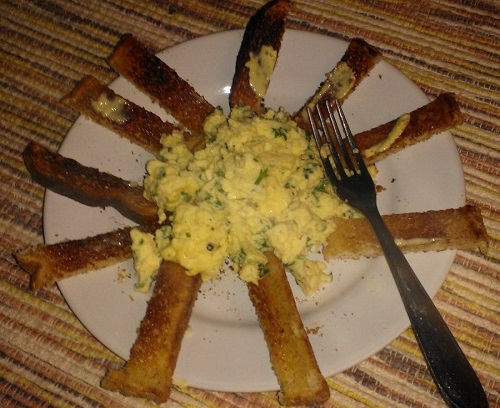
Now that we are both retirees, ‘weekends’ don’t mean so much as they used to when he was still working, but we do still tend to have some meals and other little rituals pinned to saturdays and sundays. Generally on one of those days we have a cooked breakfast, made by whoever has most hankering for their favourite egg dish. Mike generally makes excellent scrambled eggs served on toast. Sometimes there’s cooked tomato or bacon with it, but usually not. And, on cooked breakfast mornings we always have freshly brewed coffee, whereas my 6/7 beverage is green tea with a dash of orange.

Mike’s scrambled eggs

Mike’s scramblies are made this way – and I quote:

  • Put 2 eggs per person in a ceramic bowl,
  • add milk,
  • whisk,
  • then microwave at full bore for 2 minutes,
  • stir with a fork,
  • add chopped parsely,
  • cook 2 more minutes,
  • stir again with fork, and
  • if necessary cook another minute,
  • then serve on/with hot buttered toast, S&P or Tabasco to taste.

———————————–

I checked other people’s recipes on the internet, and the amount of milk or cream ranged from 1 tablespoon per 2 large eggs to 6 tablespoons for 4 large eggs, so obviously this is flexible, but my rule of thumb for good scramblies that don’t go watery at the end is “a little less is more” when adding milk or cream. And, of course, there are heaps of things you can add to scramblies, but we both like them straight, with a little S&P or a sprinkle of Tabasco added at the table.

Dragon Fruit and Pandemic Updates

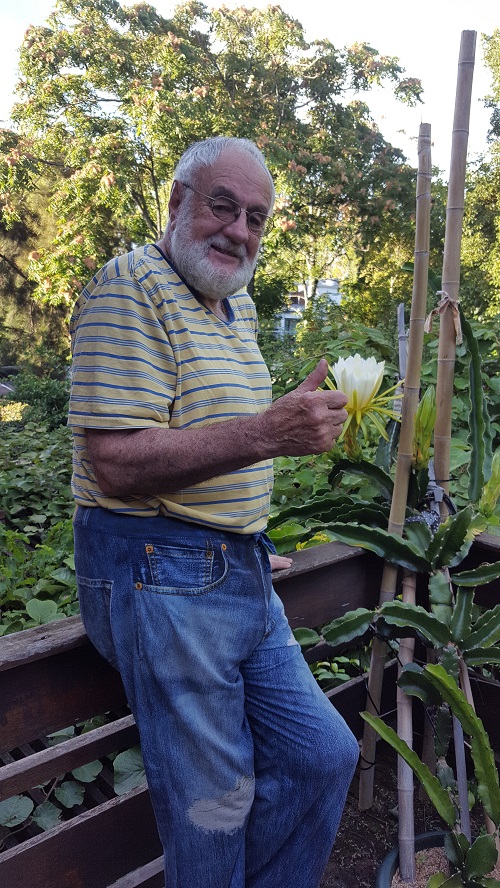
This time last year, Mike bought a couple of young Dragon Fruit plants which are thriving, side by side in pots on the terrace outside my first floor studio. He bought two different varieties, one with red fruit inside and the other with white. A couple of weeks ago, one of them produced 5 beautiful flowers, and one will open on the other plant in a couple of days’ time. However, we have no idea which plant is which 🙂 and whether these flowers will actually produce fruit, but we’re patient.

These next pictures are of Dragon Fruit that Mike recently bought from the market and ate – that’s a teaspoon beside it. I don’t especially care for them, but they’re quite beautiful.

I took this photo of the outside and the cavity left after eating the other half, purely because of the beautiful colour scheme potential.

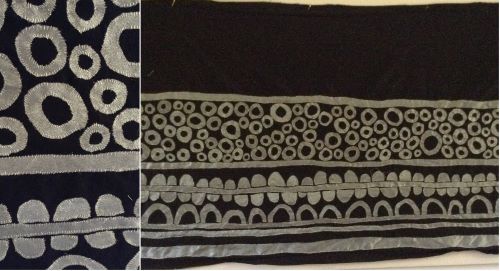
Since my last post, I’ve done a fair bit of stitching, making inroads to the 6km of thread, so now there’s a visible difference between the partially used cone of green and the untouched one, and I’m happy to say this quilt, Pandemic Pattern 4 is totally finished.

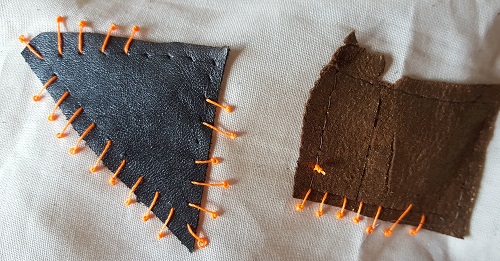
I’m sample making for the next in the series, which will feature appliqued leather coffin shapes with orange neon stitching.

In continuing pandemic conditions, there’s still plenty of stitching time as social activity is still minimal for our age group at least with the number of new covid cases has recently risen alarmingly here since January, and with the approach of Semana Tourismo known elsewhere as Holy Week, growing concern at the appearance in 6 or 7 departments,of the much more contagious Manaus variant, P.1. currently raging up in Brasil. The minute we could, we registered to get the vaccine, and are waiting to be allocated appointments.

New Thread – 6km Of It!

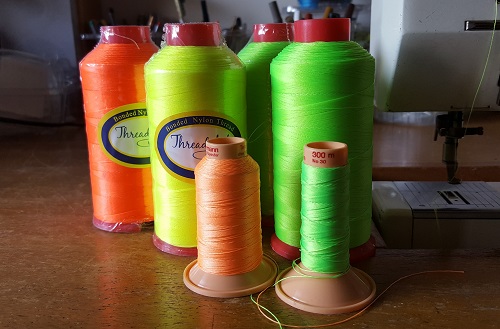
Around New Year, I realised I was using up my 300m cone of neon green thread too fast to finish the hand applique on the large quilt I’d started. I’d either have to get more thread or change my plan in some way, maybe settle for something smaller. The thread was Gutermann heavy duty thread in neons- yellow, coral and red, that I bought on impulse in a store in the USA at least 7 or 8 years ago, but their website showed nothing, and they didn’t respond to my emails. Searching around the internet I did find some neon threads of that description on Desertcart.com. It was on cones looking just the same as my original ones, so it didn’t occur to me to check the actual length of thread in the written description. I happily selected one of each neon colour they had – yellow, green and orange-red. And then, thinking I should get an extra green, ‘just in case’, I added another green, so the total was 4 cones. When the parcel arrived in a timely manner, imagine my surprise when I opened it to find 4 x 1500m cones, totalling 6000m or 6km neon thread!

The small green one, now nearly empty, is beside a little-used one of my original purchase. The very slight difference between the two greens isn’t obvious, but I’m just alternating threads as I sew to ‘blend’ , JIC.

The listed cost per cone was around what I vaguely remembered paying for the earlier (much smaller) ones and of course I expected freight on top of that. However, there were various charges and costs added by customs here that took it over the total US$200 allowed for an import duty-free consignment, allowed 3 times per calendar year to all Uruguay residents and citizens. When I saw that bill I seriously considered sending it all back, though I’d have had to fork out more transport costs for that too. So I swallowed hard, mea culpa, and paid up, vowing to learn from experience. However, after I calmed down, and considering the actual amount of thread involved, plus that there’s a pandemic on and we’re not travelling, it seems the cost/m wasn’t so bad after all.

Whether by hand or machine, 6km of thread is quite a lot to sew through. This latest thread is labelled ‘nylon’ and actually sews more nicely than the original I’ve been using, which is a plus. I haven’t put it in the machine yet, but as I love topstitching as a machine quilting method, I know I’ll be making a point of using it that way. I’m loving neon colours+neutrals, and though I haven’t done any improv freehand patchwork in the past year, I am sure I will get back to it soon, and also think just having that resource to hand may spur me on to something interesting and different that I might not have otherwise contemplated.

Summer Break’s Over

In truth, the last few weeks have been little different from any other since the pandemic’s arrival here last March 🙂 Christmas and New Year came and went very quietly in isolation, with family from Australia, New Zealand, 2 locations across USA and ourselves joining for a while on Zoom. Most years we are together with some of them somewhere if not at Christmas then probably New Year or just after. It was much the same for most people our age in Uruguay, though small family groups were able to gather – unfortunately early January this seems to have resulted in and alarming spike in new infection numbers. Right now, early February, (touch wood) we seem to have passed the peak of that wave, the numbers are still oscillating between the 400s and 700s per day, though in an overall downward trend.

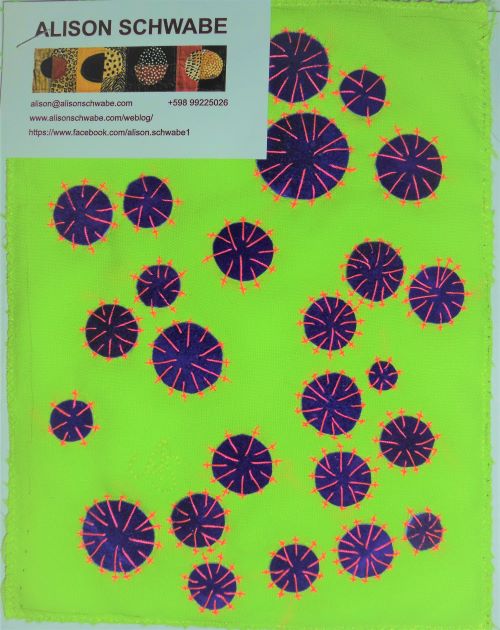
Sample “Pandemic Pattern 3″ (6:”x8”) has just been sent off to the SAQA spotlight auction. It is really bright neon green!

With the continued lack of group social citvities except online, there is ample time to stitch, and the other day I lined up a group of projects completed and works in progress (WIPs) on my pin board. While it’s hard to get a direct angle pic of that wall, I include some of the things here:

“Pandemic Pattern 2” detail, quilting in progress, for SAQA Online Auction 2021.

Also in progress are larger pieces, this next one I put aside for a while to decide what goes in the top section while I made Sunburnt Country, which I felt some obligation to make, as I’m on the organising committee for that exhibition 🙂

Untitled, in progress, hand stitched applique. Finished size to be ~90cm x 190cm

This next image is of a sample piece I made in the Stitch Club workshop by Richard McVetis:

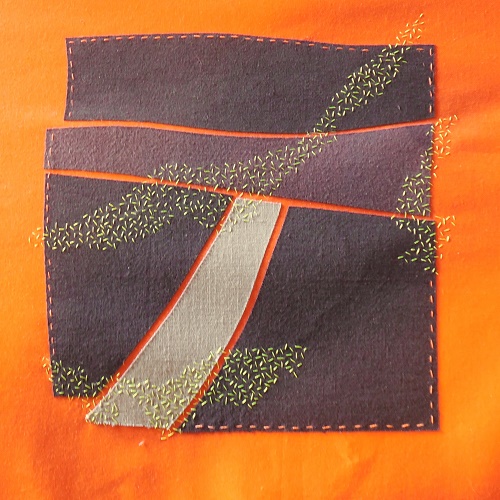
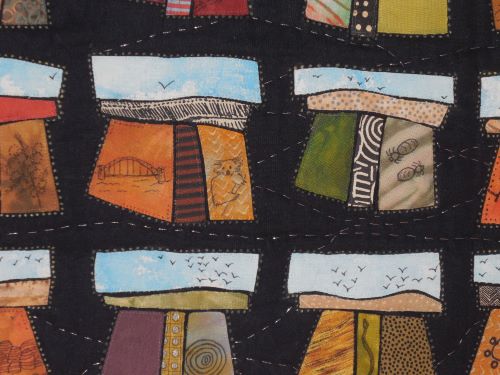
The idea of slightly pulling apart the sections of the landscapes instead of piecing them came from the Stitch Club workshop by Richard McVetis in which it was suggested we placed segments of fabric edge to edge. I applied this to the landscapes I’m always interested in, which turned out to be a really good move. Piecing the tiny little landscapes had always meant seams which showed beneath the surface and always bothered me a bit. With the help of a fusing web adhesive and setting the segments slightly apart before ironing into place show background to gives a stained glass effect with no seam allowances showing. Pleased with this I used it in Sunburnt Country:

Sunburnt Country 2021, detail.

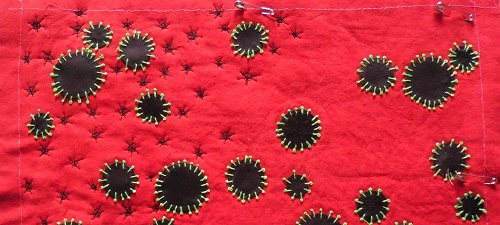
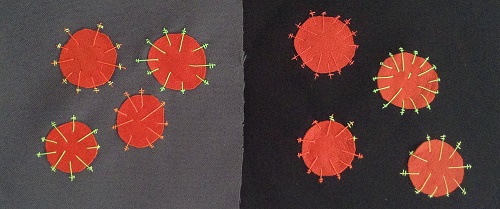
I’m currently working on a larger piece nearly 2m x about 1m, with red leather circles appliqued with neon green thread on black to represent the coronavirus virion– for the meaning of that word and the thinking behind my colour choices in this series, go to my visual diary post .

Background fabric audition (black chosen) for Pandemic Pattern Series #4, 95cm x 180cm, Hand applique, WIP.

The above sample making led to choosing black for the background and work is well underway. I’ll write separately about this piece soon, as I had an interesting time obtaining additional bright neon green thread I decided to use.

McVetis Workshop Continued

I decided to work first on the left side one, and if I’d been smarter I’d have used a thicker thread for the seed stitch… but I did want to use the flouro green and it is a pretty fine thread. Richard uses very fine seed stitch in his work, so there is that … I may do another to make a companion pair, with a ‘cloud’ of another kind of stitch filler, but I haven’t decided.

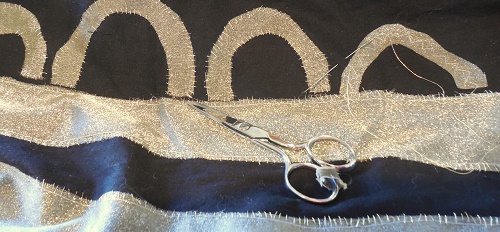
Right now I am resuming applique of the gold on black, and getting back to finish the motifs being stitched onto the little landscapes in progress.

it’s always interesting to learn how individual artists are inspired and motivated to create what they do. The next workshop, starting this coming weekend is with Mandy Pattullo, a UK textile artist I’ve been reading about https://www.textileartist.org/mandy-pattullo-from-conception-to-creation. For a prominent artist to claim to do little research before she starts making a work was very interesting, and a little reassuring to know I’m not the only one with this approach. She commented for the last 40 years she’s been ‘researching’ – by collecting postcards, photos, books and many other visuals which she pins on her board for inspiration (she might also have added Pinterest …) and all that time ideas have been formulating in her mind. I feel the same about where my ideas come from, though a big heap of my physical collection is in actual storage in Australia.

In this very stimulating series of Stitch Club workshops, it’s also interesting to me that there’s a very strong encouragement for us all to use recycled or repurposed fabric where possible in the various projects, and several of the artists have very strongly signalled that recycling is at the very core of what they do. I myself love seeking out remnants and discard bargains in outlet stores, but I do prefer to work with ‘new fabrics’ as in not repurposed. In a post by someone on a textile art organisation’s FB page this week, a member showed a very nice wool jacket she’d made for a relative, having recut and embellished a wool coat she bought in a thrift shop or somewhere. I’m not sure if the main intention of her post was to show thrift or art. A bigger question in my mind is this: does the use of recycled materials and fabric bestow some extra value on an artistic work ?

Pandemic Treat Workshop – Richard McVetis

The past week’s workshop with Richard has been challenging – very stitch texture focused, and he demonstrated a design method to prepare an interesting base for stitching. The stitches he recommended were the simpler ones – including straight stitch, button hole, long and short, seed, running and similar. These most basic stitches can be used as both outlines and fillers.

His workshop demo example was to trace the plane shapes of a building, but there were other possibilities – and two others I came up with were

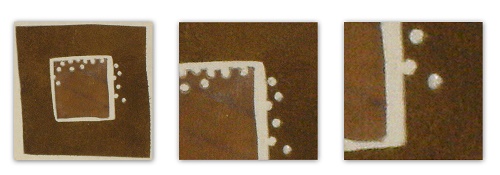
Leather block sample (L) cropped two suggested ways fo give interesting shapes.
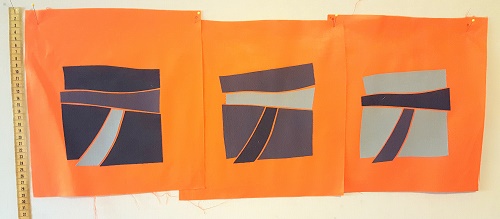
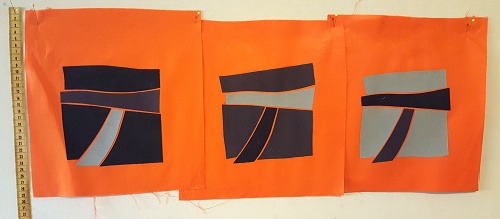
Two small freehand cutand pieced landscapes

The shapes were transformed into pattern pieces for cutting the fabric shapes that were then bonded into place on a background fabric, ready to stitch. (Go here for the basics on improvisational / freehand cutting and piecing) I chose to work on a design using a set of shapes to suggest landscape, and instead of fitting them exactly edge to edge, I left the space showing orange as a line between all the shapes:

Improv cut, not pieced but bonded into place on the background fabric showing through as a line.

I hope the stitching I do will enhance and complement these arrangements – because they’re all heat set into place now !!!

Coping by Going Online

At this time of year we’re always far away from at least some of our closest family spread between Australia, USA and currently New Zealand. I’ve long given up sending gifts in the mail for a cost that equals or even exceeds the cost of the gift itself, and instead arrange delivery from a vendor close to where the recipients live – call it supporting local businesses – theirs, not ours. As I write I’m nearing the end of Christmas shopping online for this year – a full 10 days ahead of my usual schedule!

The Christmas feeling received a boost the other day, though, when the oldies music station I was listening to played Eddie Rabbitt’s I Love A Rainy Night. That song always sends me back to Christmas 1980 which we spent with Sal and Rog at Las Cruces, early in the family’s fabulous trip in and around the southwest of USA, about which I’ll write another time. As we travelled around the sights that tune was on the car radio hundreds of times, which is the weird reason I associate it with the Christmas. I just had a another listen https://www.youtube.com/watch?v=MG0e8_foDmU

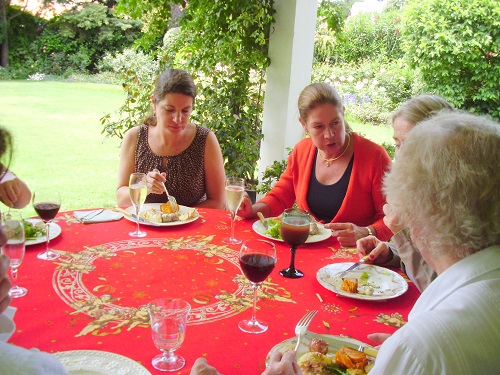
The book club I’ve belonged to for many years has always had a Christmas luncheon, usually catered, and it’s always been at Victoria’s home. Along the back of the house a very wide verandah leads out from the living and dining rooms into her beautiful garden. It has always been so lovely to help ourselves buffet style and sit around the decorated tables sharing the delicious lunch with fellow members, some of whom always brought along a visitor or two, sometimes visitors were former members. I went through some of the photos I took on those days, and sadly in the many years I’ve belonged, more than a handful have passed away or had to withdraw on health grounds. With half the membership being temporary Uruguay residents from other countries, those women have moved along, and I had difficulty remembering some of their names. They were (and hopefully still are) keen readers, great company and caring people I value having known.

The New English Book Club Christmas luncheon, December 2008

Here in Uruguay the pandemic situation has worsened recently, and some venues are again closed, activities sidelined and we’re all urged to stay at home if at all possible. We’re not in lockdown, yet anyway, but various government announcements make it clear that organisers and attendees of any kinds of events will be prosecuted if new cases are traced to them. So, in view of the pandemic, we’ve cancelled plans for what was to have been our well planned catered, socially distanced lunch out on Victoria’s back lawn. Instead we’ll be having our end of year lunch on Zoom. Lunch goodies will be delivered to us that morning and we’ll dress up and gather on screen later to eat it and toast each other for the coming year. I must make sure there’s some chilled white wine around…

We suspended our fortnightly meetings just before the start of the pandemic here, feeling we should wait and and see if the virus that was causing concern would turn up. Of course it did. A few days later the first cases were announced and within a week the whole country was in effect shut down for a while. Members have since exchanged their books by appointment with tMaureen who has the 300+ books at her house, and we’ve all been linked by WhatsApp and occasional individual meet ups. No one’s ever got round to organising meetings for us all over Skype or Zoom. Being such a huge step from how our gatherings had been since time immemorial, I just didn’t give that possibility a thought, partly because most of the reading I’ve done has been audio books while I’ve been stitching. But with this change in plan, I suggested we should try it, as we’ve all been experiencing Zoom in our own lives for a while now. The plan is to meet monthly starting in January, which might even lead to more book discussion group type meetings, which would be extra welcome.

Coping In The Time Of COVID

As new case numbers rise here in Montevideo ( 184 nationally with about half in the city) the situation is rather worrying compared to just a few months ago. That’s more reason than ever for seniors like ourselves to keep safely occupied at home. More than ever I am grateful that I am passionate about a couple of activities that take up lots of time – reading books and making textile art in fabric+thread.

Mike spends quite a bit of time reading, too, but also in tending the garden. And, as he’s doing as I write, he often lights the BBQ to cook something at the same time. as he’s moving hoses, filling the humming bird feeders, weeding and snipping, or raking fertiliser around. A few years ago I was very ill for several months and out of necessity he took over the kitchen, and though recoverd, I’ve never fully regained control of it, with the division of labour gradually settling around a 50-50 balance. During this pandemic, though, Mike’s gradually taken over more of the catering again, and this is actually fine with me, as it gives me more time for my art and the various things I write.

My ‘pandemic treat’, Stitch Club workshops, continue. They’ve become fortnightly instead of weekly, though, in response to feedback the organisers asked us to give. There’s now more time available for people like myself to explore a topic at more depth rather than whipping though a project by week’s end in time to focus on another completely different one. I’ve listened to all the tutors’ worshop videos and downloaded all the class materials for the future, just in case I feel the need to do them in the future. I haven’t done every workshop project, only the ones that really grab me, as I am spending quite a bit of time stitching on my own projects using the raw edge hand applique I’ve been developing in the past year.

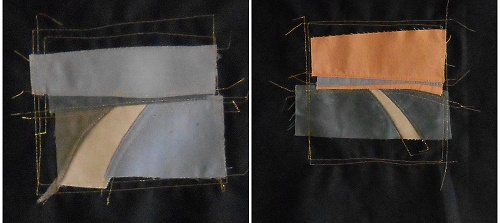
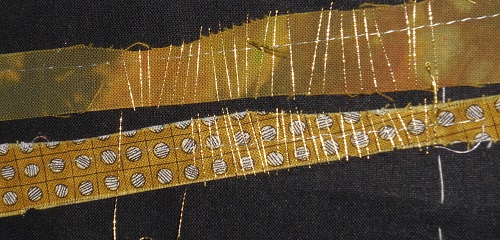
Raw edge applique with gold sample – white machine basting is removed after gold stitching is completed
A large hand stitched work, approx. 2m x 90cm , work in progress. Basting to be removed.

Once I’ve worked through the design phase and made all relevant decisions, I then stitch along, by hand or machine, listening to a recorded book or books, until I reach the end of the project. This one will need several more lengthy audio books! I’m currently learning more about the operational skills of a successful burglar in The Burglar, a thriller by Thomas Perry. Interestingly, this year I’ve finished very few of the paper or kindle format books I started, but that’s OK. I think it’s far more important that we each do what feels best to help ourselves cope with this pandemic.

So that’s it for today – it’s warm and breezy outside, I have some hand sewing to take out onto the patio with me, and as we get to lunchtime on this saturday, I will be ready for a glass of white wine. Cheers!

Sort Of Food Related …

I’m pretty sure I’ve eaten frogs legs at least once in my lie, and think I recall the meat was rather like chicken. It never occurred to me that their skins could be tanned and make lovely fine leather, until in May 2006 I received a few frog skins – hides? as a gift from a Uruguayan fibre artist. I must say I’ve never wondered what happens to the rest of the frog, either – I mean, now I think of it, I’ve never been offered frog stroganoff with rice, or roast frog served on stir fried veggies.

Frog skins, ~12-15cm x ~~6-8cm. Note – the ‘frilly’ sections where the legs join the body will iron flat.

Anyway I’ve kept these interesting skins, and pondered occasionally what to do with this beautiful fine leather, but recently when inspiration came I couldn’t find them anywhere – until today, when they suddenly just appeared, on the floor, around the back side of my cutting table where I almost never walk, so I think they must have been dislodged from within a little pile there on the corner of the table. Anyway, they are now found, and one thing I determined right away was whether this leather can be ironed – there’s a kind of frill from that bit where the limb joins the body, and it smoothes out under the iron, beautifully. Looking up an old (2006) post in my original blog that has become my visual diary, I found a post on the frog skins, but more interesting was this P.S. I added to that post a few days later. Receiving them reminded me of an appalling but very funny experience Mike and I had one night in 1992.

I had accompanied Mike on one of his periodic business trips to Uruguay, visiting from where we then lived in Denver CO. It was lovely clear night for driving, and we were on a beautiful new modern highway, heading south towards Montevideo. Suddenly on the road in front of the car was a splat of something that looked pinkish, lumpy and yet liquid – quite like a huge pile of vomit really, then another splat, and another, and then it became a trail down the middle of our side of the road. Mike did a good job of carefully straddling it and not sliding in it as it just went on and on. It was just amazing – eventually we stopped the car to see what it was – fish guts, absolutely, no doubt about it. It was probably on its way to a processing plant to become fertiliser or stuff to go into animal feed. We continued on and then passed a group of houses with people standing outside, very puzzled, no doubt pondering the difficulty of getting rid of it, and worrying what it would pong like over the next days whether they swept it off the road or left it there …. and still the trail went on. A police car ‘raced’ past us… and another…. and finally, after about 30KM, I kid you not, there in the middle of the road were police and other people, no doubt including the hapless driver, all standing around a huge tanker truck. Clearly the trapdoor had come loose, and the whole load had gradually emptied out onto the road.

Back in Montevideo we drove through some very deep puddles to wash the underside of the rental car. But, pheeeeew! by the end of the next day the stink was terrible and we simply had to turn that car in for another – of course splatters got up into the engine and all kinds of places, didn’t they? I doubt that vehicle was ever the same again no matter what they tried to do with it, as I’m sure every time the engine warmed the horrible smell would return.