Photos Trigger Memories, #1

Daughter Anna recently posted a photo of a group of four of us at my 21st birthday party, back in 1967. Standing with Mike and myself are my close friend Heather and Mike’s mate Tony Munro, who would be best man at our wedding a year or so later.

Here I was wearing my very favourite rich emerald green satin, floor length dress, which the family dressmaker, Mrs. Lucas, fashioned into an elegant halter neck number. Straps crossed on the back, and a flat bow was at the front where the straps joined the dress front. The fabric had a band of heavy machined embroidery along one side featuring paisley motifs with little lacy cutouts, which was about 40cm wide, and there was enough of it left to make the 3/4 sleeve jacket which I’m wearing in that pic. I don’t know or remember what, if anything, happened to that outfit. I don’t remember seeing it since packing up to leave the Great Boulder Mine in 1977, but surely not … but anyway, it could be under a pile of blankets packed into a brown painted wooden crate still in storage (just one of the untidinesses of our lives.) The fabric was bought for me on a shopping day with Mum in some of her favourite Sydney shops, all of them quite upscale institutions which stocked high quality brands, many, perhaps even most of them imported from England or ‘the Continent’. (I mean, from her experience, where else would one buy real quality in 1960’s Australia?)

Our hectic university student social lives in those days required several long dresses, most of which we ran up ourselves, as styles were simple then, and our budgets were low. The young men required a dinner suit, and all this formal gear was worn probably at least two dozen times in most years, possibly more for those living halls of residence on campus. This green dress was such a favourite that I saw no need for a new one for this party, much to Mum’s disappointment.

She was 16 when WWII broke out and clothing coupons took effect in Australia. Her own post-school social life, courtship and wedding (1943) were all carried during that austere period of rationed clothing, which lasted until 1948. That helps explain why she often bought what was pretty expensive clothing which I now realise was in part a reaction to what she and all other Australians went through in her youth, a kind of revisiting her dreams through her daughter’s young life.

However, she always went for quality materials and manufacture in basic classic designs. Because such designs never dated, with proper care they lasted for many years. I’ve adopted that approach, too, along with another clothing ‘rule’ which was to always change out of her ‘going out’ shoes and clothes when she returned home. (I’ve always had certain clothes I never wear outside the front gate) Of course, her parents’ generation (my grandparents) survived the privations of the Great Depression, so it was little wonder that to my eyes she often went a bit overboard spending on quite expensive clothes, and my wedding was another occasion full of examples of Mum really ripping apart the purse strings. I was once in a Launceston women’s upscale clothing boutique, trying to decide whether to buy a very expensive Diane von Furstenberg 3 piece outfit – silk skirt, wool jumper and silk scarf, in jungle print and black, browns, golds and cream. It was gorgeous, looked terrific on me, but the price, AU$400, was a huge amount of money in 1984. I’d never spent that much on anything other than furniture. (my top of the range Bernina sewing machine had cost about $300 some 10? years before) Most of that money was a gift from Mum, to which I added a bit, but she seemed shocked when I told her her the outfit’s price. I think she’d expected I’d buy a new couch or something for our home, not something personal like an outfit!

What tipped me over the brink of my hesitation ? The sales woman said “Well, it’s really investment dressing, isn’t it?” … which I immediately recognised as another one of Mum’s underlying rules, and without further ado bought it. The silk skirt wore out many years ago; after some years I found the jumper didn’t fit me as well as it used to so I ‘lent it’ to my friend Kitty who’d always loved it; and I still wear the ~150cm x 60cm silk scarf many times a year, winter and summer. It’s a great wardrobe accessory which I never travel without. A quality investment indeed!

Family Mayonnaise Recipe

When we Padman girls were young, one of Mum’s aunts, Anne Weedon from Goulburn NSW, stayed with us several times in the 50s and early 60s. Mum’s mother, Libby Weedon, was one of the large family of Weedon girls, at least 11 possibly 12 , who mostly married and raised families out on the Western Plains around Yass, Goulburn and Orange. One, our ‘Grandma in Sydney’ married Ted Croan, and another whose name I don’t remember married and went to Victoria, Narre Warren I think. But really, the only one I recall actually meeting was Aunty Anne, who visited us several times at Bifrons Court in the 50s, when I was young. She did a lot of work for the Australian Red Cross I recall, and I have the impression she’d been involved for years. I remember seeing pictures of her in a Red Cross uniform, so I imagine that was for an active role during WWII, ambulance driving rings some kind of bell. She was a lovely lady, pretty elegant, not married, and I think possibly her life included a relationship with a young man who didn’t return from WWI which was a common, sad, story for many in her generation, born in the 1890s. She had beautiful skin, and I remember watching with some interest how at the end of the day she always cleaned off her makup with coldcream. (I tried that once – yuk) Our mother who also had beautiful skin washed her makeup off with soap and water, and I followed suit, with soap and water followed by a good moisuriser on account of living in the harsh dry Aussie Outback for over 20 years, always with the goal of not developing ‘crepey neck’… anyway, as a result my own skin’s not too bad considering the parched environments I’ve lived in.

Aunty Anne cooked lovely meals while she stayed, and the one thing that all three Padman girls all strongly associate with her is her cooked mayonnaise recipe, and which Mum made for ever more. Of it, Sal once said, “It was the only mayonaise we ever had as kids, and Mum used to make it by the gallon.” – a slight exaggeration perhaps, but there were often at least two big Fowler’s jars of it in the ‘fridge. It’s quick and easy enough to make, and we liked it better than anyone else’s mother’s mayonnaise or salad dressing-

Auntie Anne’s Mayonnnaise

  • 2 cups milk
  • 2 egg yolks (freeze the whites; use in a pavlova sometime)
  • 1/2 cup of sugar
  • 1 teaspoon salt
  • level tablespoon flour
  • teaspoon of mustard
  • 1 cup vinegar
  • piece of butter the size of an egg

Combine the yolks, sugar (next time I’m going to make it a scant 1/2cup), salt, mustard, flour and milk ( a minute or two in the liquidiser) Boil the vinegar and butter together, then add the other mixture to it, stirring constantly over the heat until it thickens. Remove from the heat and leave to cool before pouring/spooning all the mayonnaise into a lidded jar – it keeps for weeks in the ‘fridge. And Mum wrote somewhere in one of my cook books that adding finely chopped gherkins makes a nice tartare sauce – that’s true, though I’d add a little grated onion perhaps. Potato salad using the mayo with lots of finely chopped mint is great….

As you can see, the consistency is approximately that of a bought mayonnaise, so spreadable, but reducing the flour a little would make it more pourable.

I don’t know why I ever stopped making it, as this lot I made yestereday took all of 5 minutes up to just setting it aside to cool…. There are a couple of commercial mayonnaises I like, but lately I’ve been finding that while they’re great for spreading to make sandwiches, they don’t seem to have much taste – and no, I don’t have covid!

Any mayonnaise, if diluted with some vinegar from the alcaparras/capers jar, white vinegar or lemon juice, plus a bit of sunflower oil, makes a nice more liquid dressing for the kind of all-into-the-one-bowl-chopped-tossed-salad I like to have for lunch several times a week. Perhaps you make a similar one?

There are no fixed ingredients or quantities for this – and it’s easily scaled up for two or more eaters: To a quantity of chopped lettuce in a bowl for each eater, I add diced tomato or a few halved cherry tomatoes, some finely chopped onion or spring onion, some cucumber chunks, croutons if I have them, perhaps a handful of unsalted toasted almonds, some diced fresh fruit, chopped celery, a few sultanas or raisins, some capers or a few bits of chopped jalapeno if there’s an open container already in the fridge … you get the idea, and don’t foget to add those little bits of left over cooked vegetables. For protein I add some diced left over cold meat or salami – even one cold sausage finely diced goes a long way. At this stage I add enough dressing to lightly coat most of the chunks in the salad, and toss well. Then, if I’m adding 1-2 chopped hard boiled eggs/person, or some diced avocado, I add these last and just stir in slightly.

It always reminds me of someone’s ‘garbage soup’ recipe – in which all the leftovers are tossed into a big pot of good home made soup base started from scratch – I’m sure we who don’t eat soup out of a can know this kind of hearty ‘soup recipe’ well!

Tempus Fugit

Dear reader – I’m sooo sorry I’ve neglected you! I can’t believe how long it is since i wrote here…

First – this is not a recipe, sorry – but this is a food related tip that I myself devised a few hours ago while preparing veggies for stirfry, or as they call it here, ‘vegetales wok’

To drain the bitterness that sometimes occurs in eggplant, slice the eggplant into layers, sprinkle each with a little salt and reassemble together held by rubber fands (adds a bit of pressure) Prop up in a bowl to drain before dicing for stirfry – it gave about a dessertspoon of liquid in the time it took to chop the other veggies. Rinse and blot dry before dicing. This has absolutely nothing to do with the rest of this post 🙂

My children are probably ignorant of the term ‘threescore and ten’, but it was commonly used as a Biblical allusion referring to the length of a human life (“The days of our years are threescore years and ten;” Psalms 90:10, KJV). “Score” means twenty, so threescore (3×20) and ten would be seventy years. So, having lived well past that, my age group can look back over enough time to see some major historical events in the world, not all of which struck us as being very significant at the time. However, others we immediately identify as groundbreaking or catastrophic without measure. And no matter how grim things are just now, nothing stays the same for ever. I know, I know – I’m an optimist, the glass is half-full kind of person.

I read a lot, and much of of it is to keep up with news and current events on three continents – the one I come from, the one I’m living on, and the one all our offsprings are living on. TV’s great for that, but I do better reading analysis by the ‘experts’ lined up by the mainstream media I trust, or by listening to some of the excellent podcasts available.

The early October Hamas attack on Israel and subsequent escalation has taken a lot of attention away from the disastrous war in Ukraine, and I feel the world now is in it’s most dangerous condition since the 1962 Cuban Missile Crisis. (the 9/11 Twin Tower attack not withstanding) I was a teenager then, and nightly the tv news talk of the threat of a nuclear war was quite frightening, and some some days several girls came to school crying. Our parents were very worried, their generation having lived the experience of Australia fighting against the advancing Japanese in WWII.

At Broadland House, my Anglican girls school, our history teacher was Miss Rooney, the excellent school principal with an excellent academic record in history, the subject she loved.  However, like many brilliant people she asssumed we all had a natural inborn interest in her subject, and her very old fashioned teaching style, while possibly ok for university classes, was pretty boring to uncommitted teenage girls with all the distractions our lives were coping with at the age of 15-16. In history class she mostly read from our text book, but some days for a change in pace we had to copy notes from the blackboard. As a result, history did not come alive for me at that time, and  as soon as I could I opted out of her classes to take economics instead. At university I took political science for a year, and too late realised that those friends who survived Miss Rooney’s history course were justifiably absorbed in history at tertiary level. I’ve frequently regretted not having a stronger history background, but one way and another I’ve been filling in gaps ever since.  Despite the awful state of the world today, as measured against the length of history, it is all fascinating, and I frequently find myself thinking or saying out loud that nothing stays the same for ever.

In the couple of years that saw the onset and height of the Covid pandemic, I spent more time stitching, so listened more to recorded books and podcasts, and read very few actual books – perhaps 4 or 5 over that whole time! But because I belong to a private, subscription library/book club, I recently resolved to get back to reading more actual books for pleasure, because we have some great titles in our collection.

For an annual fee of US$150, the group orders and brings down here to Uruguay recently published books (in English) from both UK and USA. The club was formed about 40 years ago, with half the membership being Uruguay nationals, and the other part comprised of english speaking expats usually here for a few years as accompanying spouses of diplomats and executives of banks and major companies with branches here in Montevideo. Back then, books in english were difficult to find and very expensive. Accompanying wives needed social contact while their husbands worked, and not all were avid golfers, tennis players or keen to be involved in charity projects.

This demographic has changed however, as not only do some diplomatic wives have work within their country’s mission, but trailing spouses and partners often work or study remotely while they’re here; and computers, ipads and kindles have eliminated the book problem. Another change in the ~20 years since I’ve been a member, and is that on the Uruguayan side of the membership, the middle aged women with kids at school or studying who would have joined are now working themselves. Also during that time, sadly, several of the older members have passed away, so the group is very gradually dwindling – the old order changeth etc. However it continues to be a wonderful social group, and to make the most of my subscription, I’ve determined I should read 2-3 books per month from it, aiming for about 50 pages a night, perhaps a bit more on a miserable wet day! Now that I’ve resumed reading a bit of my book each night, that book on my bedside table beckons each evening, and I’ve found it really is a better way to wind down at the end of the day than doing a final check of whatever’s on my phone. In the past week I’ve really enjoyed Mr. Nobody by Catherine Steadmnan, and tonight will start The Tobacco Wives by Adele Myers.

For many years I’ve listened to recorded books while making my textile art, a habit that increased if anything during the pandemic, as I had much more time to put into stitching. I’ve just begun re-listenening to Letters of Note: Correspondence Deserving of a Wider Audience… a book compiled by Shaun Usher, and which I enjoyed so much that I proposed it for discussion at the next online meeting of a book discussion group I belong to; and there’s a second volume I’ll listen to before the next discussion!

“Nothing Stays The Same For Ever… “

… is one of my oft-declared mantras… and since my last post there seems to have been more change than usual. I began this post a few weeks ago and it was put side for some Life stuff.

In many corners of the earth there are serious floods, fires, storms, droughts, attacks, skirmishes, invasions and all out wars – which in Ethiopia is now accompanied by spreading famine. There have been the usual departures of beloved world figures including celebrity writers and performers. Thanks to NASA, we’ve begun to receive brilliant, unprecedented, photos of what space looks like when you get way, way out there! Amazingly, a satellite sent up into the skies late late year collided as planned, with a small meteorite about the size of The Great Pyramid, both objects hurtling through space at just 14,000 miles an hour – mind blowing. The past two and a half years of Covid pandemic has exacerbated normal levels of problematic difficulties affecting parts of the world at any one time. In so many places around the world, people have taken to the streets, and in Iran both men and women are braving the authorities by open noisy violent protest against not just the death of Mahsa Amini in the hands of the dreaded Morality Police, but this unrest is spreading nationally and internationally, and is about more than ‘just’ the wearing of the hijab by Iranian women. And, of course my comments include the terrible war being waged by Russia against Ukraine, with resulting severe destabilisation of much of Europe and the Western world.

But in the last few months, the single event with the largest impact on the most people has been the death of Queen Elizabeth II, after her remarkable 70-year reign, celebrated in June with several days of Platinum Jubilee events in the UK, and all the Commonwealth countries. Queen Elizabeth’s death was followed by days of ritual, pomp and ceremony, covering her funeral and burial, plus at the same time, defined by detailed and historically significant minutae, the process of her son, Charles ascending the throne and becoming King Charles III. The TV commentary particularly on the BBC was fascinating. Additionally, we had endless discussion about particular royal family members, often accompanied by speculation where facts were not known, about the related adjustments to the line of succession, and the shuffling of titles and accompanying changes in roles and duties.

Even with my personal republican inclinations, the passing of this most unswervingly dedicated, long-reigning queen is one of the most significant historic events in my lifetime. I was a little girl of 5 years’ age when Mum announced one morning that The King had died, and Princess Elizabeth had become Queen Elizabeth. I barely understood all this princess and palace stuff and had no idea what a coronation was, but in the following 16 months until that event, I took a great deal of interest, and was a full bottle on The Royal Family by the time of QEII’s Coronation Empire tour which brought her to Tasmania, our corner of Australia. There was no TV in Australia then, so besides listening to memories and information from my grandparents, parents and their siblings, I consumed a steady diet of pre-coronation and Royal Family articles in the Australian Women’s Weekly, and we listened to radio. I remember leaning on my elbows spread out on the floor in front of the radio and following the whole coronation thing with a magazine centre spread of an illustrated map of London. I followed the commentary avidly as she set out in the magnificent elaborately beaded gown, in the golden coach with Phillip at her side, riding from Buckingham Palace, along various streets to Westminster Abbey. From there someone described the whole scene of courtiers, lords, local and European royals and Empire VIPs. After the long service and crowning ceremony the procession wound through the streets back to the Palace for the Balcony Wave to the assembled cheering crowds.

On August 28th last, in breaking news on all major networks, around breakfast time here in Montevideo, it was announced that doctors were concerned for the Queen Elizabeth’s health, and at she may have already been dead or about to pass, but it was not until early afternoon here that her death was officially announced, as there were many groups of people and authorities to be officially informed: the Royal Family itself, The Palace, the British Government, the governments of those commonwealth countries of which she was Head of State (like my own, Australia) the Anglican Church, senior military, police and security forces, and more. Special programs began appearing on our TV screens once her death was officially announced, and continuous coverage began and continued, on and on and on, for days, in all the print and digital media formats you can think of.

She’d steadfastly reigned and ‘been there’ for so long, that it was easy for people to assume she’d be there for ever and so many people expressed the shock they’d had. There was so much ceremony, beginning with lying in state in Scotland, followed by transportation down to London, the 4-days of lying in state for the general public to pay their respects. ‘They say’ over 250,000 people queued for many hours, in a line often 10 miles long, to pay respects to her coffin lying in state. I imagine it might have been more. The commentators were marvellous, informing us of all the detailed arrangements for her funeral and burial.

It was an important world scale event, and I did admire her, sharing with others considerable sadness at her departure. But, honestly, though it was all fascinating, and I’m grateful for modern TV being able to bring important events right into our living rooms, I was seriously overdosed, quite exhausted, by the first few days of all this. So after that, until the actual funeral service and processions on Monday September 19th, which I watched in full, I resorted to edited highlights each evening, and was hugely relieved when the BBC and CNN returned to regular programming on 20th. That didn’t last for long though – Hurricane Ian, force 4, then swept a devastating path across Cuba and Florida bringing havoc to Atlantic coastal areas, and (just for a few days) breaking news coverage again shoved normal programming aside.

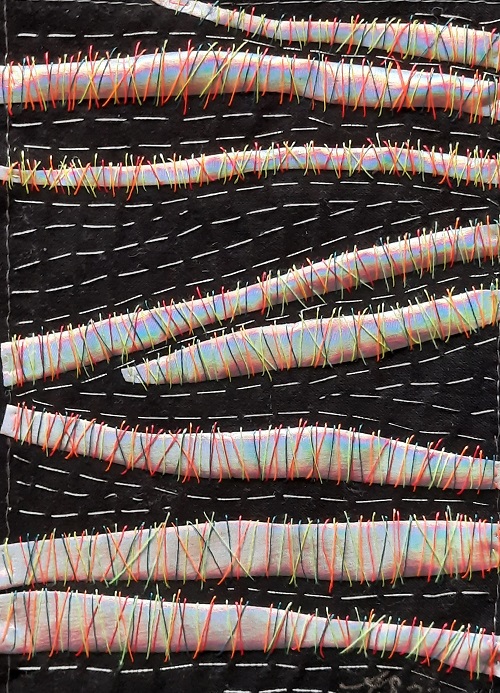
The process of constant change around us has been the essential theme of much of my art, particularly for the Ebb & Flow series of art quilts which I doubt I’ll ever complete and abandon. Just this week I again used the wandering lines that in my mind characterise change, in the making of this years small donation to the Spotlight Auction that takes place at the SAQA annual conference – I’ll publish the online link closer to the time – but here’s the image of the work I put together:

Ebb&Flow 30, 6in x 8in. Donation to the SAQA Spotlight Auction, April 2023.

Life Can Be Untidy And Complicated

In late late 1997, Mike and a colleague were funded by a group of Australian investors to search for gold in Uruguay, start a company to mine it, and hopefully make everyone a bit of money. That stake money was for hiring a few people here and carry out mapping and sample surveys, certainly not for moving the Schwabe’s household stuff to the other side of the world, and just then we couldn’t afford it ourselves. Our lengthy experience in the mineral exploration industry had long ago taught us that any speculative venture of this kind could all suddenly end, and so we decided to leave our house ready to walk back into if needed. After all, as Mike confidently claimed back in 1997, it was going to be a quick job, in and out, just two or three years…. yet here we still are.

So began a series of house sitters, beginning with the daughter of a friend, then her friend, then Mike’s niece who began sitting while studying nursing. She was followed by several more sitters in turn, always on personal recommendation from someone we knew, and each did a wonderful job living in our house, using our stuff and taking care of everything. It was an unusual arrangement in the details, but it worked well for us. Time rolled on, the place was always in good order when we turned up for a visit. The final sitters were unwed when they first moved in, but by the time we sold 7 or 8 years later (to them), they had produced three young children, and of necessity acquired more stuff, as you do. One reason we sold was because apart from needing to do some serious upgrades to bathrooms and the kitchen, now being decades older we’d realised we’d buy a different kind of house in 2020 than we did in 1994.

The full story of this quilt, is at http://www.alisonschwabe.com/weblog/?p=1503 It hung along a wall upstairs in our Perth house.

We had everything coordinated to quickly work through the house to clear our stuff out of drawers and cupboards and the places where it had gradually migrated to over the years. Not surprisingly, my sewing room in particular was loaded with stuff that had gradually been moved there to free up living space in the rest of the house. We had only a few days to get our stuff sorted before the packers were due, so we worked hard and fast with the help of a friend, discarding and donating mountains of clothes and household stuff – the removal company packed them in donation boxes which they delivered to charities. We got a bulk bin delivered to the front lawn and filled that with rubbish for the tip. After those few days the packers arrived, deftly packed all that was left including our best furniture and goods, and sent it on its way to the removal company’s storage depot to await our next instructions. Three years later those have not yet been issued!

Anyone who has downsized will confirm that you always save things that eventually you hand on or throw out, so we realise we’ll dispose of more stuff as/when we unpack again. I didn’t have the time to go through my sewing room as I’d have liked to, but I can vividly picture what was there. On visits back to Perth I often brought a few things back with me, notably favourite fabrics which I tore in half and left one part behind. I brought over just a few special books, and had magazine subscriptions redirected. Now I only subscribe to digital editions of fibre art magazines, and there’s so much other interesting stuff online, anyway. It’s years since I bought a textile art book, and here in Montevideo I’m probably ready to pass some or many on. I should organise a book sale…

In that room were also some lovely linen and Aida cross stich fabrics in several colours, all of which I’ve kept for the 30+ years since my cross stitch phase. There was a decent sized drawer of embroidery threads, including the Danish Flower Thread I was so fond of using back in the early 80s before we went to USA and I became immersed in quilt making. Who knows, I may again be interested in cross stitch, but if not, they’ll be snapped up by someone in the embroiderers guild or similar groups.

Jessica Grady – A Terrific Stitch Club Workshop

I recently signed on for another 12 months of Stitch Club workshops – go here for more information about it. My regular readers will remember this monthly subscription is my Pandemic Treat to compensate a little for not being able to socialise normally or travel to visit the offsprings. The cost is approximately equal to 2m of good quality fabric that I’d buy in a quilt shop if I could get to one! Though having said that, my work has changed so much, that it really doesn’t matter at the moment that I can’t buy quality cotton fabrics here in Uruguay. I’m using other stuff though perhaps not for the purposes I originally intended them to be used.

This is the first workshop I’ve done this year and it is a blast. Jessica Grady is a UK textile artist who uses a wide variety of waste materials to craft her highly textured embellishments she puts onto her fabric compositions with stitch. This first pic is the materials I gathered up in a few minutes rummaging around in my studio:

Card, several plastic things, bits of fancy fabrics whose planned use I never got around to, little gold stars, tea bag made of mylar, clear plastic marked with permanent pen. the green unwoven fabric lined a gift hamper.

She devised a set of little exercises for us to cut up shapes from out materials and layer them fastening with stitches and knots:

One of the great things about the Stitch Club workshops is that every workshop has a page where people can put of photos of what they\re doing or have finished. One fellow student cut some rectangular and square shapes from glossy cardboard, perhaps a shoe box or something, and using heavy bright thread stitched them all down in an overlapping mosiac kind of arrangement. That struck me as something that could be done with small fabric shapes as a surface design or texture on an art quilt/textile wall hanging, and so I did this little sample to capture that idea.

Shapes held in place by straight stitches, finished with a french knot in the centre. The stitched area is approx. 4cm x 5cm.

And somewhere in all this it occurred to me that cutting mylar tea bags into shapes for applique could look interesting, too –

A Chilled Soup And A Stitch Club Workshop

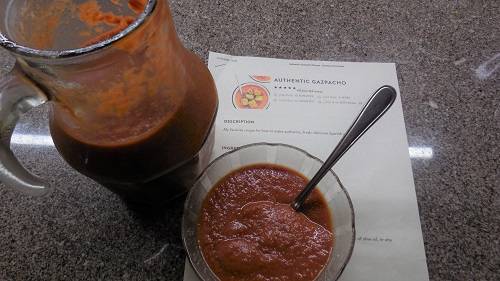
Warmer/hot weather has reminded us this week that summer’s almost here, and a couple of days ago it made me think of Gazpacho. This wonderful chilled Spanish soup is made of pureed tomatoes, red and green capsicums, cucumber, fresh garlic, some sherry or wine vinegar, onion, a slice of sodden day-old white bread without crusts for thickening, S&P to taste, and a few other ingredients. Very Mediterranean and no doubt healthy. I zoomed it all up in the food processor. and because it’s too early for my favourite Roma tomatoes, I used a jar of tomato puree instead.

As I write this post I’m waiting for the soup I made a couple of hours ago to chill down further for a light dinner tonight. We’ll sip as we watch our current Netflix serial – Season 3 of NARCOS Mexico. Gripping. It’s a shame it’s not stinking hot, but we’re having it anyway. I haven’t made croutons, but might whip up some toast if Mike wants it, otherwise, no. It will be on the menu regularly now that summer’s almost here.

In the past week, prominent UK textile artist Emily Jo Gibbs has been presenting one of the Stitch Club workshops. She uses layered sheer fabrics to provide areas of colour and adds beautiful detail using fine threads and various stitch techniques. Her intricate studies of people and still lifes are quite detailed and delicate – qualities most people would not normally associate with my work, but I’m loving this workshop anyway! Emily hand stitches with a single thread, usually sewing machine threads, achieving very fine stitch patterns.

  • It was suggested we tackle two exercises, each approx 8″ x 10″
  • the first of shapes arranged into a composition and the raw edges stitched down into place;
  • and the second ditto, but with a layer of organza over the top of the whole arrangement to contain the raw edges without necessarily needing to stitch on every edge. Of course, the overlay somewhat mutes the colour beneath.
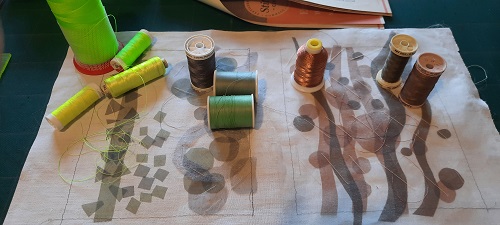
Thread auditioning for the two compositions

I auditioned some threads, thinking the raw edge one (on the left) would be nice with my trusty florescent neon threads, and on the other I’d use metallic and plain threads.

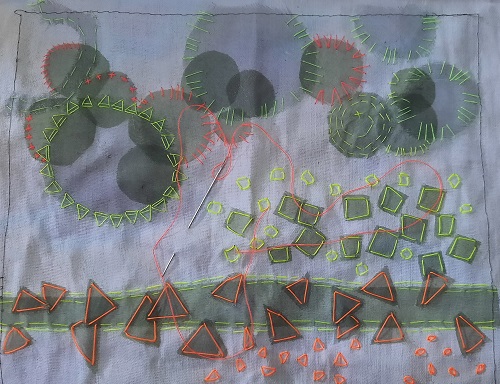
The stitched composition with raw edges – the background is actually white – sorry about the bluish cast.

In my first exercise, I’m essentially building on some of the samples I made in my SAQA 100 Day Challenge, about which I regularly wrote about on my other blog, http://www.alisonschwabe.com/weblog/?p=7124.

Second composition under a top layer – metallic stitching started but I’m not really enthusiastic with it yet.

This second exercise is currently not exciting me too much yet, but I’m thinking about it and will finish it off this week with the fine stitch patterns it needs. When I’ve achieved that, I’ll call it a day. The workshop’s second week explores painting on overlays to increase complexity in designs, but I’ll pass on that bit, being keen to continue with the surface design of the new piece I’m working on:

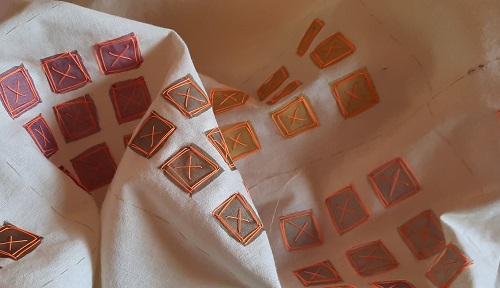
A new work in progress – surface design of squares approx. 1.5cm, fused to the cream fabric, and then stitched with heavy duty neon nylon thread.

Much more information on this new work is on my other blog, at http://www.alisonschwabe.com/weblog/?p=7124

In the 100 Day challenge, I found that small squares in paint and organza with a single stitch around each edge really appealed to me and have become a bit of an obsession 🙂

From Day 100 – stencilled squares, stitched with metallic thread. 3.25sq.in

A Recipe From My Teen Past

For no particular reason that I can think of, a few months ago I thought back to a recipe that one of my best school friends’ mother used to make so often that whenever we turned up at Caroline’s house, there was always some in their kitchen or on the afternoon tea table. I possibly have the recipe in storage – but it’s been so long since I’ve seen most of my recipe books that I don’t recall, and who knows when I’ll see them again?

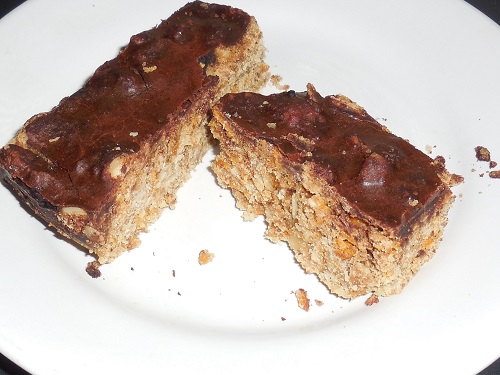
When Caroline recently turned 75, and her husband sent photos of the party we’d have attended if we’d been on the other side of the world, I suddenly wanted to make some of Mrs Fletcher’s Chocolate Iced Biscuit Base, so I emailed my birthday wishes and at the same time asked if she still has that recipe. Back came a scan of a well-used page in Caroline’s handwriting, and within a couple of days I had made it, and I knew as soon as I could smell it cooking that it was going to turn out perfectly! Well, actually, even though you could hardly go wrong with this, I do confess since it said “mix all dry ingredients” I blithely tossed in the cocoa instead of keeping it aside for the icing! But anyway, I melted a bit more butter, and measured out more cocoa for the icing – and it still tasted like I remember from all that time go. Containing rolled oats, cornflakes, brown sugar and butter, it’s very like one of those breakfast or snack bars around these days, but of course it contains all natural ingredients, just as our mothers always used.

Mrs. Fletcher’s Choc Iced Biscuit Base

Mrs Fletcher’s Choc Iced Biscuit Base

2C cornflakes, 2C SRF

1C coconut, 1C rolled oats

1 1/2 C brown sugar, 10oz melted butter

Mix all these ingredients, add melted butter and stir in to bind. Spread mix in baking dish, and bake at 350F for 1/2 hour.

While still hot, spread with this icing: Sift together 1 1/2C icing sugar, 2T cocoa, 1t instant coffee. Add 2-3 drops vanilla essence, and some boiling water (start with 1T, adding more gradually)

Stitch Club Workshop – Shelley Rhodes.

The workshop just ending has been particularly inspirational. Shelley Rhodes is a UK fibre artist whose mixed media work features fabric+paint+ various markings+stitch. Shelley suggested we chronicle a walk, and that there were various ways people could approach that – by going on a particular walk, recording markings of lines and shapes on our prepared fabric, do the same from a remembered walk, and for the mobility challenged a stroll in our own garden or nearby local park would serve the purpose. I referenced some of the many photos I’ve taken on my walks along the Carrasco beach down the years.

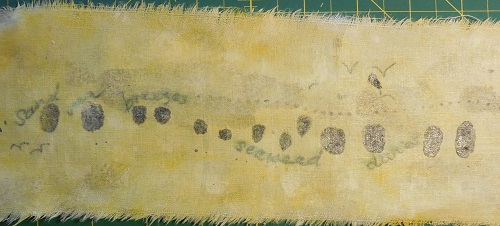
One of the things were were encouraged to explore was using some related text or written words. Our line and texture markings were to build an abstract, non pictorial record of patterns of lines and shapes we saw on our particular walk. Some people’s results were very successful, but others found doing anything non-pictorial very difficult.

In this first pic, I did some sand ripple markings and a few ‘beach’ words, but they then blurred when I added another layer of paint over them.

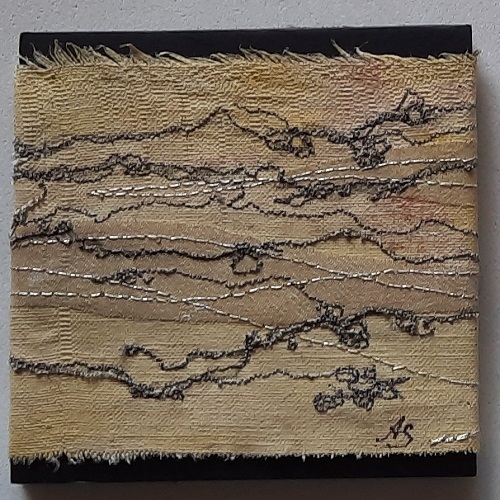
By that time, too, the paint had made the fabric too tough for me to hand stitch through, so I resorted to free machine embroidery:

Painted and free machine stitched, ~5cm x ~25cm

The next couple of pieces were both cut out of another long strip, again too stiff to hand stitch through, so I machine stitched. Each section was mounted over foam core, which I didn’t realise came in colours until I went to buy some last week. Naturally I chose some black in addition to the white, and love the effect of the torn edges against it. I made a note to tear and possibly fray more thoroughly before painting in future.

The small size, 3.25sq.in, of these two pieces, is so that these little samples also fit into the 100 Day Challenge I’m participating in with SAQA Studio Art Quilt Associates.

I’m posting many of these on my instagram page @schwabealison, as the challenge’s FB page is only visible to participants. I’m killing two birds with one stone here...

Pandemic Treat Workshop (Gwen Hedley) Plus A Great New Foody Travelogue Program

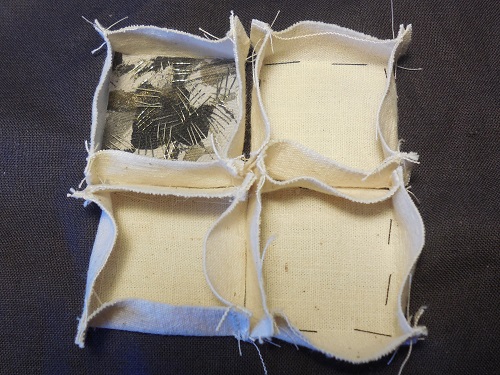
We began Gwen’s workshop by painting marks on fabric in 2 colours and then cutting sections, overlapping them and using stitch to blur the boundaries between different colours. A detailed account is on my other more textile art related blog. Where I became waylaid was trying out a presentation idea I discovered on Pinterest months ago, feeling this could be a good time to have a go at it. I’m very pleased with the result, and can envisage a whole lot of little shadow box things with paint and/or stitch squares tucked into them and fastened to the base.

With various projects in progress, I have found it ok to watch workshop videos but I don’t always follow through all the suggested classwork. Quite a few of the lesson technique topics I’ve ‘done’ over the decades I’ve been making textile art, but the videos and Q&A sessions are important, because there’s always something new to be learned from every teacher. Gwen Hedley’s art has always been a favourite, and I did tackle her workshop, though I got a bit waylaid with the presentation aspect.

After weeks of promotional publicity by CNN for a new series, this morning we enjoyed the first episode of Searching For Italy featuring American Italian Stanley Tucci – a hugely informative program, food/culture/geography/travel, with segments on Naples and places up and down the coast, mostly. In the poorest section of Naples a new cuisine is emerging as Romany immigrants and very poor Italians on the edge of the city working together developed a very successful food kitchen sharing recipes, and which has turned into much more than a local food kitchen. It is now stil la food kitchen for the poor, but also a very popular large restaurant business the profits from which provide funding and facilities of child care for residents’ children- amazing. The whole Campania region was enthralling. We learned that pizza was more like an empanada originally, and deep fried to prevent people becoming ill during cholera epidemics in C19 and early C20. It was fascinating to see how Stanley’s pizza expert mate made the pizza base – flour, water, yeast and salt – adding only fresh mozzarella, San Morenzo tomatoes salsa, and a little freshly grated pecorino cheese. I’m going to give starting from scratch a go sometime soon. We’ve often been puzzled about what passes for “pizza” here in Uruguay, where a big portion of the population has Italian roots – but this explains the absence of the large variety of toppings that typically adorn the North American style pizzas we’re more accumstomed to, and that we ourselves assemble. We saw how it important rabbit is and how it’s cooked on the island of Ischia off Minori on the Amalfi coast, and being afficionados of rabbit, which is farmed and available for sale here, we’ll have some of that very soon: it’s winter, time for some.

It was a nice way to start the day, but it will be repeated at other times, too, and we don’t really want to get into watching TV still in bed from 8-9am on weekday mornings – but, on the other hand, why not? The pandemic’s still on. It is still bad here, with most departments still in the Harvard Index red zone, although numbers suggest there’s an over all gradual decline. Vaccination is being rolled out fast and efficiently, and taken up with good responses, over 70% of the population have received at least one shot, ~40% both. Mike and I got our second shots last week, it’s a good feeling.