Why Not Mention Rice?

These days Aussies eat mountains of rice, and grow plenty of it, too.  So for a little background to this post, I went to the Ricegrowers Association of Australia’s website  which confirmed what I knew, that rice is grown in large parts of New South Wales and northern Queensland, and the different climates of those regions favour production of different varieties.   My personal favourite rices are bismati and jasmin … different rices are best for different things.  I don’t make it, but I do enjoy sushi, for which sticky roundish grain rice is required – it probably has a name, but I digress.  I read one company, SunRice, has been supplying rice to the Australian market for over 50 years, and that gels with the memories I’m sharing here today.

Today’s Aussie kids grow up eating a much larger variety of foods than we did.  In the decades since the Vietnam War, especially, many of us have travelled in nearby Asian countries ranging from The Middle East right across to Japan.   As a nation we love Asian food, and various Asian national dishes including the ubiquitous staple, rice, are on the menu in most Aussie homes and many restaurants around the nation.  People from African and South American countries also eat a lot of rice in their cuisines.  All that cultural diversity we’ve embraced in the waves of immigration in my lifetime since WWII has introduced us to many other foodstuffs like quinoa, tabouli and hummus, now so everyday common, but we’d never heard of them 50 years ago.

Tasmania produces mountains of potatoes, and like most people then, we ate potatoes every main meal and often two meals per day. Some time in the 1950s, for several winters in a row, there was serious outbreak of blight in much of Tasmania’s potato crop, making them scarce and very expensive.  When this shortage hit, Mum substituted noodles and rice for potatoes, serving them only when we had visitors; and we understood this was to be strictly without any comments from the peanut gallery.

It probably wasn’t only Mum’s basic social insecurity, as a lot of the British stiff upper lip and sturdy Scots endurance ran in our blood, too.   There was always an underlying concern that people outside the family shouldn’t know when things were financially tough, as they really were from time to time.  One contributing reason for that was that Dad may have over-reached a bit to buy the Bifrons Court house in 1954 while at the same time starting to build up his optometric practice with extra staff and plant. There was tension whenever shoes needed mending or replacing.  We each had a pair of sturdy lace-up leather school shoes and a ‘best’ patent leather pair for sunday school and parties.  Shoes were only passed down in the family and usually worn out completely.  As we girls grew out of them, clothes were handed down first within the family and then around Mum’s friends with daughters.  I’ve always wondered where the beautiful Viyella dresses Mum smocked for us each year ended up… God forbid that people might hear that the Padmans of Bifrons Court were being forced to economise, and were actually eating far more rice and noodles than potatoes – but really, who could give a fig?

However, probably because everyone else had also switched to rice on account of those severe shortages, within a few years it became socially acceptable, indeed fashionable, to serve rice at even the swishest events  😉
Mum’s Curry

I just loved chef Rick Stein’s absorbing BBC series a few years back:  https://www.bbc.co.uk/mediacentre/mediapacks/food/rick-stein.html         The story line was a quest for the best Indian curry, forming a fascinating travelogue laden with personal childhood memories, cultural notes and experiences, videos of people including Rick preparing curries, and of course a few recipes.  One of the lasting benefits of Empire was the advent of curry in British cuisine, and it is claimed by some that the best Indian curries anywhere are found in London.

I’d like to bring you ‘curry’ from my own childhood, spent in that far corner of the British Empire, Launceston, Tasmania. Our family tradition was that the Birthday Girl chose the menu for dinner that night, and like it or not, we all had to eat it.  Sister Rosemary always chose Tripe in white parsley and onion sauce, with mashed potato and peas or beans.  Sal’s choice was always Pork Fillets, in which the fillets were egg and breadcrumbed, fried and served with a wedge of lemon, mashed potato, a green veg and carrots.  My own favourite was Mum’s curry.  Until I left home I had no idea people curried all kinds of foods including nuts and vegetables, even made curries without any kind of flesh, legged, shelled or finned.  I was equally ignorant about ‘spaghetti’, too, which I will share in another post.

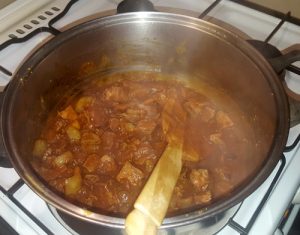
Mum’s Timeless Curry cooking, Nov. 10 2018.

Somewhere in my cookbooks in storage is Mum’s handwritten curry recipe.  It was always lamb, and the recipe never varied.

You need a finely diced large onion; a good dollop to taste of curry powder ie. 1/2 cup or heaped Tbsp (if making for the first time choose medium strength).  Saute onions and curry powder in some drippings from the weekend roast.  To these you add 2-3 cups of diced lamb, a stock cube dissolved in 1-2 cups of water, and a dsp of tomato concentrate.  When that’s bubbling turn it down to simmer gently and add in a cup+ of sultanas and wedge of squeezed lemon to be removed before serving with steamed rice.  Accompaniments: small bowls of salted peanuts, home-made tomato chutney, banana slices tossed in lemon juice, desiccated coconut, and if seasonal, diced or sliced cucumber.  (The word ‘yoghurt’ was never mentioned in decent Australian homes in the 1950s)  The recipe included “S&P to taste” and an optional pinch of garlic that I never actually saw Mum add.  In that recipe she wrote “I find many people use far too much garlic.” When we cleaned out her kitchen after her death we found her powdered garlic container was full of fine cobwebs –she hadn’t used that option for a while!


Aunty Myrtle’s Mouldy Cake

Mum’s colourful Aunt Myrtle lived in Sydney, from where  Mum herself came.  Myrtle had married and been widowed young, produced no children, and never re-married, though she did take a gigolo from time to time, as no respectable woman would attend the trots, the dogs or the races unattended by a gentleman.  On periodic travels with a circus company owned by her sister and brother-in-law, she would drop in for lunch and family chatter, catching up with Mum, a favourite niece.  On those days the conversation was extremely interesting, featuring as it did myths, legends and gossip from Mum’s large extended family of people we almost never saw or met.

One year Mum and Dad decided to take their three girls on a trip to New South Wales, taking in Sydney and Goulburn, to meet as many cousins, aunts and uncles as could be arranged. We were aged 20, 17 and 14, so old enough to take it all in, and it promised to be an exciting few weeks.  Mum sent a letter, as people did in those days, to let Myrtle know we were coming, asking her to nominate a day we could visit her.

It seemed Myrtle was no cook, as when we arrived several weeks later, the afternoon tea table was set with plates of bought biscuits and a packaged plain Madeira cake, sliced ready to spread with the raspberry jam on the table.  Her old eyes couldn’t see, but our sharp young eyes certainly spotted the fine grey mould over the whole outside of the cake.  She insisted we all have a piece, and being well brought up girls we knew it was only polite to give in to her repeated urging.  Carefully avoiding the end piece, we all somehow managed to eat one slice slathered with jam, and politely declined seconds.  We spent  a most enjoyable afternoon gathered around Myrtle’s dining table, enjoying her lively company and hospitality.  I have no memory of anyone suffering a gastric upset afterwards.

It’s funny how a group of people at the same event will notice different things.   My eye was caught and held, apparently, by the newspapers piled up everywhere around us in that room.  Every flat surface including piano, piano stool, book cases, spare chairs, and side tables, was covered with orderly heaps of newspapers.  To visit the bathroom you had to sidle down the hallway half blocked by stacks of papers, too.  Now I recognise Aunty Myrtle was a classic hoarder, but back then it seemed totally reasonable for her to theatrically wave her arm in a vague direction, saying that one day she simply must get the scissors and cut out things of interest to her, so then she could throw away the rest.  Rosemary was spellbound by the wood wall panels hand painted with exotic River Nile scenes, and gorgeous lotus reed motif trims around the walls. I have only a vague recollection of those pure 1920s decorations, which would interest me greatly today.  But Myrtle passed away over 40 years ago, and her aging, modest weatherboard home in an inner industrial suburb has long gone into the hands of her last gigolo. 

Pickle Gizzards, Pickle Anything

From early childhood I fondly remember pickled beetroot, walnuts, cabbage, sliced tomato and onion, cucumber, dills and fish, and sometimes heard whispers of pickled exotica that to this day I’ve never tried – are pickled bird nests a thing?

All around the world, fresh foods are preserved for future eating by being placed in various salt+vinegar solutions, generally with spices added according to local taste.  I picked up the wiki and found an extensive list of pickled foods, from which the most unlikely pickle candidate with absolutely no appeal to me, was ‘pickled gizzards’.  I’d much prefer gizzards fresh and grilled on a Uruguayan parilla, thankyou, if I must eat them at all.  But then I googled ‘pickled eyes’, and decided enough is enough.  “Pickled Gizzards” it is.

On pickling foods, science suggests two things.  First, it seems that eating pickled food is good for our gut.  To use one current buzzword, ‘microbiome’, shows you’re keeping up with this very important and currently trendy area of human health and medical research.  You can buy books, attend courses and consume particular foods and drinks to immerse yourself in a whole intestinal health thing.  And I’m sure there is something to the notion that gut health has an effect on every system in the complex human body. It certainly does affect inflammations, and probably legions of other ailments, possibly including and not limited to dementias, dropsy, grippe, melancholy, bunions, ague, domestic malady, falling sickness, quinsy, vertigo, hay fever, ship fever and more.  And, as you’d expect, some research suggests that pickled foods might be carcinogenic.  Life is carcinogenic, though, and with variety being the key to survival, I’m not going to take a stand either way.  Pope reminded us that “A little learning is a dang’rous thing; / Drink deep, or taste not the Pierian spring”, which seems fair enough to me.

So – for pickled gizzards and other delights, bon appetit mes amis!!


Men In The Kitchen 1

Many men cook well these days, and they include several close friends, brother-in-law John, husband Mike and our son, an early career professional chef who suggested I publish these stories.  Whether or not men shine with the BBQ or at the kitchen stove,  “It is a truth universally acknowledged, that when cooking food outside, this must always be done by a man”.

Dad built a brick BBQ at the Greens Beach shack, rather like this one Mike built years later at our Piesse St., Boulder WA, house (~1982-3).

Mike Schwabe architect and builder, Ivan, Anna and Silky, Boulder WA circa 1983

Dad was a keen Boy Scout, so I’m sure he could have cooked a roast or a stew though I don’t remember him doing that.  But at the Greens Beach shack he always made breakfast.  If someone had been out early and caught fish,  he’d cook that.  We mostly caught Tasmanian Flathead around there, and one of my strongest food memories is of fresh flattie cooked in a dab of butter on a flat pan, served with buttered toast, lemon juice and S&P to taste.  In the absence of fish he cooked “Fried Bread”.

If you’d like to try Fried Bread, here’s how:    From a slice of bread cut a round hole (cooker cutter) quickly dip both pieces into milk, and place on a hot frying pan covered with melted dripping (I never keep dripping these days, so it would be olive oil – sadly missing one important taste element)  Once the bread’s golden brown underneath, turn it over, then break an egg into that hole.  By the time the egg is cooked, the fried bread will be golden underneath. Serve immediately with the cutout on top and a bit of S&P to taste.   It was absolutely delicious, and we ate these things every breakfast for weeks during the summer or whenever else we were down at the shack, but rarely back ‘in town’.  No wonder we all developed weight problems.

Tomato chutney was another of  Dad’s big numbers, and we got through jars and jars of it each year.  It accompanied Mum’s Curry and cold meats.  The extended Padman family prepared their poached eggs on toast with a layer of tomato chutney between toast and egg.  I veered away from this family obsession when I discovered how lovely a light scrape of Vegemite between egg and toast is.

Dad’s other big number was  raspberry jam, which was divine compared with any ‘bought’ brand.  Our 4m x 4m raspberry patch seemed much bigger, probably because we had to pick them daily and even twice a day at the height of the season.  We argued incessantly about whose turn it was to pick, who was picking slower or faster, and who was eating too many.  It was usually hot, there were buzzing insects and creepy crawlies everywhere, and raspberry canes are very scratchy.  Jam making was Dad’s work, though I did relief duty stirring quite often.  Jars were thoroughly washed and sterilised in the oven.  Wet squares of cellophane placed on top sealed the jars of hot jam.  Mould occasionally developed on top, but then we just dig that bit out and used the rest left beneath. There were no gastric upsets from doing that, as I recall.  Raspberry jam was used in sponge cakes and scones with cream, as morning and afternoon tea were a routine thing in those days.

BBQ is mens’ work, of course!

At the shack, at least one meal a day was cooked outside on the steel plate BBQ.   Lamb chops, steak, minced beef rissoles, and fresh fish were cooked with sliced potatoes, pumpkin and onions.  Yum.  But as far as I know there was never any plan to build a BBQ back in town. (Launceston)  Anyway, there was no suitable area in the back yard for what Mum called dining al fresco.  Continental terminology was very trendy in the 50s and 60s.

Barbecuing was generally reserved for seaside or lakeside shacks and some rural picnics.  Then as now, on those occasions the food is usually cooked by the men.  Does this tradition play on hunter gatherer instincts?  I have no mental images of  Mum lighting the BBQ though she may have sometimes.  I rarely do, even though I was a Girl Guide who loved camping, cooking over an open fire, and could start a fire with just one match.  All that outdoor stuff stood me in good stead for our ‘Tent Period’, (see Glossary) still many years away in the mid 70s.