
On thursday afternoon Mum would go shopping for things that tradesmen did not deliver. That morning she would drop Dad off at his office so she could have the car for the day. The lovely lady we came to know as Mrs. J would arrive sometime late morning, and after we’d all eaten an early lunch together, Mum would dress up in an afternoon outfit including hat, gloves, good shoes and toning handbag, and immediately leave for a few hours. She’d return home around 5pm with all her shopping, which included her own personal things, too, as this would have been the time to try on a dress or shoes in peace. Subject to a good report from Mrs. J, she’d give us each a little treat, typically a threepenny Cadbury’s Dairy Milk Bar of chocolate in a red wrapper or a pack of Wrigley’s Fruity Chews in the clear cellophane packet revealing one each of pastel pink, lemon, blue and green fruit flavoured pellets of chewing gum which I think cost a penny or penny ha’penny.
Home Brewed Rhubarb Champagne
Yes, these days the world knows the French are very protective of their named wines and other alcoholic brew recipes and processes. Champagne is a case in point.
Back in our Kalgoorlie days around 1974, friends Jill and Mike shared their Rhubarb Champagne recipe, a refreshing home made drink we’d enjoyed at their place. It was light pink, clear, lightly fizzy and only slightly alcoholic. We were keen to make a brew of our own. I’m sure I still have the recipe but it will be in storage and inaccessible. So I looked on line, and there are several nice sounding recipes, including this one, http://justlikemynanmade.blogspot.com/2011/02/rhubarb-champagne-alcoholic-or-not-its.html?m=1 though a tip in another suggests straining the brew through a nylon curtain before bottling. Colourful.
Anyway we did as Jill’s recipe directed, putting the rhubarb and whatever else mixture plus large amounts of sugar and water into screw top glass bottles, and placed the crate on the floor in the pantry to do its thing.
About a week later I noticed the bottle tops had changed from flat topped to dome shaped indicating a build up of pressure! Ivan was a toddler with typical levels of curiosity , and we instantly realised this was a potentially dangerous situation. If he fiddled with them he could have been badly injured.
We carefully slid the crate out of the pantry to the middle of the kitchen floor. When Mike delicately just touched one bottle top, the lid flew off and a fountain of alcoholic smelling foam shot straight up and spread over much of the kitchen ceiling before dripping down like foamy stalactites.
I collapsed into a chair in a heap of hysterics at the sight, despite the danger of 11 other bottles being in close proximity. Mike very carefully took these to the back door one by one and released the tops of each, which like fire extinguishers sent foam to the back fence, about 10m away. It took a good week before the strong alcoholic fumes disappeared from our back yard. I think we may have overdone the sugar a bit …. and I am very sorry there’s no photo of a sight neither of us will ever forget.
Fish’n’Chips From Beaky
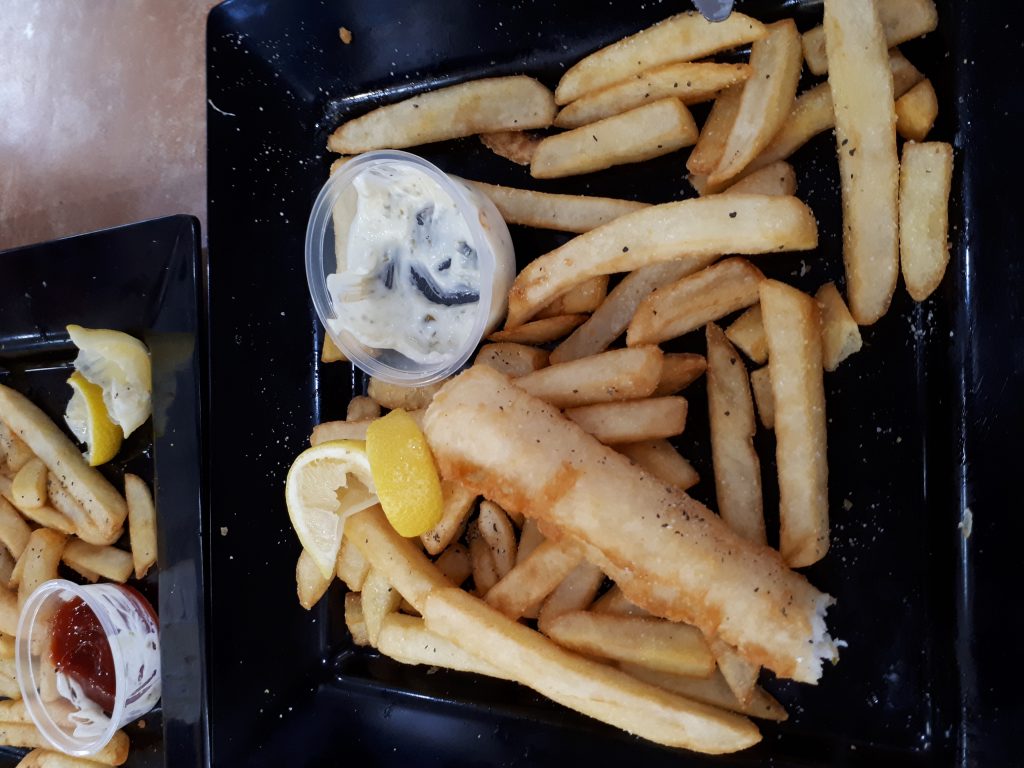
Out and about in Launceston, Tasmania, where I grew up, one day this week we stopped at a food hall kind of place called Morty’s where we knew we could get fish and chips – pictured above. The lightly battered fish you see there was Tasmanian flathead, one of those flavours that triggers ancient memories.
A sandy bottom dweller, flathead was the most common fish caught in boats that set out from our holiday place, Greens Beach, on the central north coast, next bay westwards from the mouth of the Tamar River at Kelso. Freshly caught flattie, floured and cooked on a frypan in a little butter, served with toast, lemon, S&P to taste plus tea, is a divine breakfast. I often fished with Dad from crack of dawn for a couple of hours and then we’d bring home and prepare the fish for breakfast. On a great day there’d be enough for lunch with salad or something.
But fish’n’chips was something entirely different.
It took 3-4 hours to get from Launceston to Greens Beach in the 50s. The 40 miles included 12 of unsealed road from Beaconsfield, (Beaky) the last 3 of which were sand track. The packing up and loading the car took several hours before that, so by the time we got to Beaky everyone was getting tired and we needed a major stop. The Ophir fish shop was next to a hotel of the same name. Neither are there any more. Fish and chips for everyone were ordered and while we waited everyone went to the loo in the pub. The orders were a piece of ‘flake’ and a serve of chips individually wrapped for each person. A generous amount of salt was routinely sprinkled as the food was wrapped in grease proof paper then clean newspaper. In the late 60s it became mandatory to use plain non-printed paper – on public health grounds I suppose, but the flavour was never quite the same….
‘Flake’ is delicious and is really shark, though in my memory never went by that name and according to a friend and a rellie or two, that still holds.
Anyway once back on the road to Greens Beach, we were tantalised by the smell of those parcels we weren’t allowed to open. The car had to be completely unpacked before we were allowed to hoe into them…. a powerful motivation to get us to unload the car lickety split – Mum and Dad weren’t stupid!
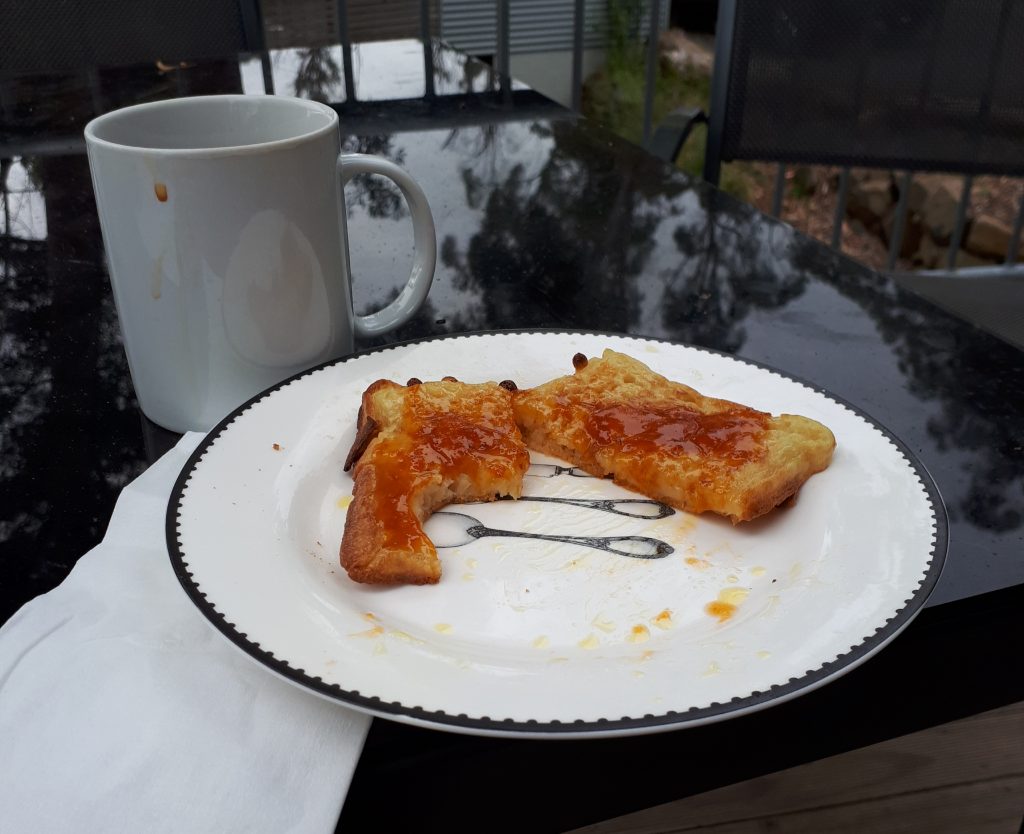
And in those days crumpets were round and seasonal… but brekky this am was lovely, anyway, thanks to good butter and property manager Helen’s home made apricot jam.
Flour Storm
Everyone goes through a bread making phase sometime in their life. For various reasons I got through mine in the 70s and haven’t yet succumbed to Round 2, which I’m sure would involve one of the marvellous bread makers on the market these days. NO, family and friends this is NOT a Christmas or other occasion gift hint !!
Staying in Busselton WA last weekend with almost-life-long friend Kitty, as I mopped up an unfortunate spillage in her kitchen we had a good laugh remembering my flour incident, 1970. In Kalgoorlie, Western Australia, in those nickel boom days no one ever phoned ahead, we just dropped in, and the kettle was always on as long as you weren’t going out or something. We drank a lot of tea. Well, during the day, anyway. One day Kitty and Caroline walked in through the back door to find me and much of the kitchen covered in flour. The then new Kenwood Chef mixer came with a glass bowl which I’d just smashed catching the base on the edge of the bench moving it from one part of the work area to the mixer stand. It’s likely I was still swearing but she’s never mentioned it. Like blood, a little flour goes a long way, and 1/2lb goes a very long way indeed.
A few days before staying with Kitty, Mike and I packed up our stuff from the house we recently sold in Perth. Tempting as it was to keep that replacement stainless steel bowl I bought, as the Kenwood itself had died anyway, I donated it to Vinnies and it will appear on one of their Perth stores soon, possibly in time for Christmas. Phone around if you’re wanting one!
In my time I made lovely breads including some herby and nutty loaves in interesting shapes, including braided fancy shaped little dinner rolls, all of which went down well. Ivan was a baby at that time so he has no recollection of my bread phase. When we left Kalgoorlie and entered our Northern Territory “Tent Period” there was a camp cook, so the habit died a natural death and somehow never revived.
The Corner Store
The social picture of women in paid employment began to change in the early 60s, but it was still the case as I was growing up that most of my contemporaries’ mothers never worked outside the home after they married. It’s a picture fairly different from our own children’s experience, and as parents today they have no expectation of being home with their children beyond statutory maternity leaves. Lots of pros and cons I won’t go into here – it’s just the way it was. There was much multigenerational living due to social custom and housing shortages which followed WWII well into the late 50s.
Most food we ate was cooked at home, or a family friends’ home. Each week after sunday school and church we had roast dinner at Gran’s house a, always with a weekly inquisition on the childrens’ sermon that morning plus weekly test results, term reports and other school activities. Looking back we were very fortunate to have this regular and influential contact with the grandmother we knew and loved. When our parents arrived around 4pm for afternoon tea we had already helped Gran cook pikelets, fresh scones or cheese biscuits, sliced some fruit cake and set the afternoon tea things out. Conversations then switched to local and national economic and political issues of the day. Radio and TV were always silent. Gran had a radio, but it only went on for the ABC News, symphony concerts, “Sunday Hymns and Choruses”, and “Guest of Honour”, a weekly interview with a foreigner of note.
As written elsewhere, many basic foods were delivered to the house. If anything like tea or sugar ran out too soon before the next delivery, there was a corner store a few minutes’ walk away. As well as basic staples like tea, sugar, butter, milk, butter and cream, eggs, and more, they stocked some tinned fruits and veggies, loose biscuits in huge tins, toilet paper, soap, laundry detergent and starch, newspapers, comics, magazines, and basic writing materials, and more. Purchases were wrapped in waxed or greaseproof paper, and further wrapped in brown paper and tied with string, in lightning fast movements that concluded with the shopkeeper winding the string around one finger and giving it a quick tug to break it. Dry goods like sugar or loose biscuits went into a sturdy brown paper bag with the top folded over, then the shopkeeper took hold of both top corners and swung it over and over in a very quick motion that closed the bag shut. I couldn’t find a YouTube – so get someone old to show you how!) We took Mum’s basket or a string bag to put stuff in – these are making a comeback as the movement against single use plastics gathers momentum. Sending the kids to the shop for something with the promise of an icy pole was a good way to get us out of Mum’s hair for the half hour or so it nearly always took us to straggle down there and dawdle our way back, as there was always something interesting to look at in the street on the way. This overall pattern of home fresh food deliveries and little corner shops all changed with the advent of supermarket shopping. I’ll write more on that later.
I’ll also need to write about picnics; Mrs. Palmers’ Tripe; the Ophir Fish Shop at Beaky; lunch at school; and another article on BBQs including how a few of us came close to starting a major bushfire at the beach. Have patience, Dear Reader 🙂
The Lost Art Of Hand Sliced Bread
When I was a kid, even up to the early 1960, many basic foods would routinely be ordered by phone and delivered to our house. Milk and bread came daily, and meat twice weekly. A grocer and a greengrocer could deliver if needed. Around the back side of our house there used to be a tradesman’s cupboard. Some neighbours had one near their side gate which was actually labelled “Tradesman’s Entrance” to distinguish it from an identical gate 5m down the street that led directly to the front door of the house. Food deliveries were placed into this cupboard which had a door opening into it from the kitchen side. Money would either be left there daily for the milkman or baker’s boy, or goods charged up to a monthly account to be paid at the actual store. This whole system went out of style, though, as supermarkets began to dominate food retailing.
We had deliveries of fresh bread in full loaves, either square ‘sandwich’ or ‘hightop’ (rounded upper crust) A full loaf was approximately 35cm long, which you broke in half in the middle to make two ‘half’ loaves. It came loosely wrapped in white tissue paper, which was carefully saved and re-used in various ways. The surfaces of pulled-apart bread were prized and called “the kissing crust” as distinct from “The Crust” at each end of the loaf. All crust was eagerly prized for toast.
Bread was not sold sliced, so of course we all learned to slice it by hand. It was considered wasteful to make it too thick, known as cutting ‘a doorstep’. If you were making up batches of sandwiches for a supper, fancy party or gathering of some kind, you’d buy loaves from one of the big fancy bakeries downtown and have them put it through a bread slicing machine. After the filling was put into the sandwiches, they were made fancy by cutting the crusts off before being cut into sections – and corner to corner diagonal was considered fancier than squares and rectangles.
But really skilled hands didn’t need to take their bread downtown to be sliced. With a good bread knife some women, and possibly men too, could slice fresh bread very thinly, and the thinner the slice the greater the refinement it suggested. To cut and serve finely sliced and buttered bread, you held the loaf in the crook of one arm, and with the other hand you carefully scraped a thin layer of softened butter evenly all over the cut surface, right out to the edges. A slice was then cut, sometimes so amazingly thin you could almost see through it. Spreading and slicing were repeated as required. Both our grandmothers did this well, but I don’t remember Mum, daughter of “Grandma in Sydney” having that ultra fine skill.
Every kids birthday party had a platter or two of “Fairy Bread” – finely sliced, buttered fresh bread, topped with the little multicoloured sprinkles we Aussies call “hundreds and thousands” .
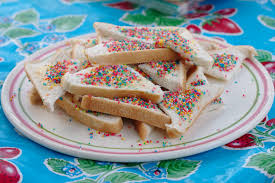
You can tell the slices of fairy bread in this pic are for an every-day children’s afternoon tea snack, as the crusts are still on, so it’s not special enough for a party, in my opinion, anyway!
To fairy bread lovers all around the world – HAPPY FAIRY BREAD DAY !!! YAY !!!
An Apple A Day
Apple seeds and saplings the early English colonists brought with them thrived in the soils and climate of Tasmania. When I was very young, Tasmania was known as The Apple Isle a term you still hear today. Apples and pears were exported to northern hemisphere markets via the Suez and Panama Canals to arrive before northern hemisphere crops were ready for market. Our export trade was dependent on those major canals remaining open.
Change was already on the way when we were hit with the Suez Crisis of 1956. Responding to serious and complicated conditions in the Eastern Mediterranean, North Africa and Asia Minor, the Egyptian government, led by Colonel Nasser, overnight and without warning, closed the canal to shipping. Australian ships were among those caught up in the crisis. Over the months it remained closed, cargos rotted, markets were lost and exports began to fall. From the early twentieth century on, nations achieving independence from colonial status changed world trade patterns. Britain began moving towards joining the European Common Market, which it joined in 1970. By the early 70s the Australian fruit growing industry was forced to rationalise, one result of which was the uprooting of many orchards as farmers were paid to diversify; and hundreds left the industry.
Being so young, I only had limited understanding of all this and the ongoing economic impacts on Australia. But I do remember some of the varieties we loved gradually disappeared. One was Cox’s Orange Pippin, another was Lady In The Snow, and if you search heritage apple varieties you’ll find plenty of home gardeners are growing these and other heritage varieties again.
Writing in the 3/5/2016 issue of The Weekly Times, Peter Cundall well known Australian gardening expert said: “… some of the most famous apple varieties were discovered as chance seedlings. The best known is the Australian Granny Smith, now grown worldwide. This remarkable apple emerged from a dump of discarded crabapple cores near Sydney … In addition, Granny Smith — which is partially self-fertile — can be harvested over a long period, even deep into winter. Under ideal conditions, these amazing apples store in excellent condition for up to a year.” I had no idea!

Granny Smith apples are a personal favourite for being so multi uso. A fresh one is juicy and crunchy, a little tart possibly, but after a couple of mouthfuls you adjust to that. Stewed with a little sugar and lemon it becomes a great dessert (crumble) or pie filling. A bowl of really cold stewed apples is divine. Apple sauce is essential with roast pork. Slices of apple and cheese eaten together make a lovely snack. Core and slice a Granny, sautee in butter with finely sliced onion and add to finely sliced cabbage in a lidded saucepan or skillet. Add just a little water, cover and gently steam together for a few minutes. Add S&P to taste and serve as a vegetable dish with any kind of meat and rice or mashed potato. Apple added to curry becomes puree, enriches flavour and thickens it a little. Add finely diced pieces to a tossed salad with whatever else you like with a dash of mayonnaise thinned with a little vinegar from your favourite pickled things, such as capers.
I wonder do people still take a drive in the country every few weeks to buy a case of Grannys and a case of Golden Delicious or Pink Ladies to keep out on the back porch for everyone in the family to snack on? We always had a case out there; we could help ourselves as long as it wasn’t too close to dinner time, and the one rule was that it had to be completely eaten, right down to a well gnawed core.
Word of the day – pomologist.
Poor Man’s Chicken
Dad’s various community involvements such as Rotary, and a committee that organised post concert hospitality for the visiting state symphony orchestra several times a year, meant they often entertained people including some relative strangers in our lovely house which was perfect for both sit down dinners and buffet meals. We kids had to be on our best behaviour, and often helped as we got older.
One of Mum’s popular items for such entertaining was chicken fricassee, initially served with whipped potatoes and peas, but in later years, rice. There are lots of recipes online, and though Julia Child’s sounds yummy, here’s a recipe illustrated with a pic that looks most like Mum’s Chicken Fricassee recipe.
In my childhood, chicken was rather expensive, plus it was a serious meat and nothing like the fast food snack role it has today. It might be my imagination, but I think overall the birds were bigger and had more flavour back then. Many people kept chickens, or as we call them, ‘chooks’ in the back yard for eggs and meat, even if a chook was an old boiler destined for the stew or soup pot by the time its egg laying value had gone. Roast chicken probably appeared on our menu half a dozen times a year including birthdays and Christmas. It was never eaten all in one meal, as a roast would be followed by a chicken pie or chicken an aspic collation. Finally the carcass was always put into a pot to boil up for stock.
So chicken would impress, and a fricassee was a good way of making it go as far as possible. To cater for 16-18 people, Mum would buy a couple of chickens, boil them and remove the meat from the bones to put in with creamy white sauce with sauteed onions, mushrooms, plenty of herbs and a little bacon. If the number was 25-30 people, she’d do likewise with a pair of rabbits to add extra quantity with little extra expense. Once rabbit was cooked, removed from it’s distinctive bones and chopped pieces, it was mixed in with the chicken mixture and left to stand a while. Reheated together, no one was any the wiser that rabbit had been added. This mattered because of social taboos that had grown around rabbit during its history in early twentieth century Australia.
European rabbits were introduced to Australia by early colonists for meat and skins. Originally kept in captivity, they eventually escaped to go wild, and their population rapidly exploded to the point of them becoming a serious pest, ravaging cultivated farm crops and competing with domesticated animals for pastures.
By the time of the Great Depression of the 1930s they were in plague proportions all over the continent. In those hard times, plenty of people on farms and in rural towns were able to trap and sell or eat them, and as a source of meat, and rabbit helped keep many struggling families stay just on the right side of starvation. Rabbit became known as ‘poor man’s chicken’.
Biological control of the pest began the 1950’s with the introduction of the myxoma virus. This virus made the rabbits sicken and die a horrible death, and as healthy unaffected rabbits became harder to find, people stopped eating them. A social taboo thus grew around ‘rabbit’, and as we often helped serve and wash plates for extra pocket money when supper was served, we were always reminded to never mention the word ‘rabbit’ on those occasions.
Today, something of this taboo lingers, as although ‘poor man’s chicken’ is now farmed in places, there are still people in Australia who won’t eat rabbit.
Why Not Mention Rice?
These days Aussies eat mountains of rice, and grow plenty of it, too. So for a little background to this post, I went to the Ricegrowers Association of Australia’s website which confirmed what I knew, that rice is grown in large parts of New South Wales and northern Queensland, and the different climates of those regions favour production of different varieties. My personal favourite rices are bismati and jasmin … different rices are best for different things. I don’t make it, but I do enjoy sushi, for which sticky roundish grain rice is required – it probably has a name, but I digress. I read one company, SunRice, has been supplying rice to the Australian market for over 50 years, and that gels with the memories I’m sharing here today.
Today’s Aussie kids grow up eating a much larger variety of foods than we did. In the decades since the Vietnam War, especially, many of us have travelled in nearby Asian countries ranging from The Middle East right across to Japan. As a nation we love Asian food, and various Asian national dishes including the ubiquitous staple, rice, are on the menu in most Aussie homes and many restaurants around the nation. People from African and South American countries also eat a lot of rice in their cuisines. All that cultural diversity we’ve embraced in the waves of immigration in my lifetime since WWII has introduced us to many other foodstuffs like quinoa, tabouli and hummus, now so everyday common, but we’d never heard of them 50 years ago.
Tasmania produces mountains of potatoes, and like most people then, we ate potatoes every main meal and often two meals per day. Some time in the 1950s, for several winters in a row, there was serious outbreak of blight in much of Tasmania’s potato crop, making them scarce and very expensive. When this shortage hit, Mum substituted noodles and rice for potatoes, serving them only when we had visitors; and we understood this was to be strictly without any comments from the peanut gallery.
It probably wasn’t only Mum’s basic social insecurity, as a lot of the British stiff upper lip and sturdy Scots endurance ran in our blood, too. There was always an underlying concern that people outside the family shouldn’t know when things were financially tough, as they really were from time to time. One contributing reason for that was that Dad may have over-reached a bit to buy the Bifrons Court house in 1954 while at the same time starting to build up his optometric practice with extra staff and plant. There was tension whenever shoes needed mending or replacing. We each had a pair of sturdy lace-up leather school shoes and a ‘best’ patent leather pair for sunday school and parties. Shoes were only passed down in the family and usually worn out completely. As we girls grew out of them, clothes were handed down first within the family and then around Mum’s friends with daughters. I’ve always wondered where the beautiful Viyella dresses Mum smocked for us each year ended up… God forbid that people might hear that the Padmans of Bifrons Court were being forced to economise, and were actually eating far more rice and noodles than potatoes – but really, who could give a fig?
However, probably because everyone else had also switched to rice on account of those severe shortages, within a few years it became socially acceptable, indeed fashionable, to serve rice at even the swishest events 😉
Mum’s Curry
I just loved chef Rick Stein’s absorbing BBC series a few years back: https://www.bbc.co.uk/mediacentre/mediapacks/food/rick-stein.html The story line was a quest for the best Indian curry, forming a fascinating travelogue laden with personal childhood memories, cultural notes and experiences, videos of people including Rick preparing curries, and of course a few recipes. One of the lasting benefits of Empire was the advent of curry in British cuisine, and it is claimed by some that the best Indian curries anywhere are found in London.
I’d like to bring you ‘curry’ from my own childhood, spent in that far corner of the British Empire, Launceston, Tasmania. Our family tradition was that the Birthday Girl chose the menu for dinner that night, and like it or not, we all had to eat it. Sister Rosemary always chose Tripe in white parsley and onion sauce, with mashed potato and peas or beans. Sal’s choice was always Pork Fillets, in which the fillets were egg and breadcrumbed, fried and served with a wedge of lemon, mashed potato, a green veg and carrots. My own favourite was Mum’s curry. Until I left home I had no idea people curried all kinds of foods including nuts and vegetables, even made curries without any kind of flesh, legged, shelled or finned. I was equally ignorant about ‘spaghetti’, too, which I will share in another post.
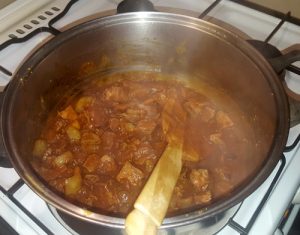
Mum’s Timeless Curry cooking, Nov. 10 2018.
Somewhere in my cookbooks in storage is Mum’s handwritten curry recipe. It was always lamb, and the recipe never varied.
You need a finely diced large onion; a good dollop to taste of curry powder ie. 1/2 cup or heaped Tbsp (if making for the first time choose medium strength). Saute onions and curry powder in some drippings from the weekend roast. To these you add 2-3 cups of diced lamb, a stock cube dissolved in 1-2 cups of water, and a dsp of tomato concentrate. When that’s bubbling turn it down to simmer gently and add in a cup+ of sultanas and wedge of squeezed lemon to be removed before serving with steamed rice. Accompaniments: small bowls of salted peanuts, home-made tomato chutney, banana slices tossed in lemon juice, desiccated coconut, and if seasonal, diced or sliced cucumber. (The word ‘yoghurt’ was never mentioned in decent Australian homes in the 1950s) The recipe included “S&P to taste” and an optional pinch of garlic that I never actually saw Mum add. In that recipe she wrote “I find many people use far too much garlic.” When we cleaned out her kitchen after her death we found her powdered garlic container was full of fine cobwebs –she hadn’t used that option for a while!