
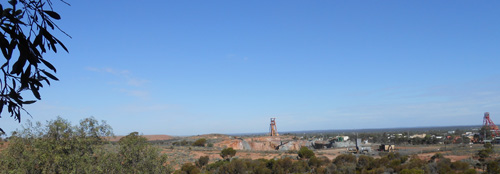
In an earlier post I wrote of our post-wedding journey from Launceston to our arrival in Kalgoorlie-Boulder about a week later. Mike, the exploration geologist husband, was working for The Great Boulder, one of the few big, old mining companies remaining on the fabled Golden Mile on the Eastern edge of the twin towns of Kalgoorlie Boulder. Such companies were struggling because of gold’s low price. However, worldwide demand for nickel was strong, and prices of that metal were soaring as demand continued. The rocks of a major part of the Eastern Goldfields were known to be prospective for the metal, and the pace in the town was definitely picking up as people moved into the area to explore for it. A good discovery was made north of Kalgoorlie in 1969, firing up the exploration boom for the new glamour metal, nickel. Mike’s job was part of that boom, and thousands of people, many of them young like ourselves, arrived in the Goldfields to be part of that booming opportunity.
Though the cost of living was higher than in the cities, no one needed be out of work for more than the day it took to get another job. Wages and salaries for skilled mining people were high and companies provided subsidised housing for professional staff to attract and hold them to the isolated area. Boundless opportunities existed for people to learn on the job. Everyone had money to spend. Interesting social and demographic changes took place, which I’ll touch on in further posts about our times in Kalgoorlie-Boulder, for this was to be our first boom in the ‘Fields. The second, 1981-7, was based on gold and changes in world economic and political conditions, and I’ll come back to that boom another time.
Anyway, in 1969, for a change from home cooked meals, one choice was to buy some chinese food or visit one of the good fish and chip shops. These were the only fast food options then, though the term ‘fast food’ wasn’t yet on Aussie tongues. The other option was to dine out. We soon found that the few restaurants in town all served good basic food, but, with one or two exceptions, lacked the menu sophistication you could now experience on a good night out in the distant cities. Cafe and restaurant menus differed mostly in the quality of the printing job on their menu; and hotel dining rooms served much the same food as cafes and restaurants, but it cost more; and additionally, hotel cooks tended to go off at about 9.30, unless it was a gala of some kind.
Hotel dining room, restaurant and cafe menus alike featured soups, roasts and desserts of the day, mixed grills, and sometimes added popular prawn cocktails, fresh oysters, Beef Stroganoff, Chicken Kiev and Steak Diane. These came with jacket baked potatoes or chips, and mostly cooked veggies, which later gave way to salads as demand for these grew from the newcomers.
Across the country at that time it was generally believed that any European food, especially French, was fancier, more ‘exotic’ than normal everyday Australian cuisine, which was still very British in tone. That was what we grew up with, it was part of our heritage, but by that time Assies were increasingly keen on cooking some of the dishes they’d experienced in their travels, and inevitably also became more interested in wine. Dad joined a wine and food club in maybe 1958, and Mum became admired among her friends for her readiness to try ‘foreign’ cookery. Their dinner parties became more elegant, they acquired a larger antique dining table with extensions that could comfortably seat 14. They bought some ‘good’ cutlery, a set of glassware that included water, port, sherry and several sizes of wine glasses, and invested in a gold rimmed, cream embossed design Wedgewood dinner set. Coming from a home and social circle where wine was now standard as a social drink, I found it interesting that in Kalgoorlie Hannans beer was still the principal social drink – before and during meals. Interestingly though, there were still one or two Wine Saloons in the main streets that nice people tended not to go into. It never occurred to me to go into one, and Mike confirms I’m not wrong about feeling they had a seedy air about them. Nice people though, including nice women, could easily be found drinking a beer in a hotel, and that was not necessarily taking a shandy in the Ladies’ Lounge Bar. Looking back, some of the many local pubs/watering holes aka hotels were no less seedy, really. However, many of them also had beer gardens and ran darts tournaments, ie. they were acceptable ‘social centres’ in pre-television days – on which I will write, too. It was all new to me!
As a new bride, having learned much from Gran and Mum, from the mandatory domestic science at school and flatted my final 2 years at uni, I knew how to cook fairly well. In that flat, I learned fast how to stretch the housekeeping budget to last us to payday, and put another name or two in the pot for unexpected mealtime guests without breaking that budget. I think that helped shaped the way I cook most things (except cakes) by process and approximations rather than a precise recipe. As a wedding gift someone gave us a boxed set of Robert Carrier Cookbooks, and during those early years it became my go-to recipe book for “recipes to impress with”. It’s pretty battered, if you’ll pardon the pun – many pages are loose and/or food stained 😉 but it’s still in my meagre cook book collection, in storage.
When I arrived in Kal, the shops and supermarkets lacked many items Aussies in the cities were now accustomed to seeing on shelves of major supermarkets. We’d become used to using a bigger range of herbs and spices, plus other basic ingredients of Greek, Italian, French and some Asian food that had moved into mainstream Australia’s cuisine. Italian and other foreign migrants who had come to the Goldfields in years gone by had tended to stock up in the big smoke to supply themselves until the next trip down to Perth – which is what we did, too. But soon enterprising people like Tom and Fred stuck their necks out and began bringing all such goodies to their expanded Boulder food store, which cut the Perth shopping list down hugely. It became easier to make some of those more glamorous recipes, and in our circle of exploration people we held a lot of dinner parties. If people were coming saturday, some of the preparation had to be started friday, as we each took extra trouble to put something exciting on the table before our friends – those Robert Carrier recipes mostly have far longer lists of ingredients than anything I’d be interested in cooking today! Maybe it’s normal before lives become more complicated with babies – but as the boom got going, collectively we exploration wives were pretty go-ahead, and it was a quiet weekend indeed if you weren’t putting on a dinner or attending one at someone’s place.
I’ll be doing a whole post on dinner parties some time soon, covering how things changed as ‘we’ went into a baby boom around 1970. And of course, being very casual, we tended to stick to whatever our BBQ favourites were, as they’d never prompted the same almost competitive menus as those dinner parties.