
Apple seeds and saplings the early English colonists brought with them thrived in the soils and climate of Tasmania. When I was very young, Tasmania was known as The Apple Isle a term you still hear today. Apples and pears were exported to northern hemisphere markets via the Suez and Panama Canals to arrive before northern hemisphere crops were ready for market. Our export trade was dependent on those major canals remaining open.
Change was already on the way when we were hit with the Suez Crisis of 1956. Responding to serious and complicated conditions in the Eastern Mediterranean, North Africa and Asia Minor, the Egyptian government, led by Colonel Nasser, overnight and without warning, closed the canal to shipping. Australian ships were among those caught up in the crisis. Over the months it remained closed, cargos rotted, markets were lost and exports began to fall. From the early twentieth century on, nations achieving independence from colonial status changed world trade patterns. Britain began moving towards joining the European Common Market, which it joined in 1970. By the early 70s the Australian fruit growing industry was forced to rationalise, one result of which was the uprooting of many orchards as farmers were paid to diversify; and hundreds left the industry.
Being so young, I only had limited understanding of all this and the ongoing economic impacts on Australia. But I do remember some of the varieties we loved gradually disappeared. One was Cox’s Orange Pippin, another was Lady In The Snow, and if you search heritage apple varieties you’ll find plenty of home gardeners are growing these and other heritage varieties again.
Writing in the 3/5/2016 issue of The Weekly Times, Peter Cundall well known Australian gardening expert said: “… some of the most famous apple varieties were discovered as chance seedlings. The best known is the Australian Granny Smith, now grown worldwide. This remarkable apple emerged from a dump of discarded crabapple cores near Sydney … In addition, Granny Smith — which is partially self-fertile — can be harvested over a long period, even deep into winter. Under ideal conditions, these amazing apples store in excellent condition for up to a year.” I had no idea!
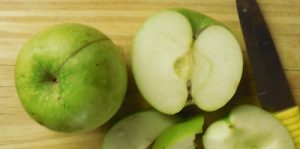
Granny Smith apples are a personal favourite for being so multi uso. A fresh one is juicy and crunchy, a little tart possibly, but after a couple of mouthfuls you adjust to that. Stewed with a little sugar and lemon it becomes a great dessert (crumble) or pie filling. A bowl of really cold stewed apples is divine. Apple sauce is essential with roast pork. Slices of apple and cheese eaten together make a lovely snack. Core and slice a Granny, sautee in butter with finely sliced onion and add to finely sliced cabbage in a lidded saucepan or skillet. Add just a little water, cover and gently steam together for a few minutes. Add S&P to taste and serve as a vegetable dish with any kind of meat and rice or mashed potato. Apple added to curry becomes puree, enriches flavour and thickens it a little. Add finely diced pieces to a tossed salad with whatever else you like with a dash of mayonnaise thinned with a little vinegar from your favourite pickled things, such as capers.
I wonder do people still take a drive in the country every few weeks to buy a case of Grannys and a case of Golden Delicious or Pink Ladies to keep out on the back porch for everyone in the family to snack on? We always had a case out there; we could help ourselves as long as it wasn’t too close to dinner time, and the one rule was that it had to be completely eaten, right down to a well gnawed core.
Word of the day – pomologist.