
That’s Spanish for bread pudding, and as I’m learning Portuguese right now, I can tell you that pudim de pão the name of this dessert in that language.
This morning I found a little latin American phrasebook in my sewing room that I’ve had for ages. It comes to the top every now and then, and though I kid myself I know it inside out and back to front, I keep it to help any visiting non-spanish speaker, but it’s a long time since I dug it out for someone. These days, everyone’s smart phone has a translator app, and with the help of Duolingo, Memrise or Babbel et al, it’s easy enough to get a bunch of basic phrases under your belt before coming. But when I first started coming to Uruguay in pre-internet days, and long before smart phones, a little book like this and a bit of homework based on it was essential survival kit back then. Of course, if I’d been able to see ahead and know how important Spanish was to become in my life, I’d have started learning it years before I did.
Looking at the return addresses I wrote in the front (who was I kidding?) and this recipe I wrote down in the back, it dates from about 1997-9, the early days of Chris and Mike’s gold exploration venture here. Friends Rudi and Gloria generously had Mike and me to stay from time to time (Mike and I took turns to trans-Pacific commute every few months until money became really tight and it was clear I had to stay, at which time we set about organising our own accomodation, well sort of – but that’s another story) and it was during one of these stays in their home that Gloria’s Paraguayan housemaid, Gladys, gave me this recipe. I’m not a big recipe collector, so it must have really impressed me; and though I’ve made it a few times, that’s not for many years because the recipe has always been out of sight, therefore out of mind.
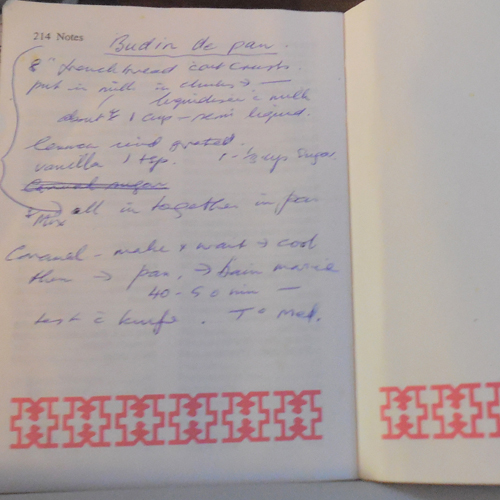
Seeking to clarify the above jottings in my handwriting, I googled budin de pan recipe and up came variations from Miami, Mexico, Cuba, The Caribbean, Puerto Rico, Argentina, Peru and more. It’s clearly a continent-wide dessert, and there are lots of things you can add to make it your own, limited only by your imagination 🙂 sultanas, nuts, spices, and maybe you could even try it with a layer of sliced peeled apples somewhere between the pan part and the caramel … 🙂
On the first line after the title I’ve clearly written my odd abbreviation of ‘without’ crusts – not sure why, because, if you think about it, there’d be almost nothing left of an 8″ piece of french stick if you remove the crusts !! Continuing down, the scratchings that pass for my hand written notes might be largely unintelligible for you, but this delightful short video with a soundtrack of Paraguayan harp music shows it perfectly. A decade or so later, when my close friend Kitty and I went to Paraguay, we were entranced by that music. As I often do when travelling, I bought a couple of cd’s, but for several days Kitty very seriously considered the idea of buying a harp to be sent back to Australia – they’re a musical family. Eventually she decided that as she was about to move into a newly constructed retirement house and needing all new appliances, it would be more practical to go for a new washing machine instead. Looking back, I don’t doubt she made the smarter decision.
On the website for Paraguayan budin de pan, is a list of ingredients which is pretty much what I wrote while watching Gladys make it. Gladys spoke no English, and I was a very raw Spanish beginner, with perhaps 100 assorted words and a few phrases! However, I have made it from what I wrote down, so we managed to communicate ok. The website recipe begins: “When you have hard bread, do not throw it away, take advantage and make this delicious and easy recipe. Easy-to-get ingredients, and a dessert that everyone likes.”
Budin de Pan
- Ingredients for large pot (10-12 servings)
- 1 litre milk
- 350-400gm old bread
- 4 eggs
- 250gm castor sugar
- lemon zest (grated lemon) or essence
- vanilla essence (optional )
- tablespoon butter (optional)
Cut or break the bread, add to the warmed milk and leave to soak for a couple of hours. (from my notes, it is clear you can speed this whole thing up by giving it a zoom in the liquidiser) When well soaked, add beaten eggs, sugar, vanilla and lemon. Here add cream which hasn’t been mentioned up to this point, but neither has ‘ointment’ whatever that means 🙂 Clearly at this stage the mixture is ‘slushy’ (runny porridge?) and if you’re going to add butter I’d melt it and add here – the instructions aren’t quite clear. Then both my notes and the website say to make caramel (website suggests 5 tbsp) and put into the bottom of the cake tin, and then when that’s cool add the bread/milk/egg etc mix on top of that. Bake in a bain marie ( ie stand it in a larger dish of water) at a medium temperature of about 190C for about 40-45 minutes up to an hour; test with a knife. Wait till cold before turning out. The caramel will then be on the top. Serve with whipped cream or possibly vanilla icecream.
So many of my/our early experiences in Uruguay come to mind whenever this little book re-appears! And I’m so glad I rediscovered this recipe this morning – my next mahjong hosting day will come round soon enough … I promise, Dalehl!