
This post was scheduled to appear several days ago, but didn’t, and I neglected to check… and so I must have a word with my tech consultant 🙂
Mike did not expect to see our favourite Australian fish, Barramundi (barra for short) in a local Montevideo supermarket yesterday!
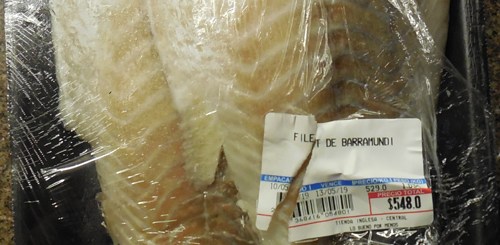
Having lived outside Australia for so long, I haven’t eaten barra for years, let alone thought about it, so Australian Barramundi is one of the last foods we’d expect to see here; and eating it again brought back heaps of 40+ year-old memories. Barramundi thrives across northern Australia, in rivers, coastal shores and estuaries, and lagoons aka billabongs. When we went north for what I now call our Tent Period, (glossary) we’d never heard of barramundi. We were blithely ignorant of most things about life in The Top End, which was so far away and isolated that most Australians had little knowledge of life up there. When we announced we were going north with a 4 year-old and a babe in arms, some people were genuinely shocked we’d even consider it, as Darwin was still a difficult place to live after the battering of Cyclone Tracy the year before.
We first encountered barra in 1975 when we went out to spend the field season in what is now Kakadu National Park, some years before it was gazetted as a national park. My geologist husband Mike established a uranium exploration camp at a spot named Bora Springs (which you won’t find on any map) but it’s somewhere between the East and West Alligator Rivers, a bit north of Munmalari Station. (glossary) Once I got over the acute culture shock at suddenly finding myself in an isolated tent camp way out in Woop Woop, admittedly with a couple of ‘mod cons’, a term I hesitate to use lest you get the impression it was a Motel 6, (glossary) I really did enjoy this amazing period in our lives.
In Outback terms there were several large billabongs ‘nearby’ (half to one hour away) teeming with barra and fresh water crocodiles, which we now know to have been very young and small at that time. A government organised culling program ceased about 1973 since when these little ones have grown huge and several people and dogs are taken by them every year in the very billabongs where we used to wallow on sundays, fishing, drinking beer, splashing with the kids and cooking BBQ meals.
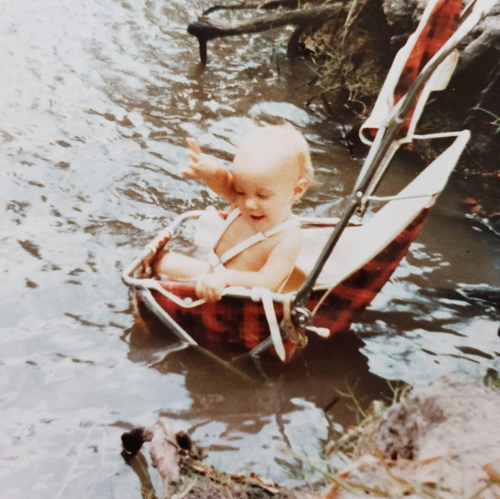
If you saw that Aus Outback movie Crocodile Dundee , those characters are no exaggeration; and if you haven’t seen it, I thoroughly recommend it. Very interesting ‘colourful’ people turn up in field camps, and everyone brings interesting stories with them. Into this camp came geologists, geotechnicians, field assistants, and mechanics, including Mick the truck driver who brought the weekly provisions, spare parts, last week’s newspapers and the long-awaited mail, and while in camp he serviced the generator. Well, Mick usually arrived weekly, but one time the creek was up, and a couple of other times he was too hungover to come our camp and get to the next one on schedule; so after sleeping it off at the previous camp, he unloaded our stuff there for someone to drive over and collect, and took a short cut over to the third camp – think triangle.
Initially in the very isolated camp, there was a cook on the team, Ken met with an unfortunate accident and had to be hospitalised to have his badly broken ankle set. After that the catering staffing was changed. Mike decided it would be better use of financial resources to have a couple more field hands than a full time cook, so from then on everyone was expected to rustle up whatever they wanted for breakfast (plenty of options available) make their own sandwiches for lunch and take fruit and bought biscuits if they wanted for lunch and smokos during the day. Everyone now had to take their turn to cook the evening meal and help wash up, and though not an employee, I took my turns, too, which only seemed fair. The new fieldies were two Aboriginal men, Ted and Ray. In their early 30’s, and clearly good mates, they were both great cooks. I don’t remember which one did this fish recipe I’m about to share, as they did everything together, and I only ever remember them as Ted’n’Ray. When either had their turn cooking, dinner was either barra, or red faced buffalo (glossary) which they brought into camp a couple of times. On those occasions, Mike was told to clear off for the afternoon and while he was gone, they brought the carcass in to the camp, butchered it and filled the freezer. When Mike returned at sundown, no questions were asked and no information given. That meat was always sooo good – as top export grade beef should be !!! However, to return to the barra, subject of this post.
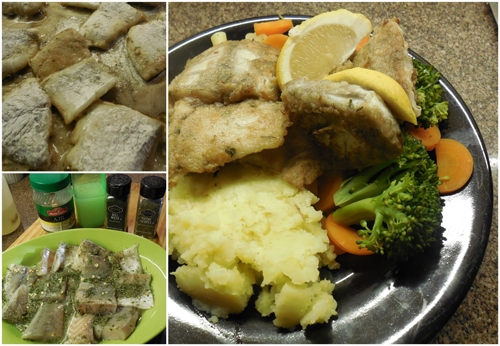
Ted’n’Ray’s Barra: Barramundi is a medium large fish, and the fillets from fish caught in the wild were about 2cm thick. These fillets were a bit thinner, but no matter, it all worked as I remembered. Here’s how to prepare what we had for dinner last night:
- About 2 hours before they were needed, fillets were cut into square pieces approx 3cm x 3cm
- and set in a dish with plenty of lemon juice+mixed herbs+a small amount of v.finely chopped onion+plenty of chopped parsley.
- They were turned over after about an hour and again just before
- draining
- then tossed in flour with a bit of S&P.
- I cooked them in a hot frypan with a little butter+oil
- Served the pieces immediately with mashed potato and other veggies.
It was very good. What we Aussies know as ‘mixed herbs’ isn’t commonly marketed in USA or Uruguay, so what I used was some dried dill, ajo y perejil (garlic+parsley) lemon juice, and I forgot the onion, so perhaps it didn’t need it anyway 🙂 The take away from this is, of course, experiment with your herbs and find your own preferred mix. The fish is delicious, so whatever you use should not overwhelm the natural flavour. Any cod- or perch-like fish with big segments that hold together well when cooked should be good with this method. Mike went back to buy more barra this morning – it was all gone! But when it comes in again next week, we’ll be there to purchase a pallet of it 🙂