
When I was a kid, even up to the early 1960, many basic foods would routinely be ordered by phone and delivered to our house. Milk and bread came daily, and meat twice weekly. A grocer and a greengrocer could deliver if needed. Around the back side of our house there used to be a tradesman’s cupboard. Some neighbours had one near their side gate which was actually labelled “Tradesman’s Entrance” to distinguish it from an identical gate 5m down the street that led directly to the front door of the house. Food deliveries were placed into this cupboard which had a door opening into it from the kitchen side. Money would either be left there daily for the milkman or baker’s boy, or goods charged up to a monthly account to be paid at the actual store. This whole system went out of style, though, as supermarkets began to dominate food retailing.
We had deliveries of fresh bread in full loaves, either square ‘sandwich’ or ‘hightop’ (rounded upper crust) A full loaf was approximately 35cm long, which you broke in half in the middle to make two ‘half’ loaves. It came loosely wrapped in white tissue paper, which was carefully saved and re-used in various ways. The surfaces of pulled-apart bread were prized and called “the kissing crust” as distinct from “The Crust” at each end of the loaf. All crust was eagerly prized for toast.
Bread was not sold sliced, so of course we all learned to slice it by hand. It was considered wasteful to make it too thick, known as cutting ‘a doorstep’. If you were making up batches of sandwiches for a supper, fancy party or gathering of some kind, you’d buy loaves from one of the big fancy bakeries downtown and have them put it through a bread slicing machine. After the filling was put into the sandwiches, they were made fancy by cutting the crusts off before being cut into sections – and corner to corner diagonal was considered fancier than squares and rectangles.
But really skilled hands didn’t need to take their bread downtown to be sliced. With a good bread knife some women, and possibly men too, could slice fresh bread very thinly, and the thinner the slice the greater the refinement it suggested. To cut and serve finely sliced and buttered bread, you held the loaf in the crook of one arm, and with the other hand you carefully scraped a thin layer of softened butter evenly all over the cut surface, right out to the edges. A slice was then cut, sometimes so amazingly thin you could almost see through it. Spreading and slicing were repeated as required. Both our grandmothers did this well, but I don’t remember Mum, daughter of “Grandma in Sydney” having that ultra fine skill.
Every kids birthday party had a platter or two of “Fairy Bread” – finely sliced, buttered fresh bread, topped with the little multicoloured sprinkles we Aussies call “hundreds and thousands” .
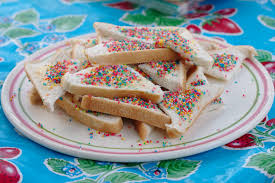
You can tell the slices of fairy bread in this pic are for an every-day children’s afternoon tea snack, as the crusts are still on, so it’s not special enough for a party, in my opinion, anyway!
To fairy bread lovers all around the world – HAPPY FAIRY BREAD DAY !!! YAY !!!